
Sickle cell trait in sport: separate rare collapse risk from exclusion
Sickle cell trait is not sickle cell disease and usually does not prevent sport. Because exertional collapse is rare and its mechanisms remain disputed, use universal conditioning safeguards and an immediate emergency response.
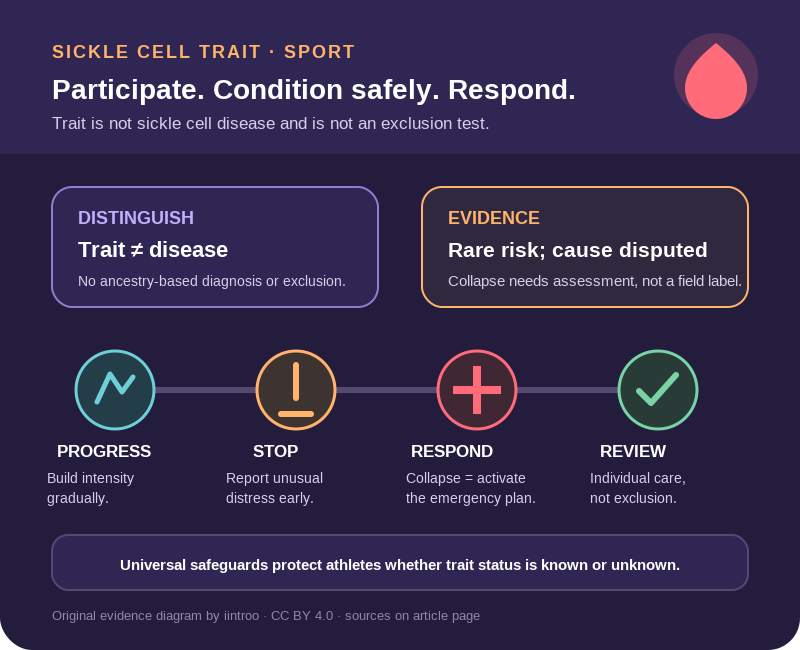
Key points
- Sickle cell trait is not sickle cell disease; most people with the trait live normal, active lives and should not be automatically excluded from sport.
- Research does not justify labelling every collapse in an athlete with the trait as a sickle cell crisis, and the proposed mechanism remains contested.
- Gradual conditioning, recovery, symptom-led stopping and a rehearsed emergency plan protect all athletes, regardless of trait status.
Start with what the trait is — and is not
This guide is for athletes, families, coaches, strength staff, event organisers and clinicians. Sickle cell trait means carrying one sickle-haemoglobin gene and one usual haemoglobin gene. It is not sickle cell disease. Most people with the trait have no symptoms in ordinary life, can participate in sport and should not be treated as fragile or assumed to be unfit because of ancestry or test status.
A trait result is private health information, not a diagnosis made from ethnicity. It should not be used to shame, segregate or automatically restrict an athlete. The American Society of Hematology opposes mandatory trait-based interventions that lack evidence and supports universal safety measures capable of protecting the whole team.
Be precise about the disputed evidence
Reports have linked sickle cell trait with rare exertional collapse, often during very intense conditioning. Yet attribution is difficult: collapse can involve heat illness, cardiac arrest, asthma, rhabdomyolysis or other causes, and published case definitions have varied. A 2025 systematic review found no support for an acute vaso-occlusive pain crisis caused by the trait and cautioned against describing such deaths as a 'sickle cell crisis.'
That review did not prove that every strenuous setting is risk-free. It means the mechanism and magnitude of risk should be stated honestly. A rare association, contested explanation and limited surveillance evidence do not support a guaranteed prediction for an individual athlete or a single universal restriction.
Make conditioning safe for everyone
Build intensity progressively, allow recovery and adapt sessions for heat, altitude, illness, recent inactivity and the athlete's current preparation. Avoid punishment drills that require distressed athletes to finish at all costs. Water, rest and a clear route to medical help should be available, but no drink volume, work-to-rest ratio or acclimatisation schedule suits every athlete.
Athletes must be able to stop when they develop unusual weakness, severe cramping, chest symptoms, breathing difficulty, dizziness or a sense that they cannot continue. Those symptoms are not specific to sickle cell trait and should not be self-diagnosed. The safety decision is to stop the exposure and assess the person, not argue about the cause on the field.
Treat collapse as an emergency, not a label
A collapse during or soon after exercise requires immediate activation of the emergency action plan. Check responsiveness and breathing, call local emergency services, begin CPR and use an AED when indicated by trained responders, and address heat illness or other urgent causes according to the clinical situation. Do not delay universal lifesaving steps while waiting for trait status or trying to decide on a named syndrome.
The HRS athlete-arrhythmia consensus provides a framework for evaluating collapse and suspected cardiac causes, but no web guide can determine the diagnosis. After any serious episode, return to training depends on clinical investigation, recovery and the demands of the athlete's sport; a fixed online timetable is inappropriate.
Use testing and disclosure without discrimination
Policies differ between schools, leagues and countries. Where testing or documentation is required, explain consent, privacy, the purpose of the result and who can see it. Athletes who know they have the trait can discuss individual questions with a qualified clinician, including prior symptoms, other conditions, medication, altitude or extreme-environment exposure.
The practical standard is the same whether status is known or unknown: sensible progression, permission to report distress, trained responders and a rehearsed emergency plan. This protects health without pretending that trait status alone can predict collapse or justify exclusion from sport.