
Skier’s thumb: why a painful grip after a fall needs assessment
Learn how skiing falls can injure the thumb’s stabilising ligament, when to seek urgent care, and why treatment and return to snow need individual assessment.
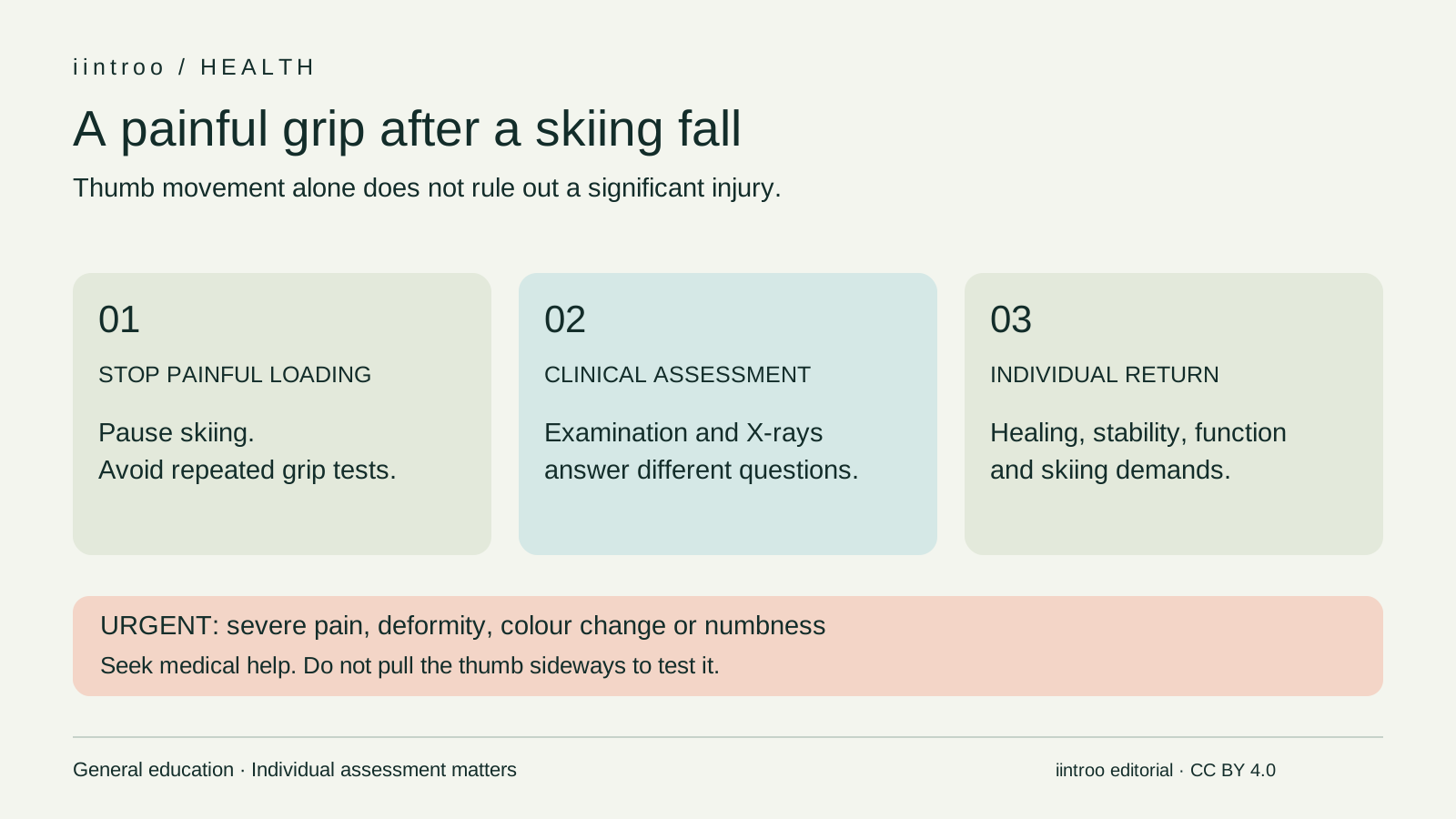
Key points
- Thumb movement alone cannot exclude a significant injury.
- Newer BSSH guidance supports shared decisions, not automatic surgery for every tear.
- Published return-to-play rates cannot provide an individual skiing deadline.
Which part of the thumb is injured?
A sore thumb after a skiing fall can be more than a bruise. This guide is for recreational and competitive skiers with pain, swelling or difficulty gripping after a fall—not for diagnosing an injury at home. Skier’s thumb usually means injury to the ulnar collateral ligament, or UCL, beside the thumb’s main knuckle, the metacarpophalangeal joint.
The ligament helps stabilise pinching and gripping. A fall that forces the thumb away from the hand, sometimes against a ski-pole handle, can stretch or tear it. Pain, bruising or difficulty holding objects cannot distinguish a partial tear, a complete tear or an associated fracture. Being able to move the thumb is not a reliable self-clearance test.
Stop skiing and recognise urgent warning signs
Do not keep testing the injury with forceful pole plants, heavy bags or repeated pinching. Remove rings or other jewellery if swelling develops and this can be done safely. Seek help from ski patrol or a local medical service when necessary.
Severe pain, a thumb that has changed shape or colour, loss of feeling, or inability to move the thumb or hold objects needs urgent assessment. A snap or grinding sensation during the injury also deserves urgent attention. Do not pull the thumb sideways to compare its looseness with the other hand. Stability testing belongs in a clinical examination, not a slope-side experiment.
Examination and imaging answer different questions
A clinician will ask how the fall happened, where the pain is and which tasks have become difficult. Examination assesses the injured structures; X-rays look for fractures, including a small fragment pulled away with the ligament. Describe any wrist pain separately so that the rest of the injured hand and wrist can also be assessed.
An X-ray does not directly show every ligament injury. Ultrasound or MRI may sometimes help clarify damage, but neither is automatically required for every painful thumb. A displaced torn ligament, often discussed as a Stener lesion, is another clinical consideration—not something to identify from an online picture.
Treatment is a decision, not a universal rule
The British Society for Surgery of the Hand’s BEST guidance recommends nonsurgical care when there is no significant joint laxity. With significant laxity, immobilisation or surgical repair may be considered through shared decision-making. This is more nuanced than saying that every complete tear inevitably needs surgery. Comparative treatment evidence remains weak.
The guidance concerns acute injuries in adults and should not simply be transferred to children. Ask what injury has been identified, what each option protects, what follow-up is needed and which activities must wait. A splint or tape should not become permission to ski before the injury has been assessed.
Sources: 4
Returning to snow needs more than a calendar date
A 2023 systematic review included 11 patient series involving 311 athletes and 12 expert-opinion articles. Return-to-play rates after surgery were high, but the heterogeneous, low-quality evidence cannot supply a dependable deadline for an individual skier or prove surgery superior to nonsurgical care.
Discuss healing, stability, function and skiing demands with the hand team. Handling equipment, gripping a pole and reacting to an unexpected fall are useful discussion prompts, not validated home clearance tests. Follow the agreed rehabilitation and protection plan. Persistent pain, weakness or giving way warrants reassessment. This educational guide cannot provide individual sporting clearance.