
Snowboarding wrist guards and helmets: lower risk without promising immunity
Wrist guards and a correctly fitted helmet can reduce important injury risks, but safe progression, terrain choices and assessment after a fall still matter.
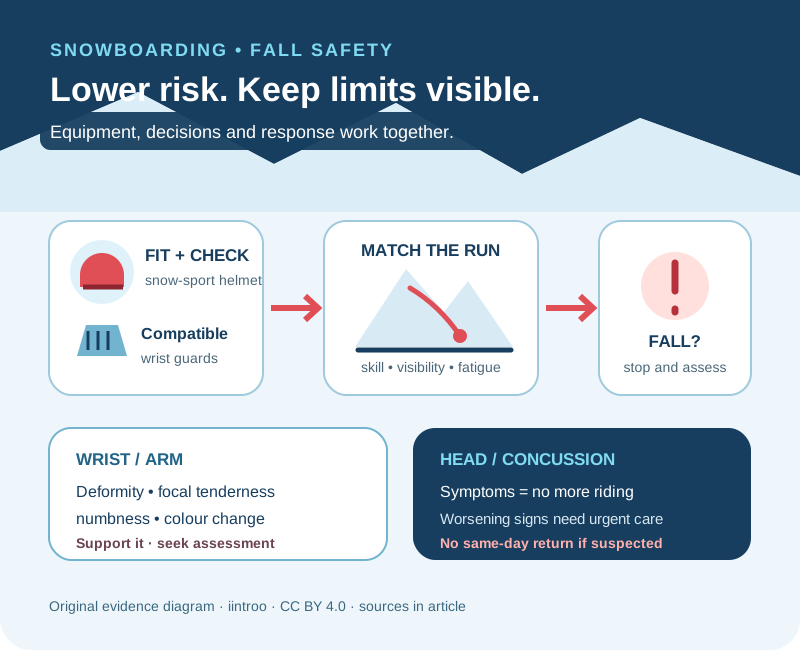
Key points
- Snowboarders sustain a distinctive upper-limb burden, with the wrist especially prominent in injury studies.
- Wrist guards reduce wrist injury risk in older trials, while helmets reduce head injury risk; neither item prevents every injury.
- Pain, deformity, persistent numbness or concussion symptoms after a fall require assessment rather than a test run back down the slope.
Use injury patterns to plan, not to predict one rider
This guide is for recreational and competitive snowboarders, families, coaches, schools and resort teams. Snowboarding combines speed, edge changes, variable snow, jumps and falls with both feet fixed to one board. Surveillance and reviews repeatedly identify upper-limb injuries—especially the wrist—alongside head, shoulder and lower-limb injuries. The pattern helps target prevention; it cannot calculate one person's risk on a particular run.
FIS publishes discipline-specific surveillance from elite competition, while the 2026 systematic review draws from skiing and snowboarding studies across different eras and settings. A United States emergency-department study of children and adolescents described wrists, heads and shoulders among commonly injured areas, but national estimates and retrospective coding are not a substitute for exposure-based local surveillance. Recreational beginners, terrain-park riders and World Cup athletes should not be treated as one population.
Match protective equipment to the rider and the rules
A snowboard helmet should be intended for snow sport, fit level and securely, and be worn according to the manufacturer and the current rules of the venue or competition. Replace it after a significant impact or when the manufacturer advises because hidden damage cannot be judged from appearance alone. A helmet lowers the chance or severity of some head injuries; it does not make high speed, a blind landing or a collision safe and cannot rule out concussion.
Older trials and observational studies in the wrist-guard systematic review found fewer wrist injuries among protected riders, but designs, products and behaviour varied, and the optimal guard design remains uncertain. Use a guard designed to work with the glove and wrist position without impairing circulation, grip or binding operation. Protective equipment should be checked for fit, damage and compatibility rather than borrowed at the last moment or assumed to transfer safely between sports.
Progress terrain, speed and falls together
Preparation can progress from stance, skating and controlled stopping to turns, variable snow and features that match demonstrated skill. Check weather, visibility, surface conditions, fatigue, bindings and boots before increasing speed or entering a terrain park. A lesson, clear spacing and a planned line can reduce avoidable uncertainty, but no coaching cue or warm-up eliminates injury risk.
Learning to avoid locking an outstretched hand into the snow may be discussed with a qualified instructor in a controlled environment; it should not become unsupervised fall practice on a crowded slope. Riders returning after time away should rebuild volume and difficulty instead of using previous ability as proof of current readiness. Alcohol, sedating medicines and severe fatigue can impair judgement and reaction time and do not belong in a safety plan.
Treat wrist and head symptoms as different problems
After a fall, stop if there is wrist or forearm deformity, focal bone tenderness, marked swelling, loss of grip, persistent numbness, colour change or severe pain. Support the injured limb, follow local first-aid arrangements and obtain appropriate assessment; do not repeatedly flex the wrist or take another run to see whether it loosens. Fracture, sprain and tendon injury cannot be separated reliably by an online checklist.
Any suspected concussion means removal from riding and assessment. Worsening headache, repeated vomiting, seizure, increasing confusion, weakness, neck symptoms, unequal pupils or difficulty waking requires urgent care through local emergency services. A helmet that looks undamaged, a normal conversation or no loss of consciousness does not clear the rider.
Return through snowboarding tasks, not a calendar
Return depends on the diagnosis, symptoms, function and the consequences of another fall. A staged plan may rebuild daily activity, wrist and shoulder capacity, balance, aerobic work, controlled stops, easy turns and then progressively harder terrain. The sequence must account for binding use, getting up from snow, poling or carrying equipment and the rider's discipline; one pain-free gym exercise is not a slope clearance test.
Concussion recovery follows qualified medical guidance and applicable sport rules, with no same-day return after suspected concussion. Persistent wrist pain, reduced motion, grip weakness, recurrent numbness or symptoms with vibration deserve review before full exposure. This article does not diagnose an injury, prescribe equipment or provide medical clearance.