
Sport after a solid-organ transplant: coordinate graft health, medicines and load
Exercise can support recovery after organ transplantation, but graft type, rejection status, immunosuppression, infection risk and sport consequence shape return.
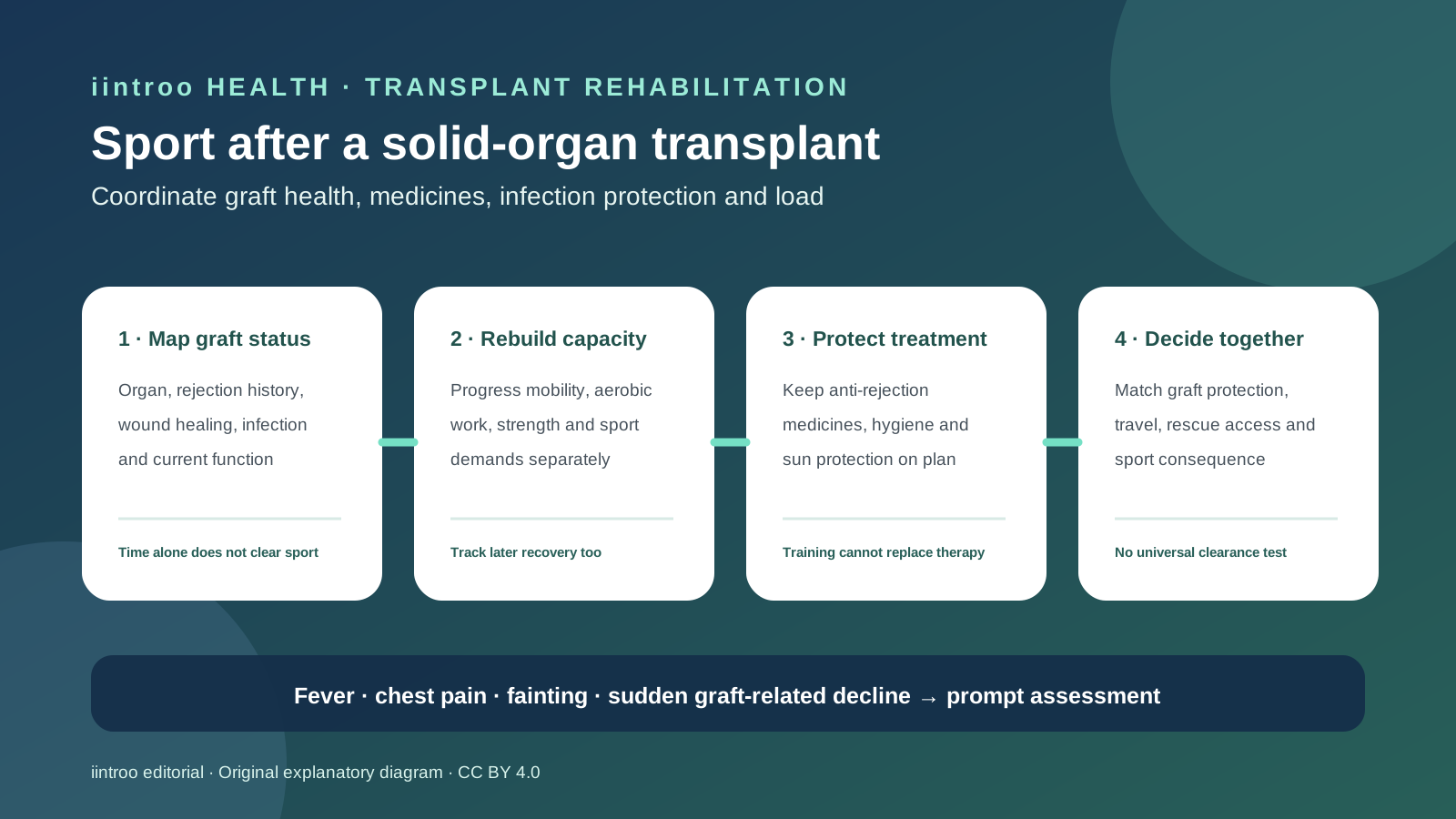
Key points
- Exercise training is recommended across the transplant pathway, but kidney, liver, heart and lung recipients do not share one timeline, risk profile or competitive clearance.
- Anti-rejection medicines must continue as prescribed. Heat, dehydration, infection, medicine interactions and organ-specific complications need the transplant team's plan.
- Fever, chest pain, fainting, new marked breathlessness, falling oxygen levels with symptoms or a sudden decline in graft-related health requires prompt clinical assessment.
Start with the transplanted organ and current clinical stability
This guide is for solid-organ transplant recipients, families, coaches and rehabilitation teams. Kidney, liver, heart, lung and multi-organ transplantation involve different surgery, physiology, medicines and monitoring. Time since transplant alone does not establish readiness. The transplant team should consider graft function, rejection history, wound healing, cardiovascular and respiratory status, infection, bone and muscle health, treatment effects, previous activity and the actual sport before higher loads or competition are introduced.
Map contact, falls, impact to the graft area, heat, dehydration, altitude, open water, remoteness, travel and access to medicines or urgent care. A supervised cycle session and a remote endurance race do not present the same consequence. Fever, chest pain, fainting, new sustained palpitations, marked breathlessness, falling oxygen with symptoms, a sudden fall in urine output or another organ-specific warning sign needs prompt assessment. Coaches should use the agreed plan, not interpret graft tests or assume reduced performance means rejection.
Rebuild aerobic capacity, strength and confidence progressively
The Canadian transplant position statement recommends exercise training before and after transplantation, and trials in adults show improvements in capacity, lower-limb strength and quality of life. Early or medically unstable phases generally need closer supervision. Later training can progress toward independent activity when the transplant service agrees. Begin with repeatable mobility, aerobic and resistance work, then add duration, intensity, technical complexity, environmental stress and competition density separately.
Competitive transplant recipients demonstrate that substantial training is possible, but World Transplant Games observations describe selected athletes and wide variation in weekly load. They do not set a programme for every recipient. A 2024 review of high-intensity work also found promising capacity outcomes but emphasized small, heterogeneous studies and limited generalisability. Track symptoms, session response and later recovery. A single fitness test or wearable score cannot prove graft stability or justify copying another recipient's training.
Protect immunosuppression, infection control and recovery
Anti-rejection medicines should be taken exactly as prescribed. Do not skip, delay or change a dose for weigh-in, travel, heat or competition. The transplant pharmacist or clinician should check interactions with supplements, pain medicines, antibiotics and travel products. Exercise studies have not established that training can replace immunosuppression or prevent rejection. A 2026 systematic review of exercise and immunosuppressant effects found limited and mixed outcomes, not permission to adjust treatment.
Immunosuppression changes infection and skin-cancer risk. Use the team's vaccination, food and water, wound, hand-hygiene and sun-protection advice, and avoid sharing bottles or personal equipment. Heat and gastrointestinal illness can disrupt hydration and medicine absorption, but fluid and electrolyte decisions may also be organ-specific. Stop and seek advice for fever, significant vomiting or diarrhoea, an infected wound or new systemic illness. Do not train through infection to meet a selection deadline.
Return through graft-specific criteria and shared decisions
Progress from rehabilitation to ordinary training, sport drills, harder intervals and competition only when clinical stability and function remain repeatable. Contact or collision, combat, heavy lifting and activities where a fall could affect a superficial graft need organ-specific discussion. Travel plans should cover medicines, temperature-controlled storage when required, documentation, insurance, local transplant care and what to do if a dose is lost or illness prevents absorption. The athlete should control how health information is shared.
Evidence is strongest for structured rehabilitation and much thinner for strenuous competition, prolonged endurance and sport after paediatric transplantation. No universal postoperative week, creatinine, ejection fraction, lung-function value, oxygen number or training test clears all recipients. This page provides general education, not graft monitoring, medicine or supplement advice, infection diagnosis, fluid prescription or personal eligibility and return-to-sport clearance.