
Sudden sensorineural hearing loss in sport: treat it as a time-critical change
A sudden drop in hearing, new tinnitus or ear fullness needs urgent assessment. Training noise, travel or water exposure should not delay specialist care.
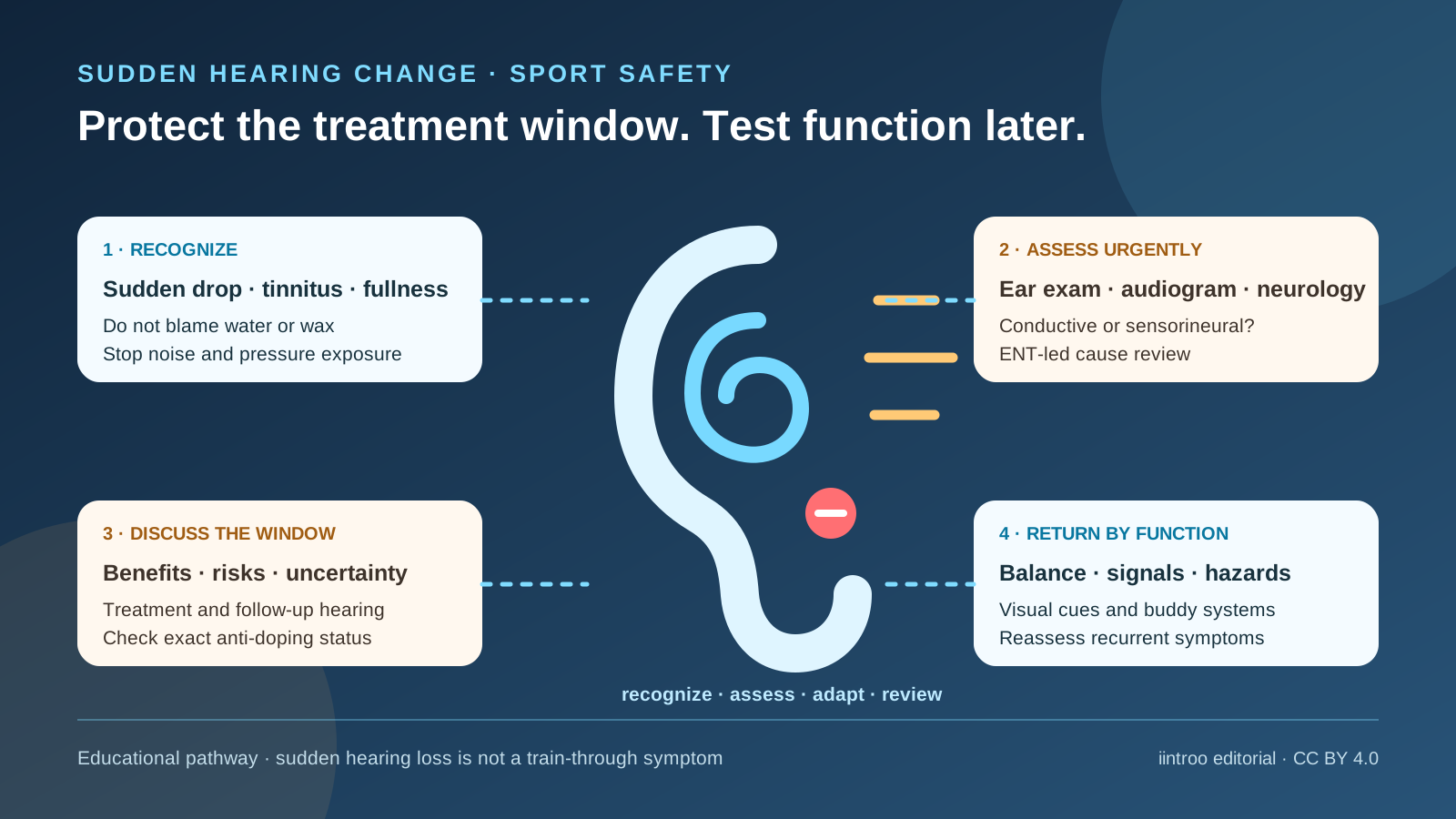
Key points
- Sudden sensorineural hearing loss is a rapid inner-ear or auditory-nerve hearing change and can be mistaken for wax, pressure or water in the ear.
- Current guidance treats recent unexplained sudden hearing loss as urgent; audiometry and specialist assessment should not wait for the competition or travel schedule.
- Return depends on hearing function, balance, communication demands and treatment effects rather than a fixed number of rest days.
Recognize a time-critical hearing change
This guide is for athletes, coaches and medical teams facing a sudden reduction in hearing in one or both ears, often with tinnitus, ear fullness, sound distortion or dizziness. Sudden sensorineural hearing loss involves the inner ear or auditory pathway rather than a simple blockage. Water after swimming, cabin pressure, an earplug, wax or noise exposure can create a plausible explanation, but those assumptions should not postpone assessment. NICE recommends immediate specialist referral when unexplained hearing loss develops over three days or less within the previous 30 days.
Stop the session and seek urgent medical care if the change is accompanied by facial weakness, altered sensation, severe vertigo, new neurological symptoms, head injury or a possible stroke. Do not test the ear with more gunfire, loud music, repeated equalisation or underwater descent. Ear pain or discharge may suggest a different problem, yet a clinician still needs to distinguish conductive from sensorineural loss. A phone hearing check, wearable or teammate's voice is not a diagnostic audiogram and cannot rule out a clinically important loss.
Confirm the hearing pattern and investigate the cause
Assessment includes an ear examination, neurological review and formal audiometry as soon as possible. The AAO-HNS guideline recommends confirmation within 14 days of onset, but urgent referral pathways aim to avoid using that outer limit as a reason to wait. Clinicians review whether the loss is unilateral or bilateral, recurrent, linked with trauma, infection, pressure exposure, autoimmune disease or ototoxic medicine, and whether vestibular symptoms are present. MRI or auditory brainstem response may be used to assess retrocochlear pathology; routine head CT and broad laboratory panels are not recommended for every idiopathic presentation.
Most cases remain idiopathic after evaluation, so uncertainty should be explained rather than filled with an unproven sport-related cause. A starting pistol, concert, dive or collision may be relevant, but temporal association alone does not establish mechanism. Follow-up audiometry matters because perceived improvement and measured recovery are not identical. Persistent unilateral tinnitus, asymmetry or balance disturbance also affects communication and venue safety even when the athlete feels otherwise well.
Discuss treatment inside the evidence window
Guidelines allow clinicians to offer corticosteroids within two weeks of symptom onset and intratympanic steroid treatment for selected incomplete recovery. Hyperbaric oxygen combined with medical therapy may be discussed early or as salvage in appropriate settings. These are preference-sensitive decisions: spontaneous improvement occurs, evidence quality varies, and systemic steroids can affect glucose, sleep, mood, infection risk and training tolerance. The 2026 guideline review identified diagnosis, medical management, outcome assessment and rehabilitation as the consistent priorities across high-quality recommendations.
Athletes should not borrow steroid tablets or ear drops, alter a prescribed course for competition or enter a chamber without an ENT-led plan. Anti-doping requirements depend on the exact medicine, route, dose and timing, so the current prohibited list and therapeutic-use process should be checked by the treating team. Hearing aids, tinnitus support or communication rehabilitation may be appropriate when recovery is incomplete. None of these interventions creates an automatic clearance for water, speed, weapons, traffic or collision exposure.
Return through communication, balance and environment
Low-risk conditioning may resume when urgent causes have been addressed, symptoms are stable and the athlete can follow safety instructions. Progression should test directional hearing, balance, start signals, radio or teammate communication and the ability to recognize hazards in the actual environment. A cyclist in traffic, an open-water swimmer, a shooter and a field player face different consequences from the same audiogram. Temporary one-sided positioning, visual signals, a buddy system or quieter practice may reduce risk while the plan is reviewed.
Do not return to diving or pressure exposure while the diagnosis, tympanic function or vestibular symptoms are unresolved. Recurrent sudden loss, new vertigo, facial symptoms or worsening tinnitus requires reassessment. Coaches need only the functional adjustments the athlete consents to share; detailed medical information remains private. This article cannot diagnose the hearing loss, choose steroids, interpret an audiogram or clear a sport. It supports rapid recognition, evidence-based specialist care and an individualized return based on communication and balance, not a universal timeline.