
Suprascapular neuropathy in overhead sport: investigate weakness, not pain alone
Posterior shoulder pain, external-rotation weakness or muscle wasting in overhead athletes can reflect suprascapular nerve injury and needs precise assessment.
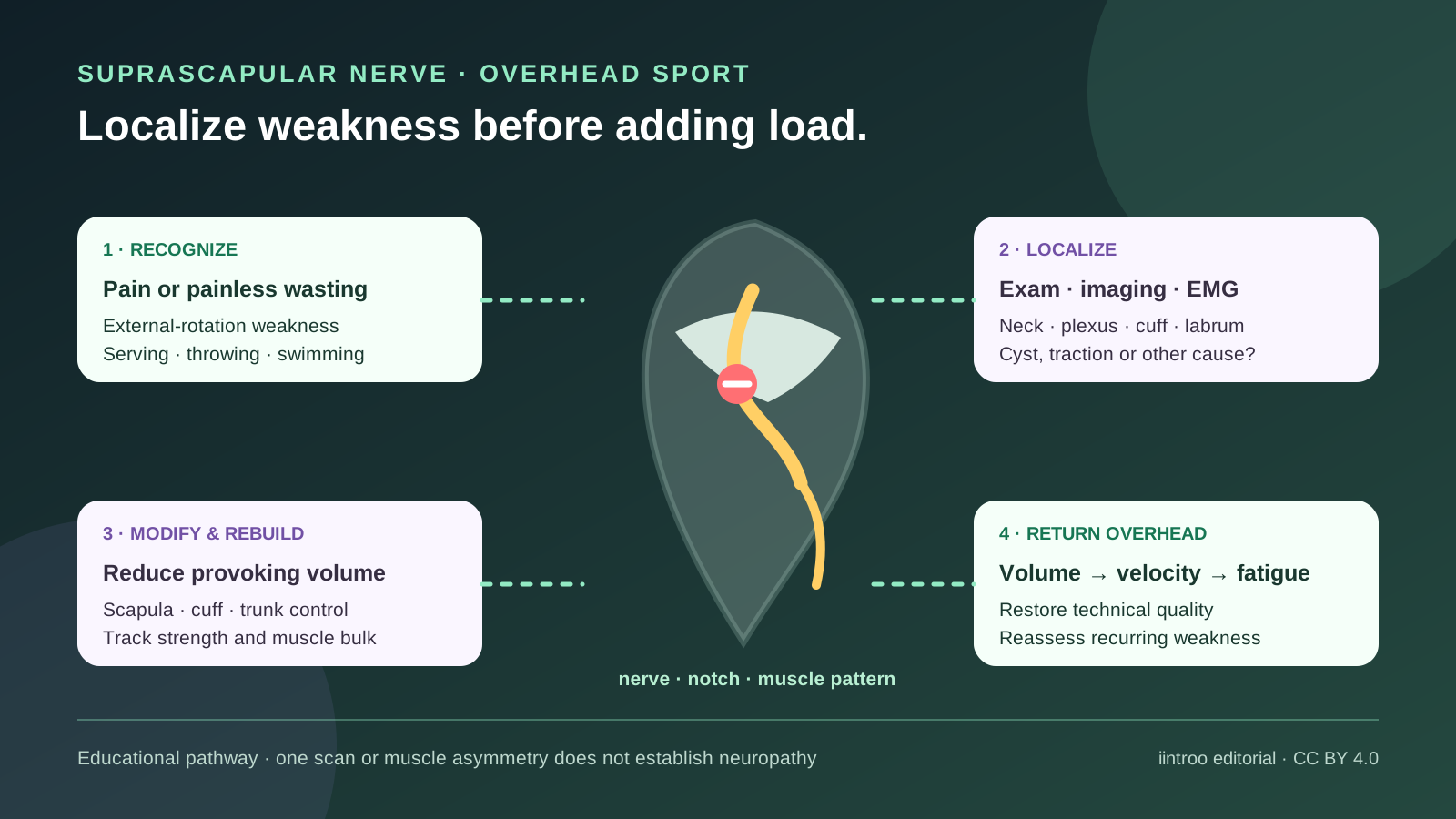
Key points
- Suprascapular neuropathy can cause deep posterior shoulder pain, weakness or visible infraspinatus or supraspinatus wasting, but some overhead athletes have little pain.
- Diagnosis combines history, examination, shoulder and cervical differential diagnosis, imaging and electrodiagnostic testing; no single finding is sufficient.
- Most dynamic traction presentations begin with load modification and rehabilitation; decompression is reserved for selected structural or persistent cases.
Recognize pain, weakness and painless muscle change
The suprascapular nerve supplies the supraspinatus and infraspinatus muscles and sensation to parts of the shoulder. Repeated serving, spiking, throwing or swimming may traction or compress it at the suprascapular or spinoglenoid notch. A labral cyst, rotator-cuff tear or other structural lesion can also compress the nerve. Athletes may report deep posterior shoulder pain, weaker external rotation, reduced overhead control or early fatigue. Visible hollowing below or above the scapular spine matters even when pain is mild.
These features overlap with rotator-cuff injury, labral pathology, cervical radiculopathy, brachial plexus disease, neuralgic amyotrophy and normal sport-specific asymmetry. Sudden weakness after trauma, progressive wasting, neck symptoms, widespread numbness or loss of hand function warrants timely medical assessment. A recent elite-volleyball case illustrates why painless atrophy should not be dismissed, but one case cannot establish that repetitive overhead motion caused every nerve abnormality.
Localize the lesion before choosing treatment
Assessment maps the painful region, muscle strength, scapular movement, cervical findings and the athlete's exact overhead workload. MRI or ultrasound may identify muscle denervation, a paralabral cyst, cuff tear or other structural cause. Electrodiagnostic studies can confirm and localize nerve dysfunction and help distinguish competing lesions, although timing and sampling affect sensitivity. Normal imaging or one negative test does not automatically exclude a dynamic problem, and isolated muscle size asymmetry does not prove clinically important neuropathy.
Clinicians should ask whether weakness is stable, improving or progressive and whether the nerve is being compressed by a lesion that can be corrected. Compare the dominant and non-dominant shoulder while accounting for the athlete's training history, because adaptation is not automatically pathology. The evidence base is dominated by case series and reviews rather than diagnostic trials with a universal reference standard. That uncertainty argues for combining findings rather than ordering surgery from an MRI phrase or treating every volleyball player's infraspinatus asymmetry as disease.
Reduce the provoking load while preserving the whole athlete
When there is no urgent structural lesion, management commonly starts with temporary modification of serving, spiking, throwing, paddling or high-volume pulling. Rehabilitation may address scapular control, cuff capacity, mobility, trunk contribution and the technique or fatigue pattern that increases nerve traction. The programme must be individualized because forcing end-range stretching or adding generic band volume can reproduce symptoms. Lower-body, aerobic and skill training can continue when it does not compromise shoulder protection.
Track external-rotation strength, endurance, pain, muscle bulk and technical quality rather than resting comfort alone. Persistent or progressive weakness, continued denervation or a space-occupying cyst requires specialist review. The consequences of delayed recovery also differ between a recreational swimmer and an elite hitter with repeated maximal contacts. Decompression can help carefully selected athletes, but the updated systematic review included heterogeneous observational studies and sometimes combined procedures. High reported return rates should not be converted into a promise or a reason to add nerve release routinely during unrelated shoulder surgery.
Return through overhead volume, velocity and fatigue
Return begins with pain-controlled daily function and measurable strength recovery, then progresses to low-load overhead patterns, limited technical contacts, greater velocity and full training density. Volleyball players need a serving and spiking count; swimmers need stroke and distance progression; throwers need distance, effort and pitch or implement exposure. Fatigue matters because mechanics can deteriorate late in a session even when early repetitions look normal.
Competition readiness considers strength symmetry in context, scapular control, absence of progressive atrophy, tolerated sport-specific workload and any electrodiagnostic or postoperative plan. Recurring weakness or loss of precision should trigger reassessment rather than compensation through the neck or trunk. Document how the shoulder responds the next day. This page cannot diagnose the lesion, prescribe nerve exercises, interpret an EMG or recommend surgery. It supports early recognition, careful localization, cause-specific management and a criteria-led overhead return.