
Tourette syndrome in youth sport: support tics without turning participation into treatment
Young athletes with Tourette syndrome need predictable, non-punitive support. Sport may help some people, but it is not a cure or a test of control.
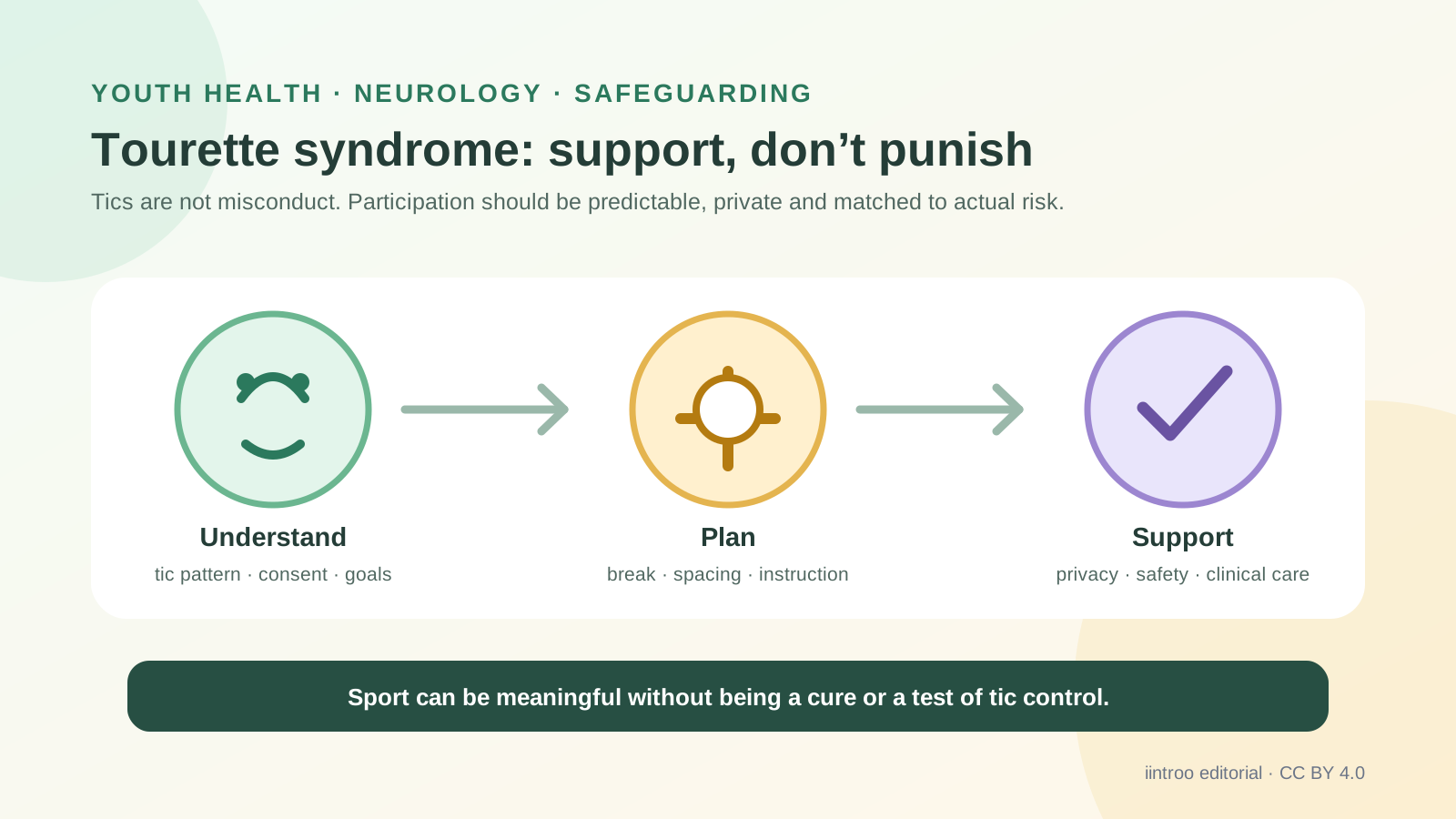
Key points
- Tics are not deliberate misconduct; asking an athlete to suppress them throughout training can add distress and is not a treatment plan.
- Exercise may reduce tics for some people, worsen them for others or have little effect; the evidence is small and heterogeneous.
- A tic that repeatedly causes injury, breathing difficulty, severe pain or sudden loss of safe control needs qualified assessment.
Treat tics as neurological symptoms, not misconduct
This guide is for young athletes with Tourette syndrome or another tic disorder, their families and sport staff working with permission. Tics are sudden, repeated movements or sounds. They can change in type and intensity over time, and some people can postpone a tic for a period at the cost of effort or a stronger urge. A vocal tic, gesture, eye movement or repeated action should not be assumed to be deliberate disruption, disrespect or poor concentration.
Diagnosis belongs with a qualified health professional. European assessment guidance emphasizes tic history, functional impact and common co-occurring conditions such as attention-deficit/hyperactivity disorder, obsessive-compulsive symptoms, anxiety and mood difficulties. Coaches should describe what happened and where safety or participation was affected, not diagnose the athlete or demand disclosure to teammates. The support plan should reflect what the young person and family want staff to know.
Build a predictable and non-punitive sport environment
Agree a simple plan before practice: how the athlete signals a break, where they can reset privately, which instructions work best and who contacts family or clinical support. Predictable session structure, concise instructions and a calm response can reduce unnecessary stress. Do not punish a tic, require an apology for an involuntary sound, imitate it, or make the athlete repeatedly demonstrate control. Anti-bullying and safeguarding procedures apply in changing rooms, travel and online team spaces as well as during play.
Some athletes prefer teammates to receive brief accurate education; others want privacy. Follow the athlete’s age-appropriate preferences and consent. A short break should remain available without becoming automatic exclusion from every drill. When a movement could bring the athlete into contact with apparatus, traffic, water or another participant, adjust spacing, spotting or drill timing around the actual tic pattern rather than applying a blanket ban.
Do not promise that exercise will suppress tics
A small systematic review found mixed evidence about the effects of physical activity on tic symptoms, with limited studies and varying designs. Some individuals report fewer tics during or after activity, while others experience no change or a rebound when concentration ends. CDC survey data also report that about half of parents said exercise or quiet hobbies made tics better, but a parent report is not proof that a specific sport treats Tourette syndrome.
Choose activity for enjoyment, skill, health and the athlete’s goals. Do not add exhausting exercise as a behaviour-management strategy or ask the athlete to train through pain to keep tics quiet. Fatigue, excitement and stress may change symptoms differently across people. Record useful context—drill, environment, sleep, discomfort and recovery—without video surveillance or public tic counts unless these are part of a consented clinical plan.
Keep treatment with clinicians and safety decisions specific
When tics cause pain, injury, distress or substantial interference, evidence-based options can include psychoeducation, comprehensive behavioural intervention for tics or other clinician-directed treatment. CBIT teaches structured skills and is not the same as a coach telling someone to stop. Medicines may have effects relevant to sport, including tiredness, restlessness, dizziness or movement changes; these should be reviewed with the prescriber, not managed by skipping or changing doses around competition.
A tic that repeatedly causes head or neck injury, interferes with breathing or vision, creates an immediate apparatus risk, or changes abruptly with severe illness needs qualified assessment. Return or adaptation depends on the person, the tic pattern, co-occurring conditions, treatment effects and the consequence of an error in that sport. There is no universal exclusion period. This page provides general education, not diagnosis, behaviour therapy, medicine advice, emergency disposition or personal clearance.