
Snakebite on the trail: immobilise, evacuate and avoid harmful first-aid myths
A snakebite is an urgent evacuation problem. Keep the person still, follow local expert instructions and avoid cutting, suction, ice or a tight tourniquet.
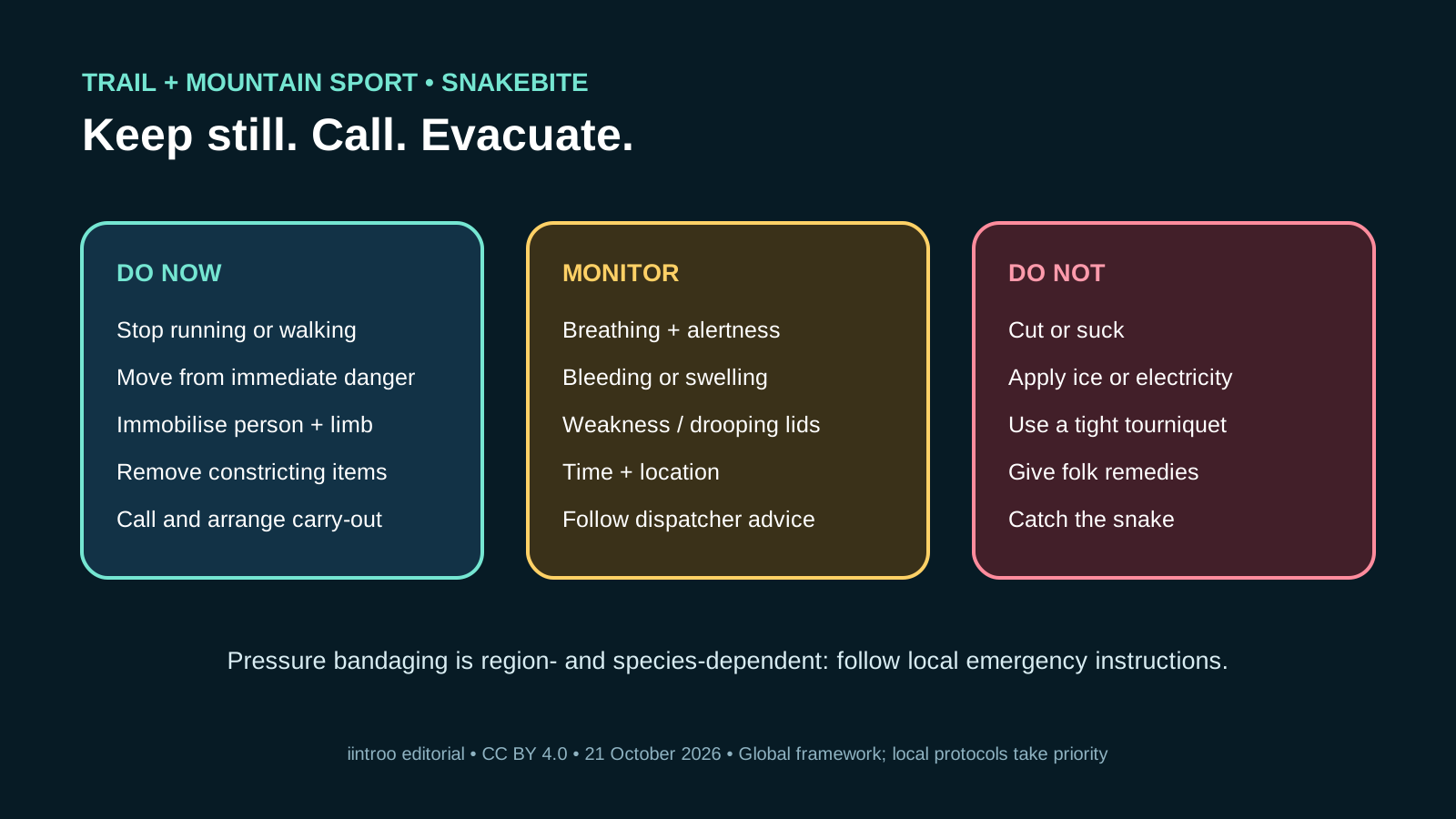
Key points
- Do not wait for swelling or collapse: stop movement, activate emergency help and arrange transport to appropriate care.
- Keep the person and bitten limb still; walking or running out can increase exertion and delay monitored care.
- Do not cut, suck, freeze, shock or tightly tourniquet the bite, and do not attempt to catch the snake.
Treat the bite as urgent even before symptoms appear
This guide is for trail runners, hikers, mountain bikers, race crews and outdoor leaders in snake habitat. A bite can be difficult to identify, and not every venomous-snake bite injects venom. Neither point makes watchful waiting on the trail safe. Venom effects vary by species and region and may involve paralysis, bleeding, shock, kidney injury or severe local tissue damage.
Stop the person from running or walking. Move away from immediate danger without trying to catch, kill or handle the snake, then have the person lie or sit in a safe position. Activate local emergency services or the event rescue plan and state that this is a possible snakebite, the location, time, symptoms and access conditions. Early transport to a facility with appropriate assessment matters.
Keep movement low while evacuation starts
WHO recommends complete immobilisation of the person and splinting the bitten limb, with carriage rather than self-evacuation when feasible. Remove rings, watches, tight footwear or other constricting items before swelling makes that difficult. Keep the person warm, calm and observed. Note changes in breathing, alertness, bleeding, swelling or pain and relay them to responders.
Pressure-immobilisation bandaging is not a universal global instruction. WHO limits it to particular neurotoxic bites without local swelling, while other regional protocols differ. Poorly applied pressure can become a harmful tourniquet. Follow live instructions from the relevant poison centre or emergency service; an article cannot identify the snake, local venom pattern or correct regional bandage method.
Do not add tissue injury or delay
Do not cut the bite, suck venom by mouth or device, apply ice, burn or electrically shock the site, use chemicals or herbs, or place a tight arterial tourniquet. These actions do not replace antivenom and can worsen tissue damage, bleeding or delay. Do not give alcohol. Food, drink and medicines should follow emergency-clinician advice because vomiting, sedation, bleeding risk and procedures may matter.
A 2016 systematic review found limited and heterogeneous evidence for prehospital interventions. It supported immobilising the person while waiting for emergency services and highlighted that correct pressure-immobilisation was difficult for lay rescuers. A 2026 WMS guideline is specific to pit vipers in the United States and Canada, so its treatment details should not be exported to Africa, Asia, Europe, Türkiye, Australia or Latin America.
Prepare the route, not a homemade treatment kit
Before training, check local snake risk, emergency numbers, mobile and satellite coverage, access points and realistic carry-out times. Share the route, avoid placing hands or feet where visibility is poor, use suitable footwear and lighting, and brief the group not to crowd or photograph a snake at close range. A commercial suction pump is not a substitute for communication and evacuation capacity.
Breathing difficulty, drooping eyelids, weakness, collapse, confusion, uncontrolled bleeding, rapidly increasing swelling, repeated vomiting or shock signs require the highest available emergency response. Begin trained basic life support if breathing or circulation fails and follow dispatcher instructions. This article does not identify venomous species, recommend antivenom, teach a regional bandage technique or decide when an athlete may return.