
Trampoline gymnastics safety: progress skills, protect landings and act on neck symptoms
Competitive trampoline needs supervised skill progression, checked apparatus and an immediate stop after head, neck or neurological symptoms—not confidence alone.
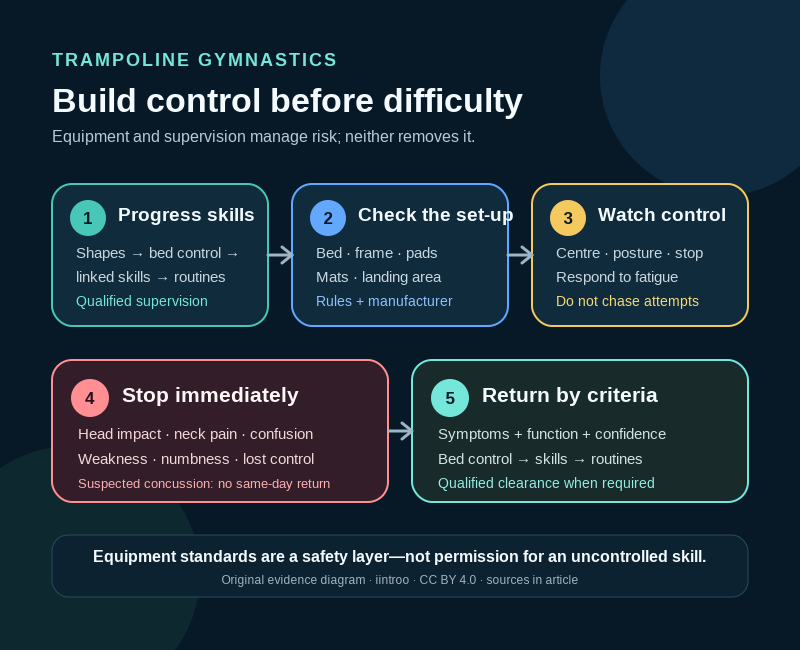
Key points
- Competition rules and apparatus standards define an organised safety environment, but compliant equipment cannot remove the consequences of an uncontrolled landing.
- Trampoline injury evidence is limited and mixes competitive athletes with recreational settings, so population and exposure must be checked before applying a statistic.
- Head impact, neck pain, weakness, numbness, confusion or loss of control ends the session and requires the appropriate assessment or emergency response.
Keep competitive trampoline distinct from recreational jumping
This guide is for competitive trampoline gymnasts, coaches, parents, clubs and event teams. The discipline combines repeated high flight, rotation, precise bed contact and deliberate control at the end of a routine. An older sport-specific study described injuries across trampoline, tumbling and acrobatic gymnastics, while a later systematic review examined children attending commercial trampoline centres. Both are useful for recognising possible injury patterns, but neither supplies a universal rate for today's trained competitors.
Setting changes exposure. A coached single athlete on certified competition apparatus is not equivalent to several recreational users sharing a park bed, and an emergency-department sample is not a register of every training complaint. Read the population, era, denominator and injury definition before applying any percentage. Clubs should pair published evidence with their own exposure, near-miss and injury records.
Build the environment before adding difficulty
World Gymnastics publishes the current Trampoline Code of Points and apparatus requirements for competition. Coaches and organisers should use the applicable federation rules, manufacturer instructions and local inspection procedures for the bed, frame, springs, pads, end decks and surrounding landing area. Required mats, spotter arrangements and apparatus checks are operating controls, not proof that a difficult skill has become safe.
Progress from shapes, bed control and deliberate stopping to linked skills only when the gymnast demonstrates consistent spatial awareness and landings at the current level. Change one important demand at a time—height, rotation, combination length or fatigue—under qualified supervision. A spotter or spotter mat supports a planned system but cannot rescue every poor take-off or landing.
Use landing quality and fatigue as stop signals
A session plan can separate technical learning from routine repetition and record failed contacts, travel toward the edge, unplanned seat or front landings and late decisions. Repeated loss of the centre, deteriorating posture or an athlete who cannot reproduce an agreed stop are reasons to reduce difficulty or finish that block. Adding attempts simply because a competition is near can increase exposure without restoring control.
Preparation should reflect the gymnast's age, growth, recent absence, training history and other apparatus work. Warm-up and physical preparation may improve readiness, but they do not guarantee injury prevention. Sleep loss, illness, pain, fear and concentration problems can change decision-making; early reporting should not cost an athlete their standing in the group.
Act immediately on head, neck or neurological symptoms
Stop the session after a head or neck impact, loss of consciousness, confusion, memory difficulty, unusual behaviour, severe or worsening headache, repeated vomiting, seizure, weakness, numbness, poor coordination or new neck pain. Keep the athlete still when a spinal injury is possible, activate the venue emergency plan and follow trained medical or emergency-service instructions. Do not ask the athlete to bounce again to prove they are fine.
Other injuries also need appropriate assessment: visible deformity, severe pain, rapid swelling, inability to bear weight or use a limb, breathing difficulty or symptoms that worsen after leaving the gym are not online triage problems. Suspected concussion means removal from training and no same-day return. Absence of loss of consciousness does not rule it out.
Return through control, skill and consequence
Return depends on the diagnosis, symptoms, function, confidence and consequence of another uncontrolled landing. A staged plan may rebuild ordinary activity, strength and balance, low-level bed control, straight jumps, simple skills, combinations and complete routines. Advancement should require repeatable control and an appropriate response after training, not merely a date on the calendar.
Head or neck injuries require qualified medical guidance and the applicable federation policy. Persistent dizziness, headache, visual symptoms, pain, weakness, numbness, fear or altered technique warrants reassessment before higher flight or rotation. This article does not diagnose an injury, prescribe a progression or provide clearance to compete.