
Uveitis in sport: protect vision while inflammation is assessed and treated
Eye pain, redness, light sensitivity, floaters or blurred vision can signal uveitis. Prompt assessment and sport-specific visual safety matter more than guessing.
Key points
- Uveitis is inflammation inside the eye and includes anterior, intermediate, posterior and pan-uveitis; infectious and noninfectious causes require different treatment.
- Redness, pain, light sensitivity, new floaters or blurred vision needs prompt eye assessment because untreated inflammation can threaten sight.
- There is no evidence-based universal exercise restriction for uveitis; participation depends on inflammation, vision, treatment effects and sport consequences.
Treat a painful or light-sensitive eye as more than irritation
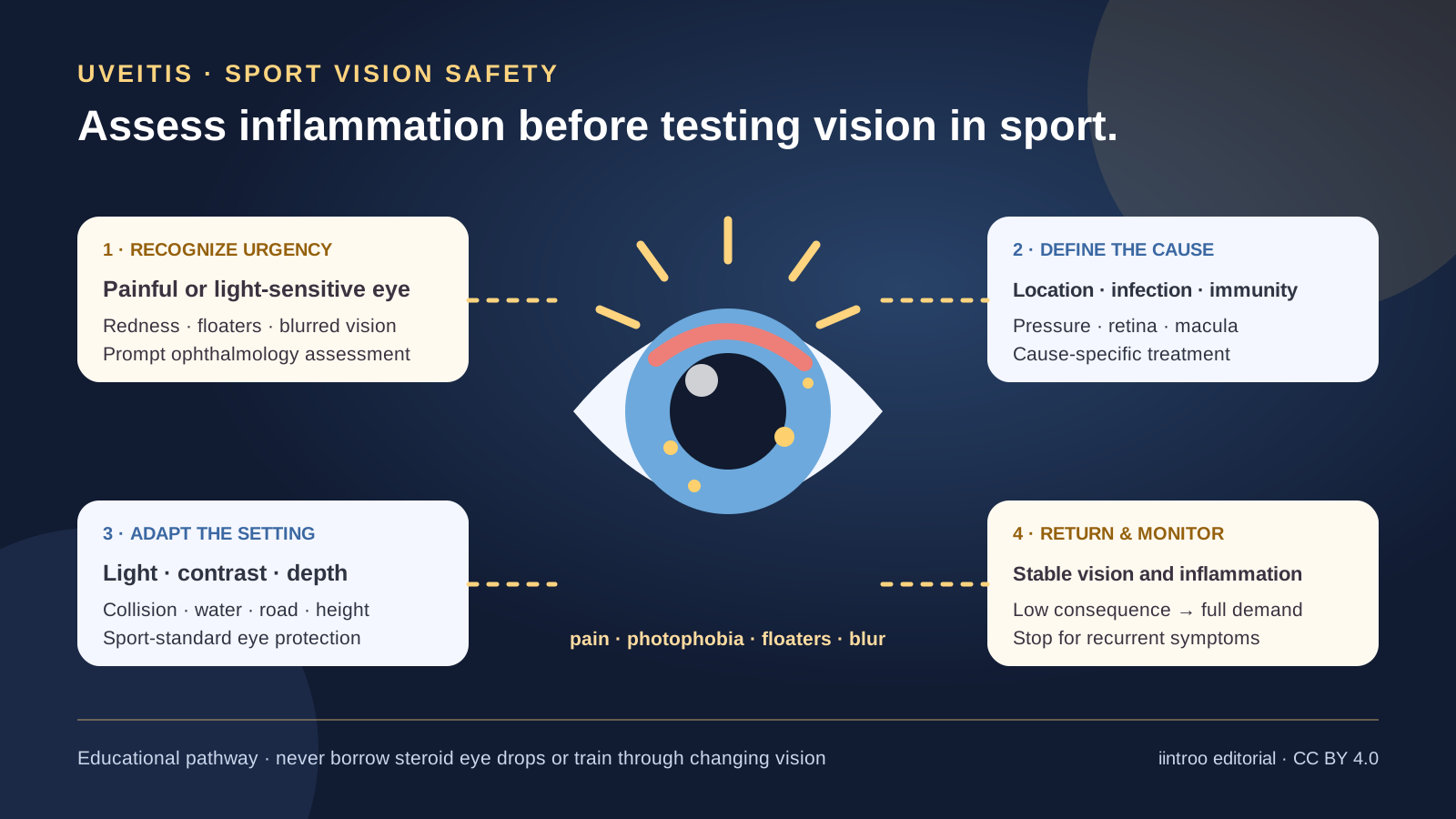
Uveitis describes inflammation of the iris, ciliary body, choroid, retina or several of these structures. Anterior disease often causes pain, redness and strong light sensitivity; intermediate or posterior disease may present with floaters, haze or blurred vision and less external redness. Infection, immune-mediated disease, trauma and other causes can look similar but require different treatment. Contact-lens discomfort, allergy and conjunctivitis are not safe self-diagnoses when vision, pain or photophobia changes.
A new painful red eye, marked photophobia, reduced vision, many new floaters, flashes, a curtain or neurological symptoms needs prompt ophthalmic assessment; sudden major visual loss is an emergency. Stop the session, remove contact lenses if advised by the athlete's eye-care plan and avoid driving or cycling when vision is impaired. Do not borrow steroid drops: they can worsen some infections, raise eye pressure or obscure the correct diagnosis.
Define location, cause and complications before planning sport
Ophthalmologists classify which part of the eye is inflamed, whether one or both eyes are affected, the time course and whether infection or systemic inflammatory disease is likely. Examination can include slit-lamp assessment, dilated retinal review, pressure measurement and imaging. Macular oedema, glaucoma, cataract, retinal disease and optic-nerve involvement change both visual function and treatment. A normal-looking eye photograph or home acuity chart cannot exclude active inflammation.
History may link uveitis with inflammatory arthritis, bowel disease, psoriasis, sarcoidosis, Behçet disease or infection, but extensive testing is not identical for every presentation. The 2025 adult review emphasizes that therapy depends on anatomical subtype and cause. Chronic posterior noninfectious disease may need systemic immunomodulation, while infectious uveitis needs pathogen-directed care. Athletes should not stop systemic treatment for competition or fear of a positive doping test; the prescriber and anti-doping team should check the exact medicine and documentation.
Adapt the visual environment and account for treatment effects
There is no established uveitis-specific exercise dose or evidence that training treats an ocular flare. A 2026 lifestyle review found that physical-activity evidence is sparse and cannot establish effects on recurrence or visual outcomes. When inflammation and vision are stable, activity may still support general health and wellbeing. During a flare, light sensitivity, poor contrast, floaters, reduced depth perception or dilating drops may make fast ball sport, road cycling, open water, heights or precision shooting unsafe.
Practical adaptations can include lower-risk indoor conditioning, controlled lighting, a brim or appropriate UV protection, a guide or training partner and sport-standard polycarbonate eye protection where impact is possible. Ordinary sunglasses and contact lenses are not impact protectors. Tournament lighting, glare, travel and medication schedules should be considered before competition rather than improvised on the day. Systemic corticosteroids or other immunosuppressive medicines may affect infection risk, bone health, blood pressure, glucose, sleep or recovery; those issues need clinician-led monitoring rather than unsupervised supplement or training changes.
Return when vision and the sport environment are both safe
Return decisions consider inflammation control, visual acuity, field and depth demands, light sensitivity, eye pressure, complications and treatment effects. Begin with daily function and low-consequence conditioning before speed, collision, water, remote routes, heights or precision tasks. Rehearse how the athlete will stop safely if vision changes. If one eye has permanent visual loss, the IOC ophthalmology consensus supports sport-specific eye protection and individualized assessment rather than automatic exclusion.
Follow-up matters because symptoms can improve before inflammation is fully controlled and recurrence may be silent. New floaters, pain, redness or blur during the progression means stop and contact the eye team. Coaches and classifiers should receive only the functional information the athlete consents to share. Privacy matters. This article cannot diagnose uveitis, distinguish infection, prescribe drops, change immune treatment or clear participation. Its purpose is to connect prompt assessment, cause-specific care, honest evidence limits, visual-risk adaptation and a staged return shaped by the athlete's actual sport.