
Vitamin D for athletes: test risk, correct low status and question performance claims
Vitamin D deficiency matters for health, but thresholds vary and trials do not show a reliable strength boost for every athlete who takes a supplement.
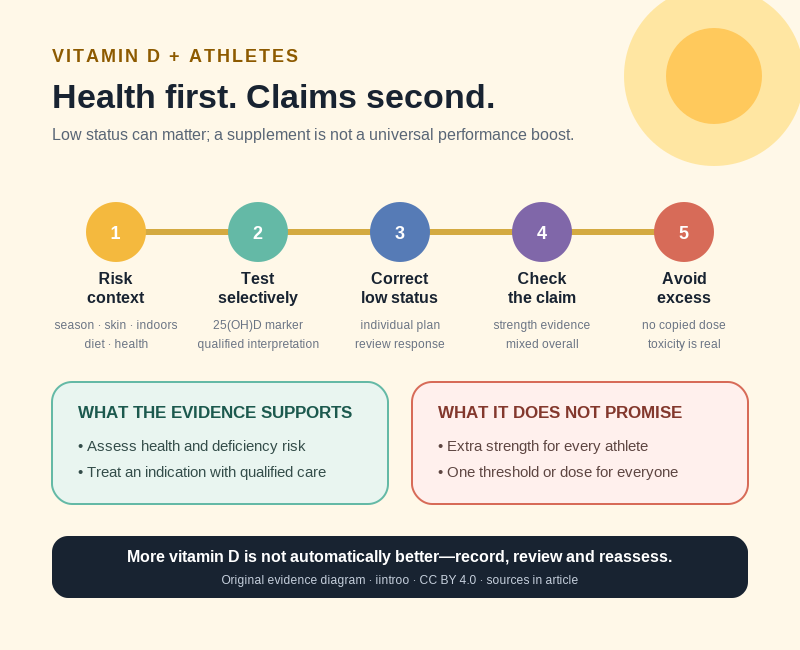
Key points
- Blood 25-hydroxyvitamin D is the usual status marker, but professional bodies do not use one universally agreed threshold for every outcome or athlete.
- An updated 2024 meta-analysis found no significant overall strength benefit across ten randomised athlete trials.
- Supplementation can be appropriate for confirmed low status or a clinical indication, but high-dose self-treatment can cause toxicity and does not guarantee performance gains.
Separate health assessment from a performance shortcut
This guide is for athletes and support teams deciding whether vitamin D testing or supplementation is justified. Vitamin D supports calcium regulation and bone and muscle health, so clinically low status deserves attention. That does not mean every tired athlete is deficient or that raising an already adequate concentration will improve speed, strength or recovery.
The Australian Institute of Sport places vitamin D within its Group A medical supplements: products used in specific situations under evidence-based protocols. Assessment starts with the athlete's health, diet, sun exposure, skin pigmentation, latitude, season, indoor training, clothing, medication and relevant medical conditions. A supplement label is not a diagnosis.
Test selectively and interpret the result in context
Serum 25-hydroxyvitamin D is the usual laboratory marker, but cut-offs differ among authorities and depend partly on the health outcome under discussion. Laboratory method, season and recent supplements can affect interpretation. Population screening without a reason is not automatically useful; risk-based testing and a qualified clinician's interpretation are more informative than a direct-to-consumer result in isolation.
A low result should prompt review of the whole situation, including symptoms, bone health, nutrition and possible causes, rather than an automatic copied dose. Repeat testing, if needed, should follow a clinically appropriate interval and the same plan. Persistent abnormal results or suspected absorption, kidney, liver, parathyroid or bone disease require medical assessment.
Read performance claims against the trial evidence
The 2024 updated review pooled ten randomised controlled trials involving 354 athletes and found no significant overall improvement in muscle strength with vitamin D supplementation. Trials differed in baseline status, sport, dose, duration and strength tests. A null pooled result does not mean deficiency should be ignored; it means a general strength promise is not supported.
A 2023 systematic review of elite athletes included 14 studies and 482 participants and found mixed effects across performance and recovery outcomes. Small samples, variable definitions and different protocols limit certainty. Benefits may be more plausible when low status is corrected, but that is not evidence that athletes with adequate status should supplement for an extra performance gain.
Correct low status without treating more as better
When supplementation is indicated, a clinician or sports dietitian can select a product and plan that accounts for age, baseline concentration, diet, other medicines and medical history. Food sources and safe, context-appropriate sun exposure may contribute, but sun advice must also respect skin-cancer prevention. Do not use a research protocol or teammate's prescription as a personal dose.
Vitamin D toxicity is usually caused by excessive supplement intake rather than ordinary sun exposure. High concentrations can lead to hypercalcaemia and symptoms such as nausea, weakness, thirst, frequent urination, kidney stones or more serious harm. Combining fortified foods, multivitamins and separate high-dose products can raise total intake unnoticed.
Review the plan and the product
Record the reason for testing, result, exact product, total intake, start date and planned review. Athletes subject to anti-doping rules should follow their organisation's supplement-risk guidance and prefer independently batch-tested products when supplementation is justified. Batch testing reduces contamination risk; it does not confirm that the dose is necessary or that the product improves performance.
Seek medical advice for symptoms of toxicity, recurrent bone stress injury, persistent bone pain, unexplained weakness or a result that remains abnormal. The priority may be a broader health, energy-availability or bone assessment rather than another supplement. This article does not interpret an individual's blood test, prescribe vitamin D or guarantee a performance effect.