
Volleyball ankle sprains: rebuild landing confidence before return
Volleyball ankle sprains often happen at the net. Use early assessment, progressive balance and jumping work, and criteria-based return instead of a fixed date.
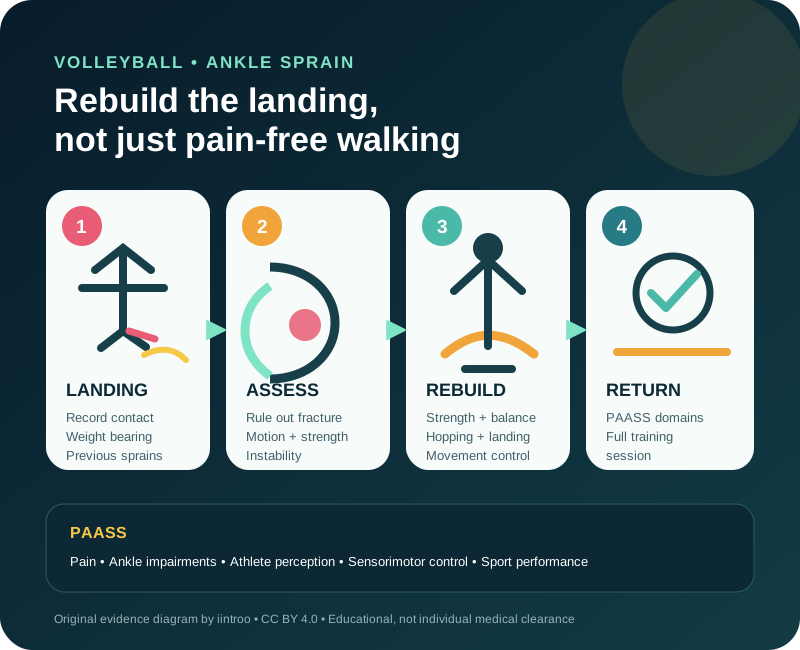
Key points
- Many volleyball ankle sprains occur near the net when a player lands on another foot; previous sprain is an important recurrence signal.
- Balance and neuromuscular training can reduce ankle-injury risk, but programme effects vary and a brace is not a substitute for rehabilitation or safe landing practice.
- Return should consider pain, ankle function, confidence, sensorimotor control and volleyball performance, not only time passed or the ability to walk.
Start with the landing and the injury history
This guide is for volleyball players, parents, coaches and health teams. An ankle can roll when a blocker or attacker lands on another player near the net, but sprains also occur during defence, approach steps and off-balance landings. Record the exact mechanism, whether the athlete heard or felt a snap, whether weight bearing was possible, and any previous sprain or repeated giving-way.
A previous sprain can change both recurrence risk and the rehabilitation task. Do not label every swollen ankle a simple sprain: bone injury, a higher ankle sprain, tendon injury or dislocation can look similar. Marked deformity, an open wound, loss of sensation or circulation, severe bony tenderness, or inability to take steps needs prompt clinical assessment and may require imaging under an established decision rule.
Restore more than pain-free walking
Early care should protect the injury while preserving safe movement as advised by a qualified clinician. Assessment can follow the injury from pain and swelling through range of motion, strength, walking, dynamic balance and self-reported function. Persistent swelling, instability or giving-way is a reason to reassess rather than repeatedly tape the ankle and continue full training.
Volleyball demands rapid approaches, repeated jumping, lateral movement and landing amid other feet. Rehabilitation therefore needs progressive calf and ankle strength, range of motion, balance, perturbation, hopping, deceleration and landing control before unrestricted play. The progression and loading must fit the diagnosis, age, role and symptoms; one exercise sheet or symmetry percentage cannot clear every athlete.
Use prevention evidence without promising immunity
A 2023 review found fewer lateral ankle sprains with proprioceptive training, with a larger effect in people who had already sprained an ankle. A 2026 meta-analysis also associated neuromuscular training with fewer ankle injuries and better dynamic control, although the included trials differed and statistical heterogeneity was substantial. The volleyball-specific 2026 review reported improved stability, not direct proof that every programme prevents match injuries.
Build regular balance, landing and movement work into warm-ups and conditioning rather than adding it only after symptoms return. Bracing or taping may be considered with the athlete and clinician, especially after previous injury, but the evidence and appropriate duration are context-dependent. Equipment cannot correct crowded net landings, incomplete rehabilitation, poor adherence or an unsafe return decision by itself.
Check the five PAASS return domains
The PAASS consensus groups return assessment into pain, ankle impairments, athlete perception, sensorimotor control and sport or functional performance. For volleyball, that can mean reviewing pain during activity and over the following day, movement and strength, confidence and perceived stability, dynamic balance, repeated hops and jumps, lateral reactions, landing quality and the ability to complete a full training session.
PAASS is a framework, not a validated pass-fail score, and the consensus does not supply universal cut-offs. A strong hop result cannot cancel fear, swelling or loss of motion, while pain-free walking does not demonstrate readiness for a contested block. The athlete, clinician and coach should agree what is being tested, what constitutes a setback and which training steps precede match exposure.
Return through controlled volleyball exposure
A staged return may move from individual ball work and controlled footwork to predictable jumping, multidirectional reactions, net drills with managed traffic, full practice and competition. Monitor the ankle during the session and the next day. Recurrent giving-way, increasing swelling, altered landing, falling confidence or inability to complete the planned volume should pause progression and prompt review.
Coaches can reduce avoidable risk by teaching net awareness, organising landing space and keeping prevention work in the programme after return. Clearance is not a guarantee against another sprain, and competition availability is not the same as restored performance. This page provides general education and cannot diagnose an ankle injury, choose a brace or prescribe an individual rehabilitation plan.