
Wildfire smoke and outdoor sport: make the air-quality call before warm-up
Wildfire smoke can change quickly and hard exercise raises inhaled dose. Use local air-quality data, athlete risk and clean-air alternatives to adapt sport.
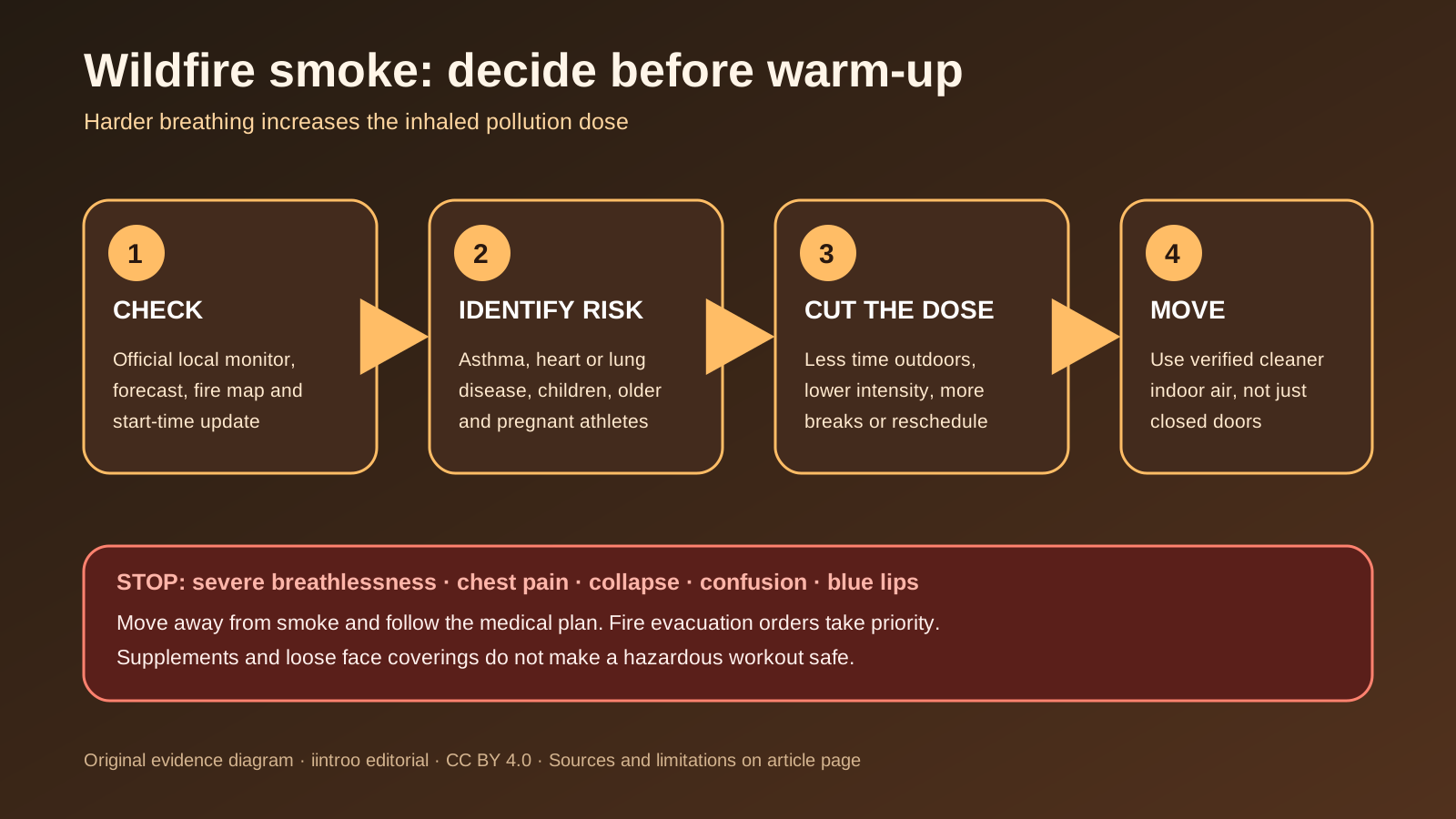
Key points
- Wildfire smoke contains fine particles and gases; harder and longer exercise increases the amount of polluted air an athlete moves through the lungs.
- A visible blue sky or the smell of smoke is not a reliable exposure measure. Use current and forecast information from the official local air-quality service.
- Chest pain, severe breathlessness, confusion, collapse, blue lips or symptoms that do not settle after leaving smoke need urgent medical assessment.
Smoke exposure rises when breathing demand rises
This guide is for athletes, coaches and event organisers planning outdoor training during wildfire smoke. Fine particulate matter, especially PM2.5, can travel deep into the lungs, while smoke may also contain irritating gases and other combustion products. Exercise increases ventilation substantially, so a hard interval session can deliver more pollution than quiet outdoor exposure. Health effects vary with concentration, duration, individual susceptibility and co-exposures such as heat; no universal smell or visibility threshold can define a safe session.
Children, older adults, pregnant athletes and people with asthma, cardiovascular or other lung disease may be affected earlier, but high smoke levels can affect anyone. Cough, throat or eye irritation, wheeze, chest tightness, unusual breathlessness, headache or reduced performance are reasons to reduce exposure and reassess. Symptoms are not a precise pollution monitor: waiting for several athletes to feel ill is not an event plan. Pre-existing asthma action plans and access to prescribed reliever medication should be checked before smoke arrives.
Use the official local index and its health advice
Check the nearest official monitor, current conditions, forecast and fire-smoke map before travel and again near start time. Air-quality indexes are communication tools with country-specific scales; a number from one system should not be pasted into another country’s colour rules. EPA guidance notes that AQI 101–150 is unhealthy for sensitive groups and values above 150 increase risk for the wider population, but teams outside the United States should follow their own health authority’s categories and instructions.
Create written decision points for postponement, relocation, shorter duration, lower intensity, extra breaks and cancellation. Assign who checks conditions and who has authority to stop play. Smoke can shift by hour and across a course, so one morning screenshot is insufficient for a long race. Protect workers, officials, volunteers and spectators as well as athletes. A competitive calendar, broadcast slot or sunk travel cost does not reduce biological exposure.
Reduce dose instead of trying to out-supplement it
The strongest practical levers are cleaner time and place, less time outdoors and lower breathing demand. Move training to a verified cleaner indoor environment, reschedule for improved conditions, shorten the session or replace high-intensity work with lower-demand activity. Closed doors alone do not guarantee clean indoor air; filtration, building leakage and ventilation matter. If smoke and heat occur together, an indoor alternative also needs temperature control and adequate ventilation.
A respirator can reduce particle exposure when correctly selected and fitted, but it does not remove all gases, may be difficult during high ventilation and does not make a hazardous workout acceptable. Loose face coverings are not equivalent. Supplements, antioxidant drinks and breathing gadgets have not been shown to neutralise an inhaled smoke dose. Athletes with respiratory or cardiac disease should discuss an individual plan with their clinician rather than starting or increasing medicine without advice.
Stop for symptoms and review the return environment
Move an athlete with symptoms away from smoke, stop exertion and follow the established medical plan. Severe breathlessness, chest pain, collapse, confusion, blue lips, a severe asthma attack or symptoms that do not improve promptly require urgent assessment. Organisers need emergency communication and evacuation routes that remain workable when visibility, traffic or fire conditions change. Wildfire movement itself may create a separate life-safety emergency; air-quality guidance never overrides evacuation orders.
Resume outdoor training only after current local conditions and the athlete’s symptoms have improved. A normal resting feeling indoors does not prove that high-intensity exposure is appropriate. After a significant respiratory episode, return should rebuild duration and intensity while watching for recurrent cough, wheeze, chest discomfort or unusual recovery. This article does not set a global cancellation threshold or replace local public-health, fire-service or medical direction.