
Wilson disease and sport: coordinate copper treatment, liver status and movement
Wilson disease needs copper-control treatment. Sport planning should integrate liver health, neurological function, rehabilitation and medication continuity.
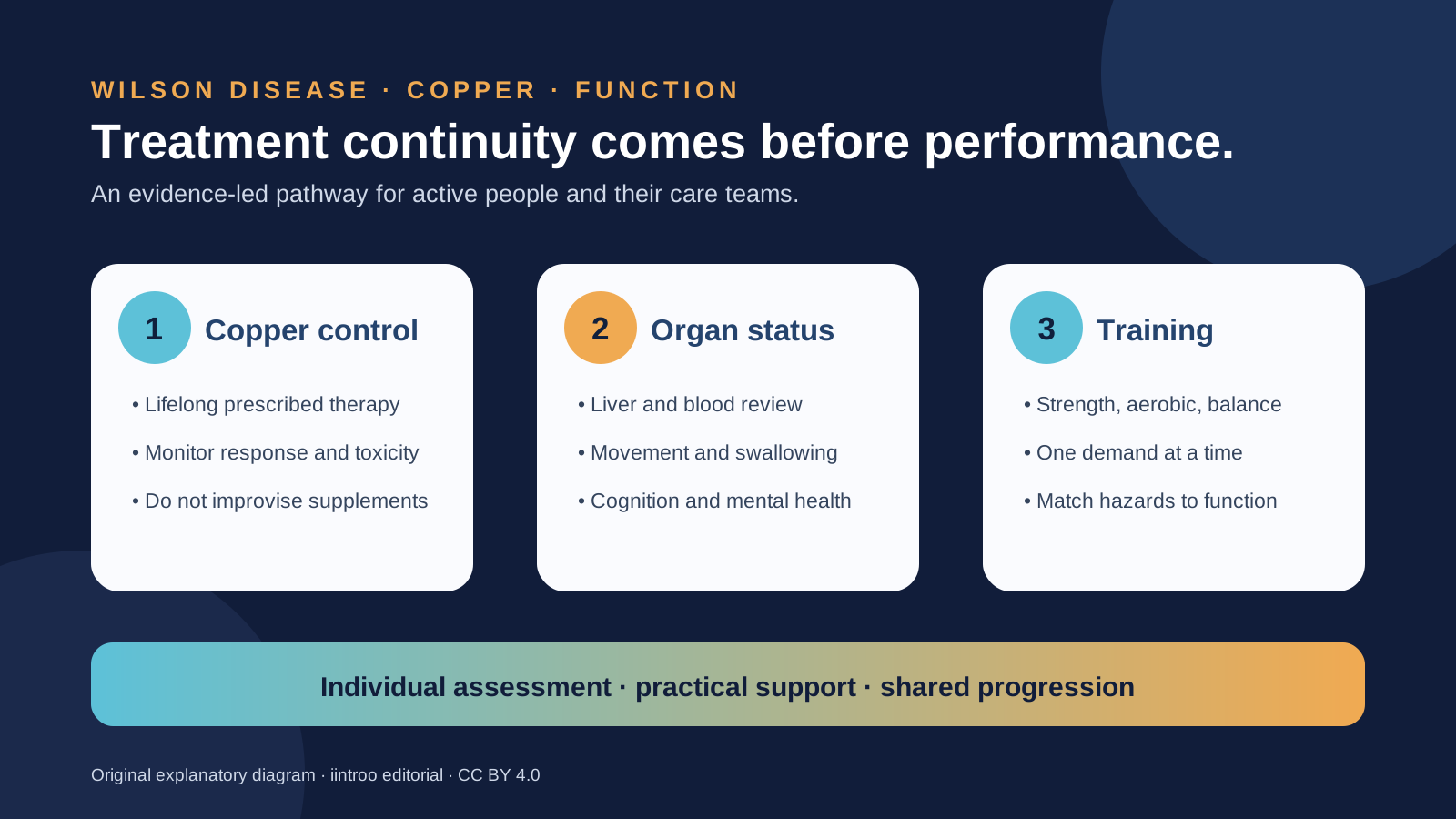
Key points
- Wilson disease is an inherited copper-metabolism disorder that can affect the liver, brain and other organs; treatment is lifelong even when a person feels well.
- Sport advice must reflect liver status, movement and balance, swallowing, cognition, mental health, treatment effects and the consequences of the activity.
- Exercise and rehabilitation may support function, but the sport-specific evidence is sparse and does not justify changing chelation, zinc or diet without the specialist team.
Start with the treated disease, not a generic fitness label
This guide is for people with Wilson disease who want to be active and for teams working with their permission. Wilson disease is an autosomal-recessive disorder of copper metabolism caused by ATP7B variants. Copper can accumulate in the liver, brain and other tissues, producing hepatic, neurological or psychiatric features in different combinations. Some people are identified before symptoms; others have jaundice, abnormal liver tests, tremor, dystonia, speech or gait change, swallowing difficulty, mood symptoms or acute liver failure. A diagnosis does not predict one athletic ceiling, but untreated or undertreated disease can be life-threatening.
The 2025 EASL-ERN guideline and 2026 APASL guidance use clinical assessment, copper studies, ceruloplasmin, urinary copper, genetics and sometimes liver testing within a structured diagnostic process. Neither a low ceruloplasmin result nor fatigue alone diagnoses Wilson disease. Treatment usually uses chelators or zinc, chosen according to presentation and specialist judgement, with regular monitoring for response, adherence, overtreatment and adverse effects. Athletes should never stop therapy for a competition, travel day, weigh-in or supplement routine. The apparent absence of symptoms is not evidence that copper control is no longer needed.
Let liver and neurological status define the safety questions
Sport review should document liver function and complications, current treatment, blood counts and relevant biochemistry, movement and balance, speech and swallowing, cognition, mental health, vision, bone and joint concerns and any previous transplant. Decompensated liver disease, acute neurological worsening or significant dysphagia changes the risk profile and needs specialist care. New jaundice, abdominal swelling, vomiting blood, black stool, confusion, collapse, severe weakness or rapidly worsening movement is not ordinary training fatigue and requires urgent assessment.
Neurological Wilson disease may involve tremor, dystonia, rigidity, ataxia, dysarthria or gait impairment. The 2022 AASLD summary describes physical, speech and assistive-device support as part of care, but high-quality rehabilitation trials remain limited. A 2023 dual-task study linked cognitive measures with pace and step size in 63 patients; it was observational and cannot set a sport threshold. Coaches can reduce simultaneous cognitive and balance demands during early progression, use stable environments and allow extra practice, while qualified clinicians assess the cause and progression of any change.
Use rehabilitation to build capacity, not to replace copper control
Physical therapy may address mobility, gait, posture, balance, coordination, endurance and contracture risk. A small 2022 running study in long-term-treated patients found altered running speed and suggested that non-motor symptoms influenced performance; it does not show that running is unsafe or provide a training prescription. A 2026 propensity-matched cohort reported functional gains after an eight-to-twelve-week multimodal rehabilitation programme in adults with persistent neuropsychiatric symptoms, but it was retrospective, involved 68 matched participants and requires confirmation in controlled trials.
These findings support access to individualized rehabilitation, not a claim that exercise removes copper or cures neurological disease. Quality-of-life evidence is also heterogeneous and often worse where neurological or psychiatric symptoms are prominent. A practical plan can separate strength, aerobic, balance, coordination and sport skills, then progress one demand at a time. Where falls, water, height, speed, weapons or intentional contact are involved, the consequence of tremor, dystonia or impaired judgement matters as much as cardiorespiratory fitness. Adaptive equipment and para pathways can expand participation without hiding real risks.
Protect medicine, nutrition and follow-up across the season
Medication schedules can interact with food, minerals and other medicines, so the Wilson team should plan training-day timing and travel rather than the athlete improvising. Copper restriction is an adjunct to treatment, not an invitation to remove broad food groups or chase internet detoxes. High-dose zinc, chelators and supplements can cause harm or interfere with management. A sports dietitian familiar with liver and metabolic disease can protect energy and protein needs within the prescribed plan. Athletes subject to anti-doping rules should check every medicine through an official national or global database without delaying essential care.
Review is needed when treatment changes, liver tests shift, new neurological or psychiatric symptoms appear, swallowing or falls worsen, or the sport becomes more hazardous. This article cannot diagnose Wilson disease, interpret copper tests, choose chelation or zinc, set a low-copper diet, provide transplant clearance or decide collision-sport eligibility. Research has not established one return-to-sport test. Safe participation grows from lifelong disease control, transparent symptom reporting, rehabilitation where needed and an activity-specific decision shared by hepatology, neurology, rehabilitation and sport professionals.