
One kidney and youth sport: replace a blanket ban with an informed plan
A solitary kidney does not automatically rule out contact sport. Check kidney health, explain the rare high-consequence risk and decide together.
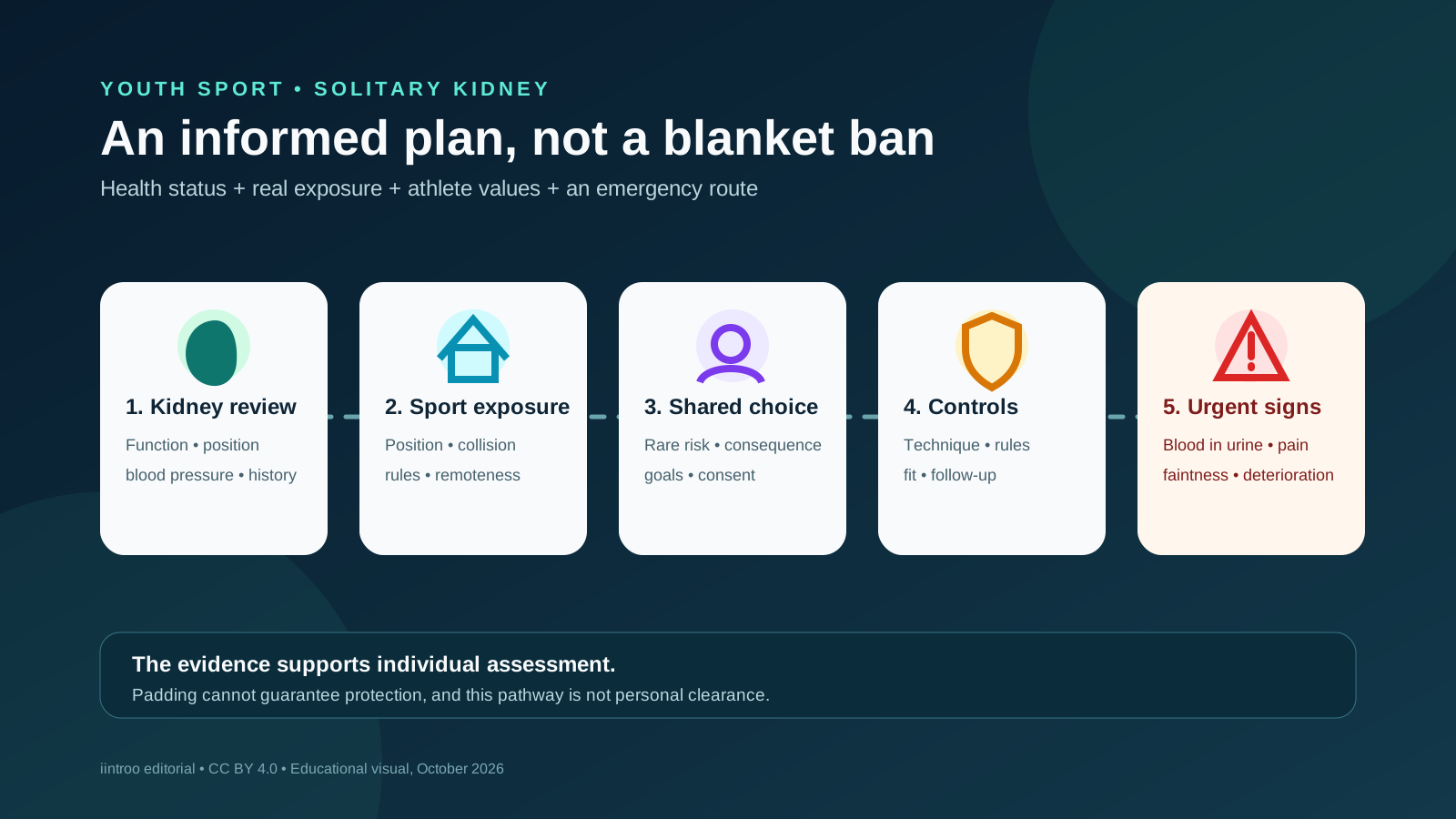
Key points
- Current paediatric guidance treats a solitary kidney as a reason for individual assessment, not an automatic exclusion from every contact or collision sport.
- The chance of a catastrophic kidney injury in sport appears very low, but injury to the only functioning kidney can have major lifelong consequences.
- Visible blood in urine, flank or abdominal pain, faintness, vomiting or deterioration after a blow needs prompt medical assessment.
Begin with the kidney, the athlete and the actual sport
This guide is for young athletes with one functioning kidney because of congenital absence, surgery or another condition, and for their families, clinicians, schools and clubs. The label alone does not describe risk. The remaining kidney may be normal, scarred, enlarged, unusually positioned or affected by urinary anomalies, high blood pressure or reduced function. The treating paediatrician, nephrologist or urologist should establish the clinical context before anyone turns a sport name into a yes-or-no decision.
The American Academy of Pediatrics' 2026 Preparticipation Physical Evaluation guidance says a solitary kidney may not limit contact or collision sport and calls for individual counselling. Its 2024 quick reference similarly lists one absent kidney as qualified participation requiring individual assessment. This is a shift from reflex exclusion, not a statement that trauma is impossible. The discussion should cover the child's values, kidney health, previous injury, sport position and rules, level of play, travel, supervision and access to emergency care.
Put the injury evidence in proportion without minimising consequence
A 2025 systematic review of high-grade kidney injuries in children found that severe sport-related injuries were rare across the available studies. Cycling, equestrian activity and motorised recreation appeared among mechanisms alongside organised contact sports. A 2012 surveillance study of US high-school athletes likewise found kidney injury uncommon and reported none requiring surgery or causing permanent dysfunction in that dataset. These findings help challenge the assumption that football or martial arts are the only relevant exposures.
The limitations matter. Injury surveillance can miss recreational activity, long-term outcomes and children already kept out of sport. Studies classify sports and injury severity differently, while the number of young people with a known solitary kidney is small. Population rates therefore cannot predict one child's outcome. The balanced message is that catastrophic sport-related kidney injury is uncommon, yet damage to an only functioning kidney has a higher personal consequence. That uncertainty belongs in shared decision-making rather than being hidden behind either reassurance or fear.
Build practical controls around participation
Keep routine kidney follow-up, blood-pressure checks and any urine or blood testing recommended by the treating team. Tell the clinician about a new sport, a move into a more physical position, higher competition level or equipment change. Coaches need only the safety information and emergency actions the family and athlete agree to share; the diagnosis should not become team gossip. Good technique, enforced rules, progressive contact practice, suitable field or course design and prompt reporting of blows are more useful than pretending risk can be reduced to zero.
A commercially marketed kidney guard may be considered, especially where a direct flank blow is plausible, but evidence that padding prevents serious renal injury is limited. It must fit, stay in place, allow breathing and movement, and comply with the sport's equipment rules. Do not let a guard create false clearance for an unhealthy kidney or unsafe practice. Hydration advice should follow the athlete's clinical plan and conditions; one kidney does not justify overdrinking, and a coach should not prescribe salt, fluid or pain medicine.
Treat a significant blow as a medical event, not a toughness test
After a substantial hit to the flank, back or abdomen, stop participation and assess the athlete. Visible blood or red-brown urine, worsening flank or abdominal pain, tenderness, swelling, bruising, dizziness, fainting, vomiting, unusual pallor, reduced urine or feeling acutely unwell needs prompt medical evaluation. Collapse, severe pain, confusion, breathing difficulty or signs of shock require the local emergency response. The absence of visible blood does not completely exclude kidney injury, so the mechanism and symptoms still matter.
Do not press repeatedly on the area, give non-prescribed anti-inflammatory medicine or send the athlete back because the score is close. Return after an injury depends on the diagnosis, kidney function, healing, symptoms, imaging when indicated and the demands of the sport; there is no universal waiting period. This article does not clear a child for contact sport, prescribe protection or replace specialist follow-up. Its purpose is to make the decision transparent, proportionate and centred on the young athlete.