
Youth ice hockey body checking: choosing a safer playing environment
Understand checking rules, injury evidence and skill development, plus the concussion response families should expect from a youth hockey club.
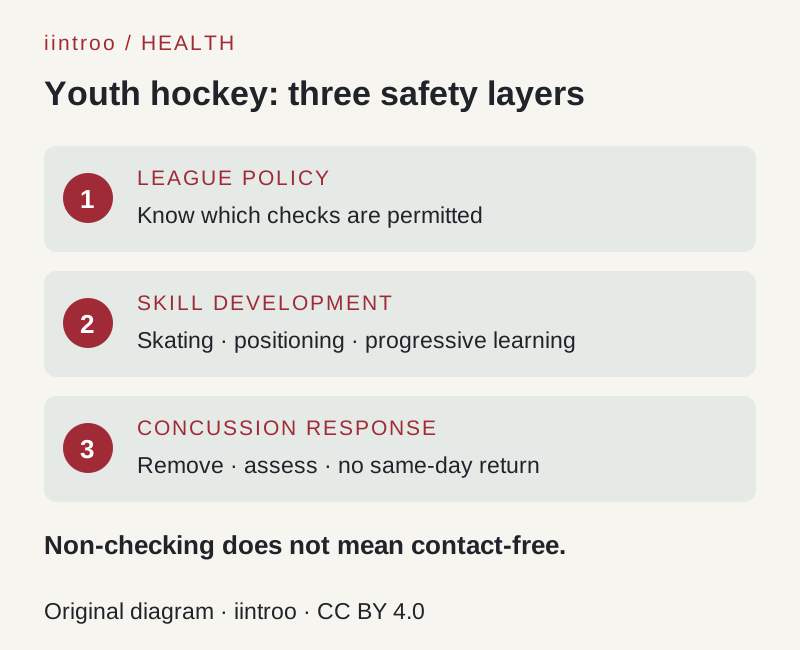
Key points
- Non-checking hockey still involves incidental contact; it changes which deliberate checks are permitted.
- More years of body-checking experience have not been shown to protect older adolescents from injury.
- Suspected concussion means immediate removal and no return that day, followed by healthcare assessment.
Ask what the league actually permits
This guide is for young ice hockey players, parents and club organisers choosing a playing environment. Body checking is not synonymous with every collision. A non-checking game still includes close marking, puck battles and incidental contact. The relevant question is whether deliberate body checking is permitted and how the rules are taught and enforced.
Hockey Canada describes U13 and younger hockey as non-body-checking, with checking introduced in eligible U15 leagues and non-checking options continuing at older ages. That is a Canadian policy example, not a universal age threshold. Families in Türkiye and elsewhere should obtain the current rules for the exact age group, competition and division before registration.
Read injury studies with their corrections
A prospective Canadian study compared non-elite leagues for players aged 15–17 that permitted or prohibited body checking. The current online report associates non-checking policy with fewer game injuries and concussions. Its 2024 correction changed results and tables as well as authorship. A larger 2024 Canadian cohort, covering 4,418 players aged 11–17, also associated non-checking policy with fewer game injuries; these research programmes overlap and are not wholly independent replications.
Use the current online study and correction together; this guide does not reproduce older percentage reductions from the print report or a database abstract. League comparisons are observational: player selection, competition level and regional practice can affect results, and a group estimate is not an individual guarantee of safety.
Earlier checking is not established protection
Another cohort study followed 941 players aged 15–17, contributing 1,168 player-seasons, and compared those with at least three years of checking experience with those having two years or less. Experience was estimated from policy and playing region rather than assigned at random, so the study cannot isolate a simple causal effect of learning earlier.
Its 2023 correction reported an exposure-coding error, recalculated injury rates and revised interpretations. The correction explicitly retained the conclusion that more checking experience did not protect against injury. This weakens the claim that early exposure is necessary injury prevention; it does not prove every player with more experience will be injured.
Develop skills without promising immunity
Hockey Canada's teaching progression starts with positioning and angling, then stick checking and body contact, before body checking where permitted. Families can ask how coaches teach skating control, awareness, receiving contact and respect for opponents. Progression should match the programme's rules and the athlete's learning, rather than pressure to demonstrate toughness.
A sensible registration conversation also covers non-checking options, referee enforcement and how a player can report symptoms without losing support. Skill instruction and a rule change address different parts of the environment. Neither authorises illegal contact, and good technique should not be presented as proof that collision-related injury or concussion cannot occur.
Know the response before the first game
CDC guidance says to remove an athlete immediately when concussion is suspected after a hit to the head or body. Keep them out for the rest of that day and until a healthcare professional clears return. Coaches and parents should not decide severity by whether the player can skate or wants to continue.
Check for concussion danger signs and obtain emergency care when they are present. The club should have an emergency plan and a clear route to clinical assessment. Ask who contacts the family, records the incident and coordinates the return process. This article provides no home clearance test or fixed recovery timetable.
Sources: 7