
Young baseball pitchers with inner-elbow pain: stop throwing before the next inning
Medial elbow pain in a growing pitcher is not routine soreness. Stop throwing, assess the growth plate and track pitches across every team and showcase.
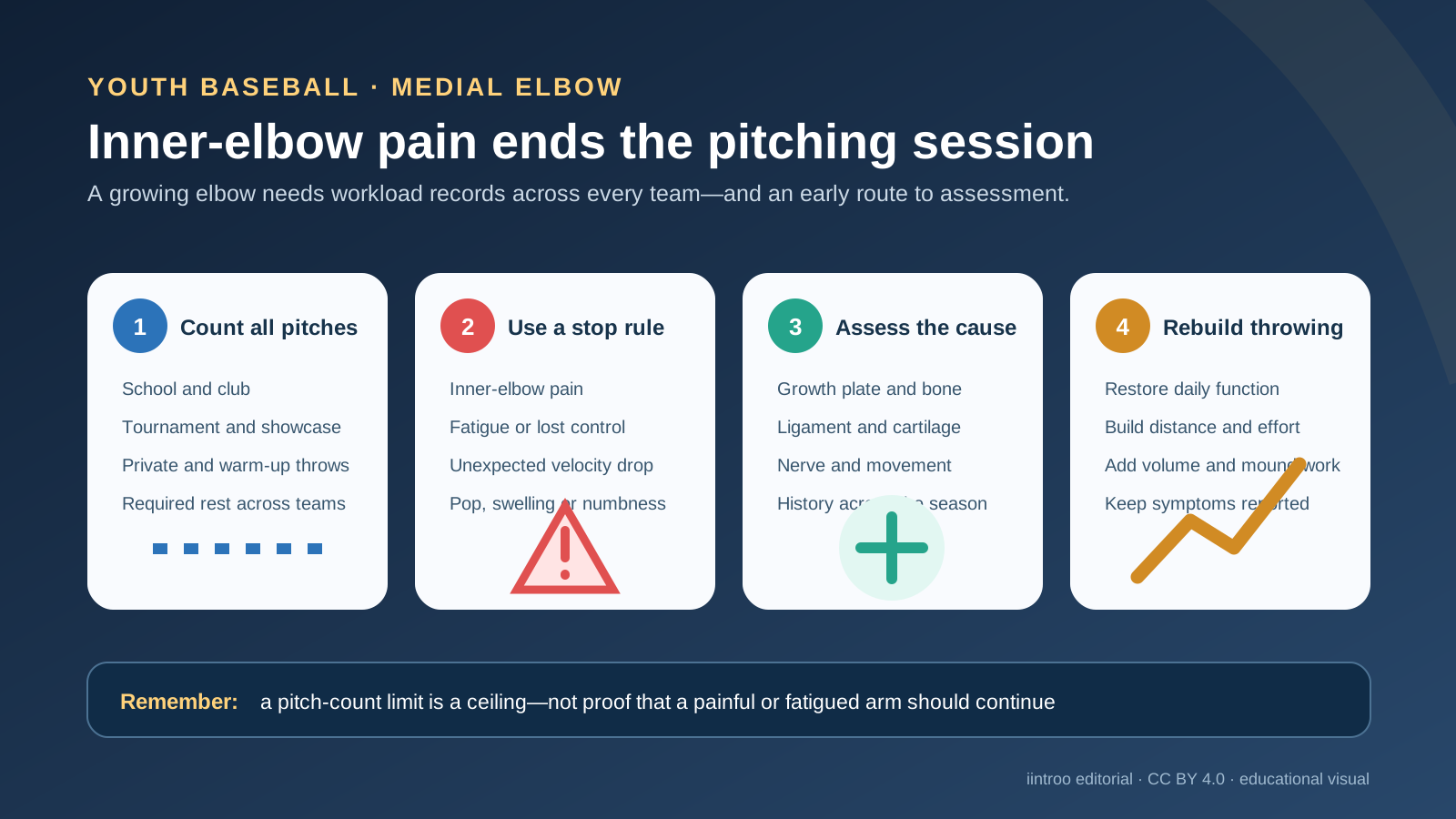
Key points
- Inner-elbow pain, loss of throwing control or reduced velocity in a growing pitcher should end the session and prompt appropriate assessment.
- Pitch counts and required rest must be tracked across school, club, tournament, private training and showcases rather than reset for each team.
- Workload limits reduce exposure but cannot diagnose an injury or guarantee protection; fatigue, pain and development still matter.
A growing elbow is not a smaller adult elbow
This guide is for young baseball pitchers, families, coaches and league organisers. Repeated valgus force during pitching loads the inside of the elbow. Before skeletal maturity, the growth plate and developing bone can be the vulnerable link; later, the ulnar collateral ligament and other tissues become more prominent. Pain location alone cannot identify the injured structure, and the label ‘Little League elbow’ can hide several different conditions.
Stop throwing when inner-elbow pain appears, when control changes, when velocity drops unexpectedly or when the athlete reports arm fatigue. Do not tape the elbow and send the player back for a decisive inning. A clinician familiar with youth throwing injuries may use the history, examination and selected imaging to distinguish growth-plate stress, avulsion, ligament injury, cartilage injury, nerve symptoms or another cause.
Count the workload that the arm actually experiences
MLB and USA Baseball Pitch Smart publish age-specific pitch-count and rest recommendations, while Little League applies its own current competition rules. The exact thresholds differ by age and organisation, so teams must use the rules that govern the player. The principle is broader than one chart: count pitches across every team, tournament, showcase and private session, and communicate the total before the player takes the mound again.
Pitch-count compliance is a ceiling, not proof that an athlete is fit to continue. Fatigue, pain, recent illness, a rapid velocity increase, insufficient preparation and year-round throwing can alter risk. Playing catcher after pitching and making high-intensity throws at another position can add exposure not captured by the mound total. Families should keep their own record when schedules span organisations.
Use rest and preparation as parts of development
Pitch Smart recommends time away from competitive pitching and overhead throwing, age-appropriate preparation, gradual preseason build-up and monitoring for fatigue. Systematic reviews link injury with factors including workload, high velocity, fatigue and participation on multiple teams, but the studies vary and many are observational. No warm-up, strengthening programme, pitch type or mechanics cue removes risk.
Coaches can plan a staff deep enough to honour rest, teach efficient mechanics without chasing early maximum velocity, and protect players from pressure to hide symptoms. A recent scoping review found promising prevention programmes, yet methods and interventions differed. Compliance and culture are as important as handing out a programme. The catcher, shortstop and outfield throws made between pitching appearances also belong in the weekly conversation, even when they are not counted as official pitches. A child should not lose their place for reporting pain.
Return to throwing by criteria, not tournament pressure
After an injury, the treating team should guide healing, strength and movement recovery before a staged throwing progression. Pain-free daily activity is not the same as readiness for repeated high-velocity pitches. The return plan may need to rebuild distance, effort, volume, rest and mound work separately while monitoring the elbow and the whole kinetic chain. A fixed number of weeks cannot fit every diagnosis or stage of growth.
Urgent assessment is needed after a pop, visible deformity, marked swelling, inability to straighten the elbow, numbness, weakness or acute trauma. Persistent pain and recurring loss of control also warrant review even without one dramatic pitch. Families should bring the season workload record and note when symptoms began, because a single-game count may miss the exposure that matters. Tournament availability must never substitute for recovery. This article does not diagnose an elbow injury, set a personal pitch limit, prescribe rehabilitation or clear a child to pitch.