
Youth basketball knee pain: understanding Osgood-Schlatter
Knee pain below the kneecap in young basketball players needs careful assessment, whole-load planning and a return based on function rather than a fixed date.
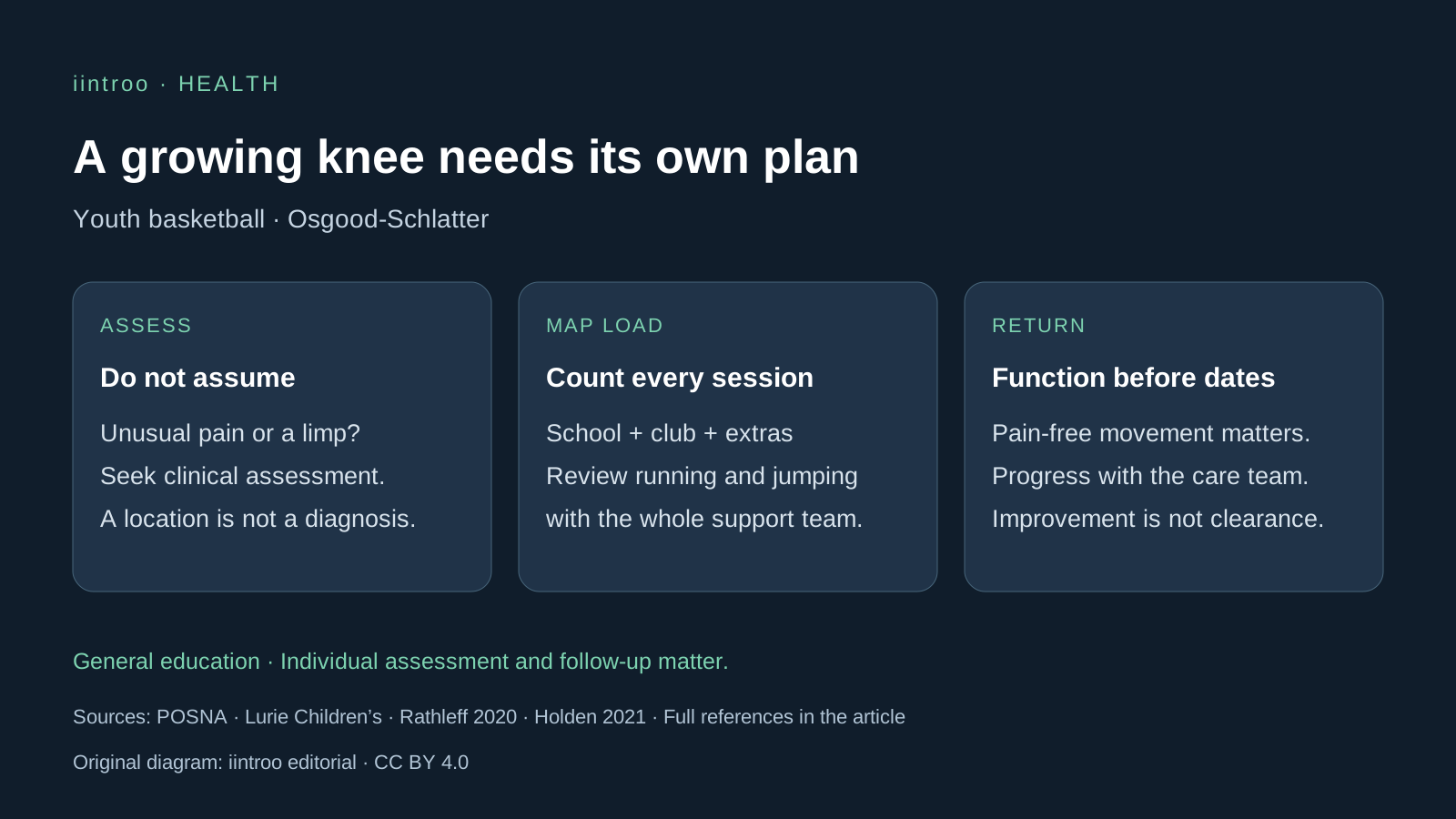
Key points
- Pain location alone cannot diagnose Osgood-Schlatter or exclude another cause.
- Improvement and return to sport are different outcomes; evidence does not establish one best programme.
- Basketball workload includes school, club, pickup games and extra conditioning.
A growing knee is not an adult tendon
Pain just below the kneecap can make rebounds, defensive drills and kneeling uncomfortable. In a growing basketball player, one possible explanation is Osgood-Schlatter disease: irritation around the tibial tubercle, where the patellar tendon attaches to the shinbone. This growth-related attachment problem should not simply be treated as adult patellar tendinopathy.
Typical features include local tenderness and sometimes a prominent bump, with symptoms aggravated by running or jumping. A clinician assesses the pattern and examines the knee; imaging is not automatically necessary, although it can help investigate another explanation. Pain location alone cannot establish the diagnosis. This guide is for players, parents and coaches, not a substitute for personal assessment.
Recognise symptoms that need assessment
Do not dismiss every painful knee as growing pains. Seek urgent medical advice if a child cannot walk, develops a sudden unexplained limp or major loss of movement, has an injury with deformity, or has a hot, red joint with fever or shivering. Persistent numbness, repeated night pain or pain that does not settle when activity is reduced also warrants assessment.
A child struggling with ordinary daily activities needs a different response from someone with mild discomfort after sport. Tell the clinician when symptoms began, whether an injury occurred, and about swelling, other painful areas or changes in walking. Do not use an online exercise programme to postpone investigation of an unusual pattern.
Sources: 3
Review the whole basketball workload
Load is not limited to match minutes. Orthopaedic guidance highlights extra conditioning, private coaching, practice and competition as relevant contributors. Applied to basketball, that means mapping school sport, club sessions, pickup games and additional jumping workouts together. A lighter team session may not reduce the overall demand if everything outside it stays unchanged.
Agree which painful activities to reduce with the treating clinician or physiotherapist, and share the plan with all relevant coaches. This is not a punishment or a test of toughness. Staying involved through team discussions and suitable activities can preserve connection while demands are adjusted. There is no single rest prescription for every growing athlete.
Sources: 1
Rehabilitation is promising, but evidence has limits
A 2020 prospective study followed 51 adolescents aged 10–14 through education, activity modification and strengthening. At 12 weeks, 80% reported improvement, but only 16% had returned to sport. Feeling better and being ready for unrestricted basketball were therefore different outcomes. Without a comparison group, the study cannot establish that its programme caused the improvements or was better than alternatives.
A 2025 conference abstract reported a randomised trial involving 130 adolescents. A self-management approach was not superior to usual care for the primary sport/play outcome at five months. Both groups received variations of exercise, education and activity modification. Because the available report is an abstract, detailed appraisal is limited; it does not establish one best rehabilitation package.
Return by function, with follow-up
Recovery should not be reduced to a calendar deadline. Children’s hospital guidance uses pain-free movement and progressively more demanding activities, including walking, stairs, running and hopping, to inform return. These are discussion points for an individual plan, not a self-clearance test. Basketball-specific progression should be agreed with the professional overseeing care.
At two-year follow-up of the same 2020 cohort, 17 of 46 respondents still reported knee pain. This selected group cannot predict every child’s recovery, but it challenges promises that symptoms always disappear quickly. Reassess a stalled recovery rather than repeatedly pushing through. Persistent symptoms deserve attention without assuming permanent damage or imposing an arbitrary return date.