
Finger pain in young climbers: protect the growth plate before chasing grades
Adolescent climbers can develop finger growth-plate stress injuries that resemble adult pulley pain. Early reporting and qualified assessment matter.
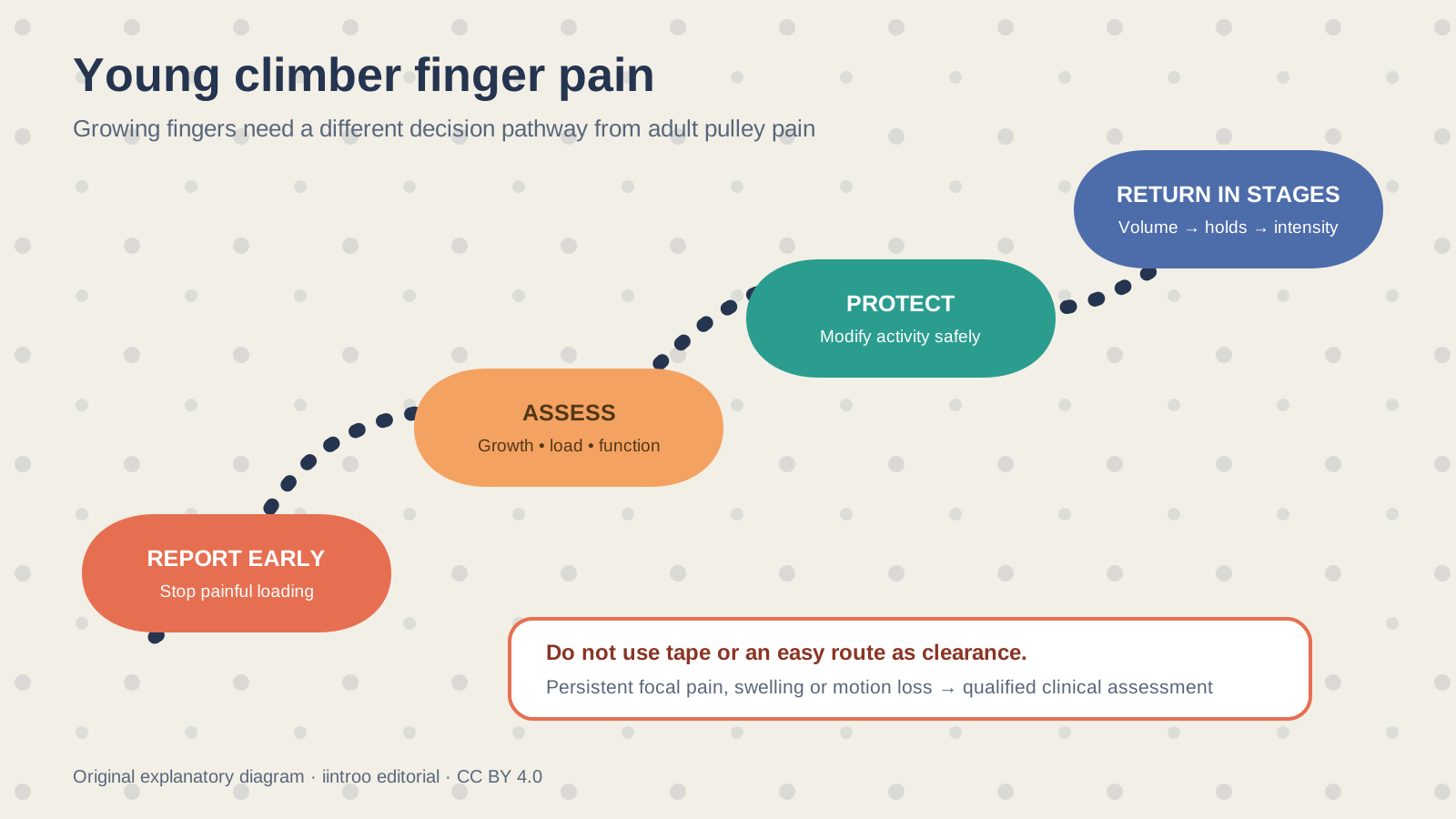
Key points
- Open finger growth plates create an injury pattern specific to growing climbers; adult pulley advice should not automatically be applied to adolescents.
- Persistent focal pain, swelling or reduced motion deserves prompt assessment, particularly after rapid increases in difficult crimping or finger-specific training.
- Return should be based on diagnosis, healing, function and graded climbing load rather than a universal rest period or a pain-masking tape test.
Treat persistent finger pain as information
This guide is for young climbers, parents, coaches, route setters and clinicians. During growth, the finger's epiphyseal plate remains a vulnerable area that adults no longer have. Stress injury there can produce pain around a finger joint and may be mistaken for the flexor-pulley problem commonly discussed in adult climbing. Pain location, a social-media photograph or a taping response cannot distinguish these conditions. Continuing to repeatedly test a hard crimp can add load while delaying the correct diagnosis.
Stop the provoking climbing or fingerboard task and arrange assessment when focal pain persists, returns with climbing, is accompanied by swelling or reduced movement, or changes grip and technique. Marked deformity, an open injury, loss of sensation, poor circulation, severe swelling or major acute trauma needs urgent medical care. The 2026 scoping review describes finger growth-plate stress injury as a significant adolescent climbing problem, but the published cases and series do not provide a simple symptom rule that parents or coaches can use to clear a finger.
Describe load, growth and timing
A useful history includes age and growth stage, which finger and side hurt, the exact holds and grip positions involved, competition and training volume, recent jumps in difficulty, board or campus training, other sports, previous symptoms and whether pain continues in daily life. Coaches can supply the route and load history without trying to provoke pain during examination. Rapid progression, repeated maximal crimping and high finger-specific loads are plausible contributors, but no single exposure proves the diagnosis.
Research is dominated by retrospective case series, surveys and clinical experience. A 2020 survey of 267 youth competitors found low awareness of growth-plate injury and safe training practices, illustrating an education gap rather than measuring injury risk. A 2021 diagnostic and treatment algorithm was evaluated as a case series, not a randomised trial. These sources can guide structured assessment, yet they cannot establish a universally safe age, number of moves, hangboard protocol or weekly volume for every growing athlete.
Keep the athlete active without loading the injured finger
Management depends on the diagnosis and severity. A qualified clinician may use examination and imaging, then decide whether protection, rehabilitation or specialist referral is needed. While painful finger loading is restricted, the team can consider comfortable conditioning, lower-limb or trunk work, technical learning away from the wall and continued social involvement. The substitute activity must fit the clinical plan; squeezing a grip trainer, hanging open-handed or climbing only easy problems may still load the affected region.
Taping, splinting and pain medicine should not be used to create a pass-fail climbing test or to hide symptoms for competition. Nutrition, sleep and adequate energy support normal growth and recovery but do not replace injury assessment. Coaches should remove incentives that reward silence, such as last-minute team selection tied to a maximal attempt. Parents and athletes need a clear contact for questions, a written description of allowed activity and a way to report worsening pain without feeling that they have failed the programme.
Rebuild climbing demands in stages
Return begins after the clinician's healing and function criteria are met, not after a fixed number of calendar days. Progression can move from pain-free daily use and prescribed rehabilitation to low-load climbing, then increased duration, hold difficulty, grip variety, dynamic movement and finally competition-specific density. Change one main variable at a time and monitor the response during the session, later that day and the next morning. A pain-free easy route does not establish readiness for small crimps or repeated maximal attempts.
The 2026 scoping review reported generally successful returns but wide variation in management and timing, reflecting different injuries and limited evidence. That variation should not be converted into a guaranteed return window. Reassess if focal pain, swelling, motion loss or compensatory technique returns. This article does not diagnose a growth-plate injury, prescribe immobilisation, ban a training tool at a universal age or provide clearance. Its practical message is early reporting, growth-aware assessment, protection from provoking load and a staged return matched to the young climber.