
Youth floorball injury prevention: make the programme part of practice
A structured neuromuscular programme reduced acute injuries in one youth floorball trial. Correct technique, consistent delivery and symptom reporting matter.
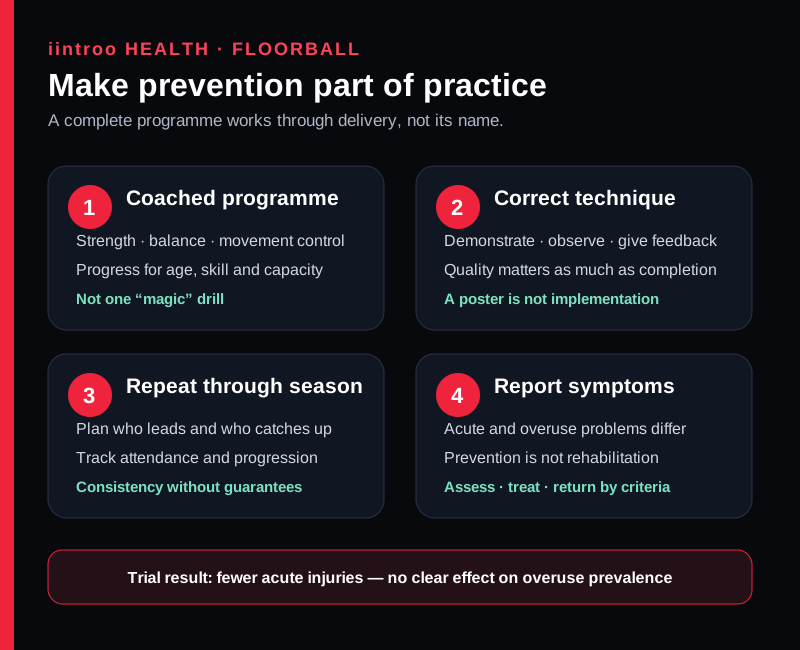
Key points
- In one cluster-randomised youth floorball trial, the Knee Control programme reduced acute injury incidence but did not reduce overuse-injury prevalence.
- A programme name is not the active ingredient: coaching, exercise quality, progression and repeated use determine what players actually receive.
- Prevention work does not diagnose pain or clear an injured player; persistent or sudden symptoms still require appropriate assessment and rehabilitation.
Use a complete programme, not one favourite drill
This guide is for youth floorball players, coaches, parents and club health teams. Floorball combines sprinting, stopping, turning, stick work and close play. The IFF's international surveillance highlights acute ankle and knee injuries alongside head and face injuries, while the broader systematic review found substantial variation between populations and study methods.
A Swedish cluster-randomised trial followed players aged 12 to 17 for one season. Teams assigned Knee Control plus a running warm-up had lower overall and acute injury incidence than usual-practice teams, but overuse-injury prevalence was not reduced. That result supports a structured programme; it does not prove that one exercise prevents every injury or that the same effect will appear in every league.
Coach the movement that is actually performed
The trial programme combined several movement-control, strength and balance tasks rather than a single knee exercise. Progressions need to match age, skill and current capacity. Explain the purpose, demonstrate clearly and watch alignment, balance, landing and control instead of treating completion as a box-ticking race.
In a companion fidelity study, only 58% of observed exercises were performed correctly and the full programme was completed in 4 of 31 observed sessions. Those observations came from a limited number of intervention teams, but they show why a club cannot assume that distributing a poster reproduces the tested programme.
Make consistent use realistic
Plan where the programme fits, who leads it, how absent players learn it and how exercises progress across the season. Keep enough variation to maintain engagement without removing the programme's core tasks. Players and coaches in qualitative work described time, boredom and unclear relevance as barriers; involving them in delivery can make regular use more workable.
A secondary adherence analysis found lower injury outcomes with higher use in male players but not in female players. It was observational within the trial and cannot prove a universal dose or sex difference. Monitor attendance and quality while avoiding a false promise that a particular weekly number guarantees protection.
Track acute and overuse problems separately
A sudden ankle sprain and gradually increasing knee pain need different responses. Ask players about symptoms and participation every week, not only when they miss a match. A programme that helps reduce acute injuries can still leave overuse problems unchanged, as the youth trial showed.
Stop and arrange prompt assessment after major swelling, deformity, inability to bear weight, locking, instability, loss of sensation, head-injury symptoms or severe pain. Persistent pain, altered movement or falling performance also deserves review. A prevention session must not be used as rehabilitation or return-to-play clearance for an injured athlete.
Evaluate the club system, not just the player
Record whether sessions happened, which progressions were used, who missed them and whether coaches received support. Pair that information with injury and participation data. If adherence drops, ask about schedule, space, confidence and player feedback before blaming motivation.
Clubs should also maintain an emergency action plan, current concussion guidance, appropriate protective equipment and access to qualified care. Neuromuscular training is one layer in a wider health system. This article provides general education and does not prescribe an individual exercise programme or replace the rules and medical arrangements of the relevant federation.