
Heel pain in young footballers: understanding Sever’s disease
Heel pain in young footballers needs assessment, a view of the whole activity week and gradual return. Explore Sever’s disease and uncertain treatment evidence.
Key points
- A painful heel or limp in a growing player needs assessment, not an assumption.
- Evidence does not establish one best insert or exercise programme for every child.
- Return should follow symptoms and function rather than the next fixture.
A growing heel needs a different assessment
A child who starts limping after football training does not simply have a smaller version of an adult running injury. Sever’s disease, also called calcaneal apophysitis, involves irritation of the growing area at the back of the heel. Repeated running and jumping can stress this area, particularly during periods of growth.
This guide is for young players, families and coaches. Symptoms can affect one or both heels and often increase during activity. The name does not mean an infection or an inevitable permanent problem. However, a familiar pattern is not enough to diagnose it: heel pain has other causes, and a child should not be told to prove their commitment by playing through a limp.
Do not label every painful heel as Sever’s
Assessment usually starts with the symptom history and examination of the foot and ankle. A clinician may ask about recent activity, footwear and when pain appears. An X-ray cannot establish Sever’s disease by itself; imaging may instead help investigate another explanation, such as a fracture. Buying an insert before assessment does not settle the diagnosis.
An unexplained limp warrants medical review. Seek urgent assessment for persistent night pain, pain that fails to settle with reduced activity, new numbness or sudden deterioration. A child unable to bear weight, with a visibly deformed leg, or generally unwell with fever needs emergency assessment rather than another training session.
Count the whole week, not only the football match
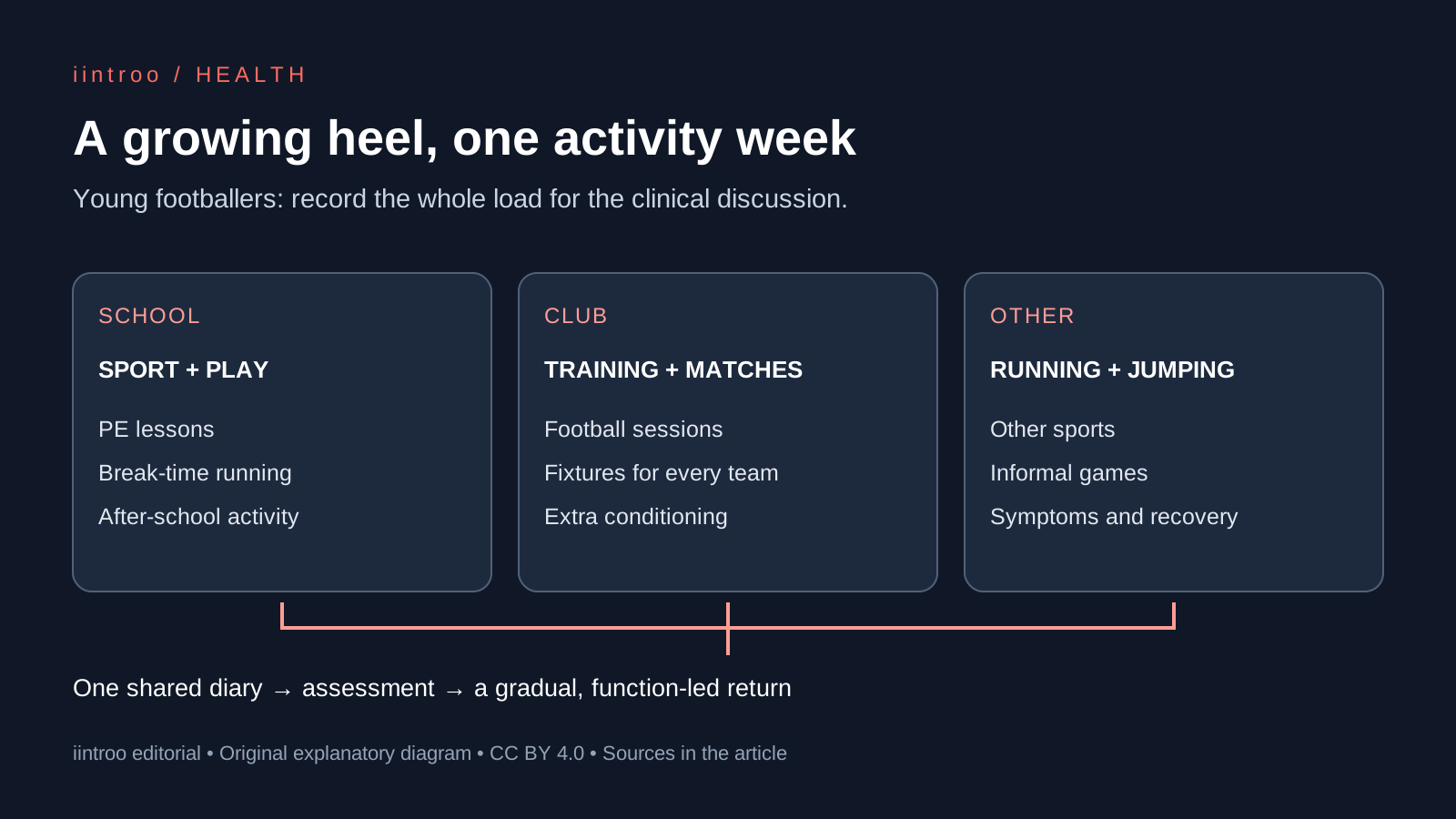
Practical load management begins by listing the activities that provoke symptoms. Club training, school sport, playground running and another team’s fixtures can all contribute to the same week. This is a useful application of activity-modification advice, not a scientifically validated weekly limit. Share that picture with the clinician and coaches so one session is not reduced while another replaces it.
Discuss reducing painful impact activity and whether comfortable lower-impact options are appropriate. Review boot fit and heel cushioning: some children notice more discomfort in cleats. Calf exercises, heel cups or other supports may be considered after assessment. They are options to individualise, not permission to ignore pain or a universal shopping list.
There is no clearly established best treatment
A pragmatic randomised trial published in 2016 enrolled 101 children aged eight to fifteen. It compared activity modification, a heel-raise insert and supervised physiotherapy. All groups improved, with no clinically important between-group differences at the final three-month assessment. That follow-up point was a research measurement, not a promised recovery deadline.
A July 2026 Cochrane review included ten trials involving 654 children; seven trials concerned heel apophysitis. It found considerable uncertainty about which treatments work best. Small samples, inconsistent outcomes and participants knowing their treatment limited confidence. Natural improvement also complicates interpretation. These findings support discussing comfort, feasibility and preferences rather than promising that one device or exercise programme will cure every player.
Return according to function, not the fixture list
Return decisions should reflect the child’s symptoms and functional recovery, with professional guidance where needed. Lurie Children’s describes pain-free walking, jogging, sprinting and hopping, together with comfortable ankle movement, as relevant milestones. These are discussion points for an assessed child, not an invitation to repeatedly test a painful heel at home.
Build football participation back gradually instead of jumping directly from daily comfort to a full match. Renewed pain or limping should prompt adjustment and reassessment. Symptoms can recur while growth continues, so keep communication open rather than treating recurrence as poor motivation. This educational guide does not prescribe an individual rehabilitation plan or a fixed return-to-play interval.