
Concussion in youth ringette: a bench plan for contact, falls and return to play
Head contact in youth ringette can follow a bodycheck or a fall. Learn what benches and officials can do to prevent contact and respond to suspected concussion.
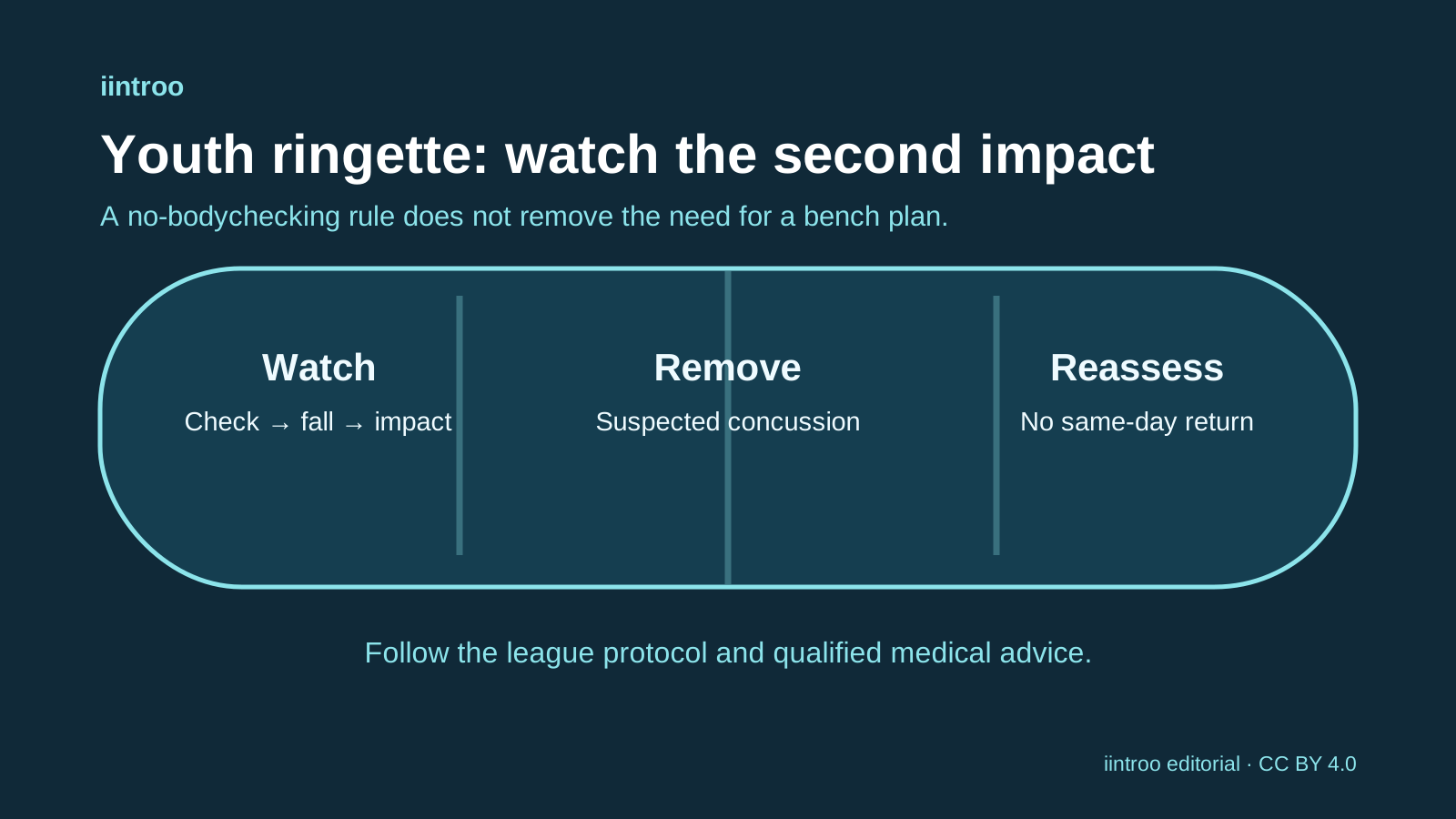
Key points
- Head contact can follow a body collision even without an initial direct blow to the head.
- A helmet and a no-bodychecking rule do not remove the need for enforcement or a practiced response.
- Remove a player with suspected concussion and do not send them back the same day.
Watch the second impact
In youth ringette, the contact that starts a fall and the impact that follows it can be two different events. A player may be checked off balance and then hit their head on the ice or boards. A bench that watches only for a direct blow may miss that sequence. This guide is for youth players, families, coaches, officials and tournament staff, especially when games are played in quick succession and the next line is already on the ice.
A 2026 video study examined 35 competitive Canadian U16 and U19 games at A and AA levels. In that sample, suspected concussions most often followed indirect head contact, primarily after bodychecking. Video coding identifies possible events, not clinical diagnoses. The study was cross-sectional and from one city and season; it cannot estimate concussion rates for every age or country, or prove that a particular penalty policy reduces injury. The federation protocol and international consensus independently support acting on reasonable suspicion rather than waiting for certainty.
Practice the decisions before the whistle
Put a named adult in charge of removal and another in charge of contacting family or emergency services. Check the rink address, ambulance entrance and who will meet responders. In practice, use legal positioning drills near the boards and stop repetitions that reward pushing an opponent off line. Officials and benches can review repeated illegal contact by game situation rather than treating every collision as an unavoidable part of skating. After any suspected incident, record the observed sequence and symptoms privately, without attempting to diagnose or relying on a helmet inspection.
Headache, dizziness, confusion, balance difficulty or acting unusually after a hit to the head or body can raise suspicion even without loss of consciousness. Remove the player and arrange assessment by a qualified healthcare professional. Do not use a brief symptom-free conversation, a parent’s reassurance or a phone test as clearance. Red flags such as deteriorating consciousness, seizure, repeated vomiting, limb weakness or severe neck pain warrant an emergency response. If a neck injury is suspected, avoid moving the athlete unless needed for immediate lifesaving action or instructed by responders.
Keep return decisions separate from the tournament schedule
No same-day return after suspected concussion. Once assessed, follow the clinician’s and applicable governing body’s stepwise pathway, with return to learning addressed for school-age players. Tolerating classroom work, easy physical activity or one quiet stickhandling session is not equivalent to tolerating traffic, speed or unpredictable contact. Reintroduce risk of head impact only with the medical clearance required by the local protocol. Share only the participation information needed by relevant staff, and apply the plan consistently at away fixtures and between teams.
A useful handover tells the next coach which stage applies and which activities are off limits, not when the athlete is expected to be back. If symptoms recur or the athlete is having persistent problems at school or in daily life, reconnect with the care team. This is an educational bench framework, not a diagnosis, treatment plan or competition clearance.