
Motorsport · International
Historic Monte Carlo rally brings 215 crews to Valence
Crews completed the January concentration journeys before the regularity stages scheduled for February.
Event date:
The January arrivals reach Valence
The Automobile Club de Monaco counted 215 crews at Valence’s Champ de Mars on 31 January as the 27th Rallye Monte-Carlo Historique completed its concentration journeys. Cars had set out the previous day from Monaco, Bad Homburg, Turin and Reims on routes of roughly 400 to 800 kilometres with control points. The organizer reported four mechanical withdrawals on those journeys, involving a Ford Escort, an Opel Kadett and two Porsches. Its arrival count is the reported total rather than a calculation from the preview entry list. Crews fitted the Tripy-R navigation and timing equipment before preparing for the regularity sections due to begin the next morning.
An international entry with returning winners
The ACM preview had announced 220 crews representing 34 marques and 25 nationalities. Its planned departure distribution was 16 from Bad Homburg, 65 from Reims, 86 from Monaco and 53 from Turin. Those were pre-event expectations; the subsequent report supplied the actual Valence arrival count. The entry included returning winners Henrik Bjerregaard and Jaromir Svec, who had won in 2022, and Claudio Enz with Cristina Seeberger, the 2023 winning crew. Defending winners Michel Decremer and Jennifer Hugo were listed in a 1965 Alfa Romeo Giulia TI after their previous success in an Opel Ascona. They selected the lower average-speed category. The preview also identified seven all-women crews. Its combination of past winners, different car designs and two average-speed groups describes the composition of the competition without implying that the concentration journey had settled any final ranking.
A defined historical eligibility window
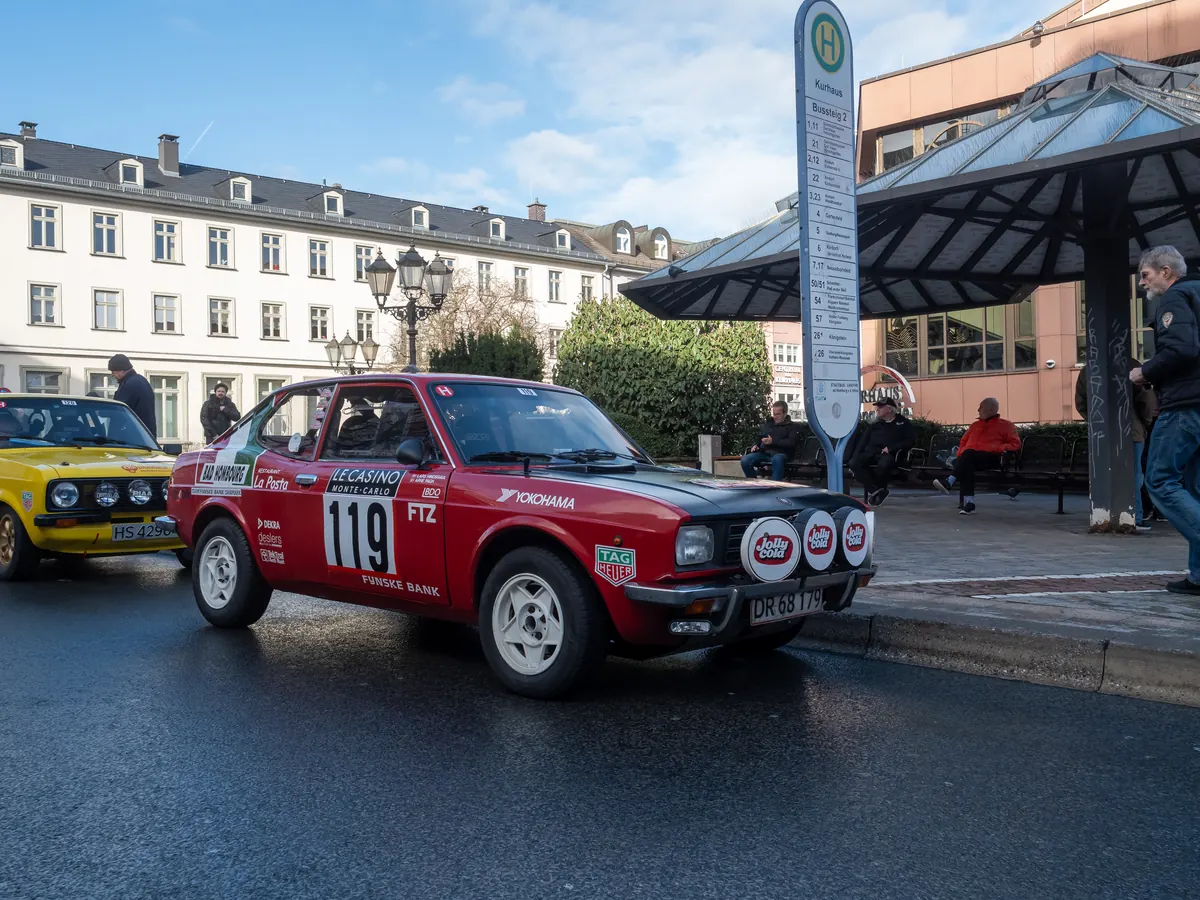
The official presentation limited the rally to vehicle models that had participated in Monte Carlo rallies between 1911 and 1983. That requirement tied the field to the event’s history rather than simply admitting any old road car. The organizer’s route outline separated the arrival journeys from the scored regularity programme. The accompanying photograph records the Bad Homburg departure on 30 January, one of the four official starting points; it does not purport to show the later Valence arrival or a February stage.
February stages remained ahead
For the first classification day, the published route included four regularity sections through the Vercors and nearby mountain roads, with the Col de l’Echarasson, Col de Menée, Col des Carabès and Col de Chamauche among the named landmarks. Further stages were scheduled in Ardèche on 2 February and through the Vercors, Diois and Baronnies on 3 February. The final approach to Monaco and the night stages followed on 4 February, including the Col de Turini. That itinerary was still prospective when the crews reached Valence in January. The January achievement was completion of the concentration leg and preparation for the competitive sections, with the overall result still to come.
Original sources
Read the underlying records.
Explore the official results, organiser reports or original research behind this story.