
Adaptive multi-sport · National
Warrior Games close with 111 SOCOM medals and Hayden’s Ultimate Champion award
The Colorado Springs event combined 11 adaptive sporting events with individual and team outcomes documented by the official military organisers.
Event date:
Nine days of adaptive competition
The 2025 Department of Defense Warrior Games ran from 18 to 26 July in Colorado Springs, Colorado. Official Warrior Games coverage records 175 athletes competing in 11 adaptive sporting events. The U.S. Army Training & Doctrine Command hosted the Games, while the Marine Corps’ event page identifies the competition as part of the sporting opportunities available to wounded, ill and injured service members and veterans.
The competition brought participants into both individual disciplines and team games. Its official description places sporting activity within wider recovery journeys outside traditional therapy settings. That purpose explains the emphasis on participation and community, but it does not change the nature of the published results: medals and awards are sporting outcomes, and should be reported separately from any claim about the effectiveness of a rehabilitation intervention.
SOCOM’s medal total
A U.S. Special Operations Command report posted on 5 August credited athletes from its Warrior Care Program with 111 medals: 51 gold, 40 silver and 20 bronze. The listed disciplines included cycling, wheelchair basketball, track and field, wheelchair rugby, archery and swimming. These are the command’s own team totals, rather than a complete medal table for every service branch at the 2025 Games.
The same official account describes the Warrior Care Program as providing resources for recovery, rehabilitation and reintegration. Beyond sporting opportunities, its support includes care coordination, family resources and career planning during transitions from active service. Those programme functions give context to why a team remains engaged after the event; the medal count alone cannot measure those services or the longer-term experiences of individual athletes.
An individual award and a team finale
Official Warrior Games footage records Team Army’s Bianca Hayden receiving the Ultimate Champion award on 26 July at Colorado College. The organisers explain that the title recognises the athlete earning the most points across the Games’ main sporting events. It therefore captures an all-round competitive outcome and should not be confused with a single-event gold medal or with a judgement about a participant’s medical recovery.
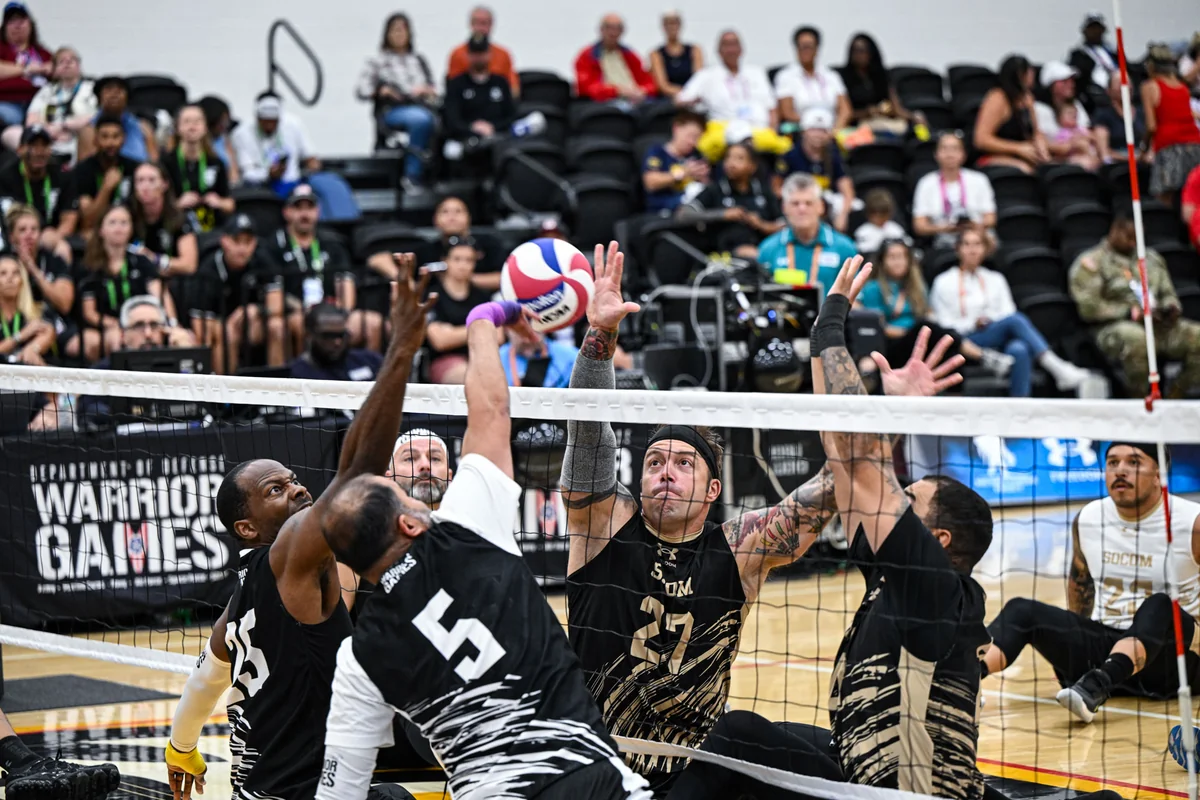
The official competition media also records Team Army defeating Team Special Operations Command in the final round of sitting volleyball. The accompanying photograph shows the two teams at the net on 26 July, with the actual Games banner and spectators visible behind them. Tech. Sgt. Marleah Miller made the photograph for the U.S. Air Force; its DVIDS record explicitly identifies the event, teams, date and Colorado Springs location.
Analysis: reading the outcomes fairly
Together, the SOCOM totals, Hayden’s award and the sitting volleyball result give a broader picture than any one podium story. Individual versatility and team competition rewarded different sporting abilities within the same nine-day programme. The results also show why adaptive multi-sport coverage needs precise labels: a team’s accumulated medals, an overall points award and a final-match victory describe three distinct achievements.
The next useful measure of the event’s legacy is continued access to appropriate sporting opportunities and the support structures described by the participating programmes. That is an editorial interpretation of the organisers’ stated purpose, rather than a clinical finding. The 2025 competition can be documented through its verified dates, scale and outcomes while leaving private medical experiences with the participants and avoiding unsupported comparisons between sporting success and recovery.
Original sources
Read the underlying records.
Explore the official results, organiser reports or original research behind this story.