
Persistent insomnia in athletes: why sleep hygiene may not be enough
Trouble sleeping despite enough opportunity deserves assessment. Learn what CBT-I offers, what athlete studies cannot prove and when to seek professional help.
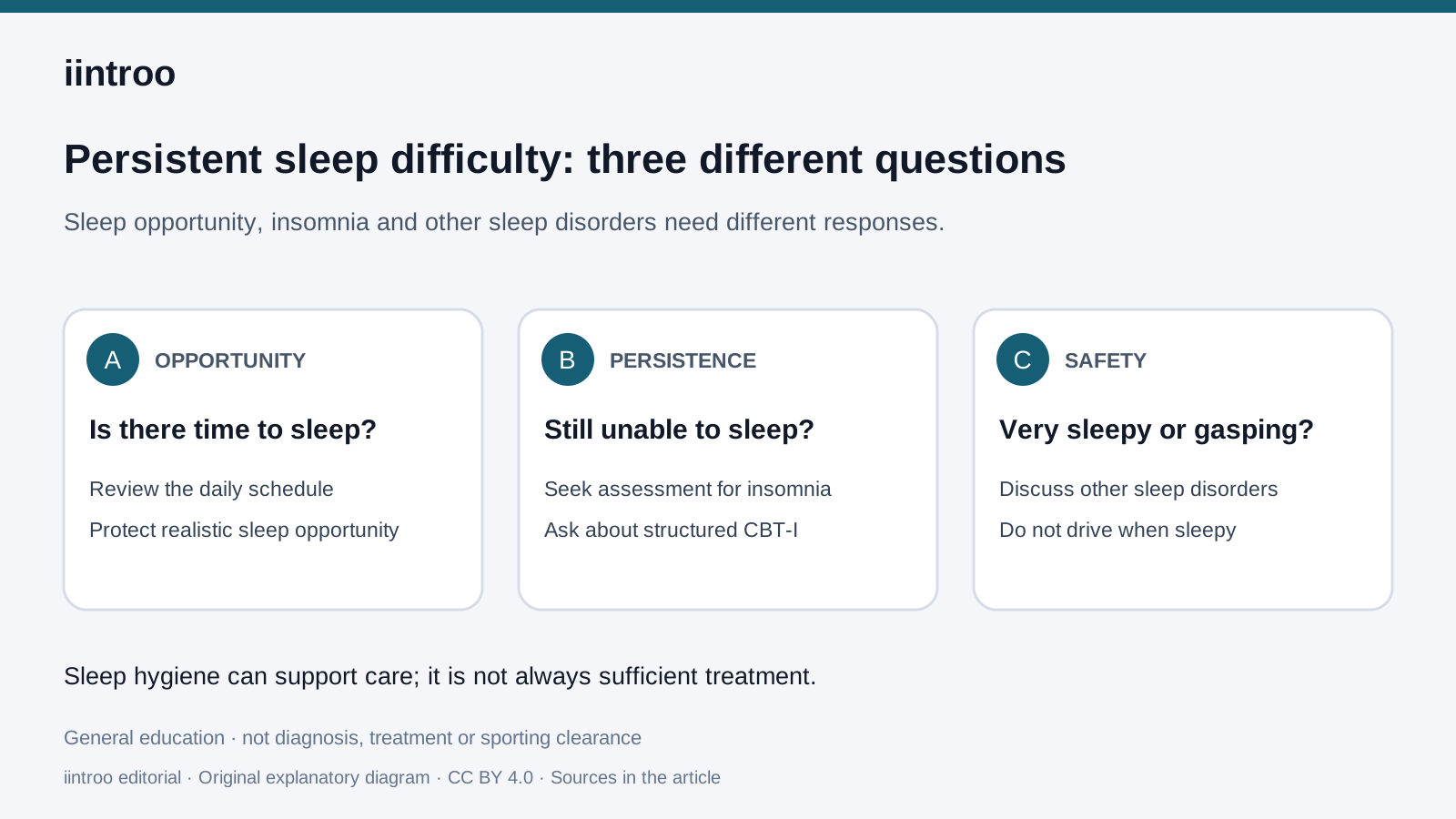
Key points
- Too little time available for sleep is not the same as insomnia.
- CBT-I is a first-line treatment for chronic adult insomnia.
- Sleep-hygiene advice alone is not an adequate treatment for every persistent problem.
First ask whether there is time to sleep
An early training session after a late shift can leave an athlete short of sleep even when falling asleep is easy. Persistent difficulty falling asleep, staying asleep or waking too early despite an adequate opportunity is a different problem. This guide is for adult athletes whose sleep difficulties are affecting everyday life, not for judging health from one restless night before a competition.
Look at the real schedule: work, family responsibilities, travel and training may crowd out sleep. A simple diary of sleep opportunity, perceived sleep and daytime functioning can support a clinical conversation. A wearable score does not establish insomnia or identify its cause. Nor does a good score invalidate a person's ongoing symptoms.
Why another checklist may not solve it
A comfortable environment and helpful habits can support sleep, but persistent insomnia may need more than advice about screens or caffeine. The AASM behavioural guideline strongly recommends multicomponent cognitive behavioural therapy for insomnia, usually abbreviated CBT-I. It conditionally recommends against using sleep hygiene alone as the treatment for chronic adult insomnia.
CBT-I works on sleep-related behaviours and thoughts through a structured therapeutic approach. It is not simply being told to relax or try harder. The European guideline also recommends it as first-line adult treatment, delivered in person or through appropriate digital programmes. A generic wellness app should not be assumed to provide the same intervention.
What the evidence does and does not establish
The 2021 AASM guideline identified 66 CBT-I randomized trials, with 49 contributing to at least one critical-outcome meta-analysis. The overall certainty was moderate, with imprecision an important limitation. These results support improvement in insomnia-related outcomes; they do not promise that treatment will make an athlete faster or guarantee a particular competition result.
Sport-specific work is more limited. A small pilot offered telephone-based brief behavioural treatment to 40 former NFL players and reported improvements in self-reported sleep. It had no control group, involved retired players and did not measure sporting performance. Brief behavioural treatment is not identical to full CBT-I. The study suggests feasibility in that setting, not proof of a universal athlete treatment effect.
Medication is a clinical decision, not a shortcut or taboo
The AASM's April 2026 combination-treatment guideline adds nuance. It conditionally favours CBT-I plus medication over medication alone, but does not recommend routinely preferring that combination over CBT-I alone. The certainty for these comparisons was low, and much of the evidence concerned short-term outcomes.
This does not mean every athlete should take a sleeping medicine, or that prescribed medication should be stopped abruptly. Discuss the benefits, adverse effects, other medicines and the practical demands of training with the prescriber. A treatment choice depends on the person and the reason for the sleep problem, not a team-wide rule.
Sources: 3
Seek help before safety is compromised
Arrange assessment when symptoms persist, habit changes do not help or coping and daily life are affected. Bring information about pain, mood, caffeine, alcohol, medicines and the training calendar. Loud snoring, interrupted breathing or substantial daytime sleepiness may point to another sleep disorder that deserves investigation.
Do not drive when sleepy. Activities where a lapse could cause a fall, collision or water emergency also need a safety discussion. Some behavioural treatment components can initially increase sleepiness and require clinician oversight; this article deliberately gives no do-it-yourself time-in-bed restriction schedule. Ask about qualified CBT-I support and how care can fit sport without allowing performance pressure to delay assessment. This is general education, not a diagnosis or individual sleep prescription.