
Cricket helmets: check the standard, fit and impact history
A compliant, correctly fitted helmet can reduce impact force, but it cannot make a head strike harmless or rule out concussion. Replace severely impacted components and assess the player.
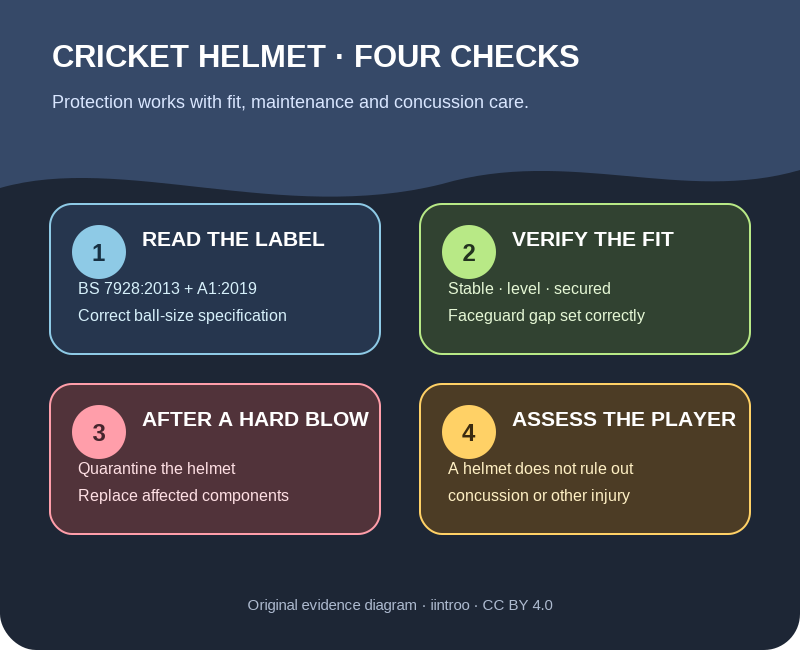
Key points
- For international cricket, a chosen batting helmet must comply with BS 7928:2013 plus the 2019 amendment under ICC equipment rules.
- A severe blow can damage a helmet component even when damage is not visible; the ICC advises replacement of the affected component.
- A helmet reduces some impact forces but does not prevent every head, face or neck injury and never clears a player after a head strike.
Choose a tested product for the player and ball
This guide is for cricket players, parents, coaches, clubs and equipment staff. The ICC says a player who elects to wear a helmet while batting in international cricket must use one compliant with BS 7928:2013; the A1:2019 amendment adds neck-protector specifications. Domestic and youth competitions may have additional rules, so check the current governing body requirements before play.
Read the permanent label rather than relying on marketing or appearance. The ICC list distinguishes testing with the men's and junior ball sizes. Because the standard women's ball sits between them, the ICC recommends a helmet tested against both sizes or at least the junior ball. A second-hand shell without a readable standard, size or history is difficult to verify.
Sources: 1
Fit includes stability, coverage and the faceguard gap
Use the manufacturer's fitting instructions and the correct size. The helmet should sit level, remain stable with the retention system secured and allow normal vision and movement. The faceguard position matters: an incorrect gap may allow a ball through or let the guard contact the face under impact.
Do not drill, bend, pad or combine components outside the manufacturer's instructions. Hair, head coverings and growth can change fit, so recheck at the start of a season and after equipment changes. For a junior player, an adult should verify the setup without assuming that a helmet can simply be bought large for future growth.
Sources: 1
A hard strike triggers two separate checks
First, assess the player. The ICC's June 2025 concussion guidance says a significant head knock with loss of consciousness, seizure, unsteadiness, blank stare or inability to return immediately demands medical assistance. A less dramatic helmet strike also requires assessment when concerning signs appear. Remove the player from exposure and follow the local emergency and concussion pathway.
Second, quarantine the equipment. The ICC explains that a head protector may absorb impact energy by sustaining structural damage and that a component receiving a severe blow needs replacement even when damage is not apparent. Record the event, follow the manufacturer's replacement advice and do not hand the helmet straight to another player.
Do not turn protective equipment into concussion clearance
A helmet can reduce some force to the skull, face or neck, but it cannot guarantee prevention of concussion, death or long-term disability. Sport-wide randomised evidence on padded headgear does not support a simple claim that headgear prevents all sport-related concussion, and it is not a direct test of every cricket helmet design.
A cricket cohort found associations between patterns of helmet use and self-reported concussion, but its cross-sectional design cannot prove that a helmet caused or prevented concussion. Exposure, playing standard, position, recall and risk-taking can confound the result. The safe inference is to use compliant protection while keeping recognition, removal and medical assessment fully active.
Keep an equipment record, not just a kit bag
The 2022 cricket systematic review identified 29 studies and found that ball impact was the most commonly reported mechanism of head, neck and facial injury. Helmet use at the time of injury was poorly reported, limiting precise effectiveness estimates. Clubs can improve practice by recording model, size, standard, purchase date, owner and significant impacts.
Before nets or a match, inspect the shell, liner, fasteners, faceguard and retention system and confirm that the helmet is the player's verified fit. This check complements safe bowling, net and supervision systems; it does not shift all responsibility to the player or promise that a compliant helmet removes risk.