
Freediving blackout safety: a buddy must be close enough to act
Hypoxic loss of motor control or consciousness can occur near the surface. Active buddy supervision, trained rescue and medical follow-up are essential.
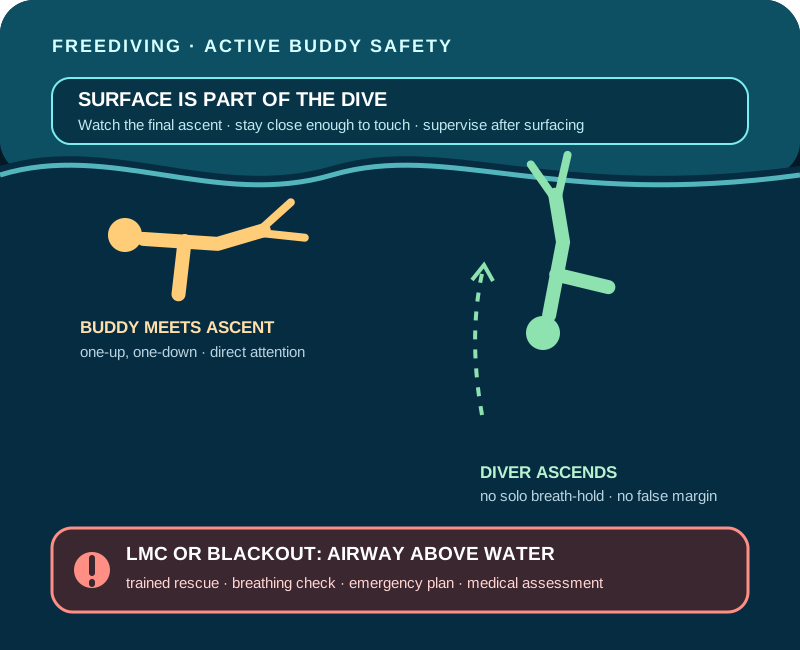
Key points
- Hypoxia during breath-hold diving can cause loss of motor control or consciousness with little warning, including at or just after the surface.
- Never practise breath-holding alone or unattended in a pool, bath or open water; a trained buddy must actively supervise and be positioned to intervene immediately.
- Blackout, breathing difficulty, chest symptoms, confusion, weakness or other neurological signs require removal from diving and urgent medical assessment under the local emergency plan.
The surface is part of the dive
This guide is for recreational and competitive freedivers, buddies, instructors, pool operators and event teams. During a breath-hold, oxygen falls while the urge to breathe does not provide a precise countdown to safety. Hypoxia can impair judgement, coordination and consciousness. Loss of motor control may appear as involuntary movement or inability to complete a recovery sequence; blackout means loss of consciousness. Neither should be normalised as a successful limit test.
A study covering 988 competitions and 38,789 starts documented discipline-specific rates of loss of consciousness and peripheral muscle fatigue, with higher blackout rates in some no-fin disciplines. Competition safety systems and selected athletes limit how far those figures can be applied to recreational dives. They still show why reaching the surface is not the end of supervision: deterioration can occur in the final ascent or immediately after surfacing.
A buddy watches, meets and can reach
Never perform static or dynamic breath-holds alone, including in a bath or apparently shallow pool. In depth diving, use the recognised one-up, one-down system, agreed dive plan, appropriate line and lanyard where required, and a safety diver who meets the ascending diver at the planned depth. The buddy needs direct attention on the diver, not a phone, another lane or their own simultaneous breath-hold.
Before entering the water, agree on the maximum depth or distance, turn time, communication, where the safety diver will meet the ascent and how help will be summoned. Confirm that each buddy is trained for the discipline and can manage loss of motor control, blackout and airway support. A person on the beach, a lifeguard who has not accepted the role or a partner too far away to touch the diver is not active close supervision.
Do not manufacture a false safety margin
Deliberate hyperventilation before a breath-hold can lower carbon dioxide and delay the urge to breathe without adding a dependable oxygen reserve. It can therefore remove a warning while hypoxia progresses. Do not use repeated deep or rapid breathing, breath-hold contests, aggressive packing or online tables as a shortcut to a longer performance. Training choices should come from a qualified freediving instructor within a supervised progression.
Depth, cold, current, exertion, stress, illness and repeated dives change the physiological demand. Equalising difficulty, chest discomfort or unusual fatigue is a reason to abort, not something to push through for a number. CMAS medical-risk material also addresses pulmonary and neurological complications beyond simple blackout. A device, lanyard or surface float can support a system but cannot replace the alert human who performs the rescue.
Rescue starts with the airway above water
If a diver loses motor control, the safety person supports them and protects the airway while following the trained rescue protocol. For blackout, bring and keep the mouth and nose clear of the water, remove facial equipment as trained, stimulate and assess breathing, and call for the event or local emergency response. If the person is not breathing normally, begin the resuscitation sequence taught by an accredited provider and use available oxygen or an AED only within training and local protocols.
Do not continue the session after an apparent quick recovery. Aspiration, pulmonary symptoms or neurological problems may become evident later. Record the dive profile, estimated time, observed signs and care given for medical handover. Rescue practice should happen in controlled training with a qualified instructor; this article is not a substitute for in-water rescue, CPR, oxygen-provider or emergency-action training.
Blackout ends the dive and starts evaluation
Any blackout or loss of motor control warrants removal from diving that day and appropriate medical assessment. Emergency evaluation is especially important for persistent cough, breathlessness, chest pain, pink or blood-stained sputum, severe headache, confusion, weakness, loss of coordination, visual change or symptoms after repetitive deep dives. These signs can reflect aspiration, pulmonary barotrauma or oedema, decompression illness or another urgent condition.
Return depends on what happened, complete recovery and assessment by a clinician familiar with diving medicine when indicated. The systematic review of decompression illness in breath-hold diving found only 17 articles and 44 incidents, so rare-event mechanisms and risk estimates remain uncertain. That uncertainty is a reason for conservative referral, not for self-diagnosis. Follow current federation rules and the venue emergency plan for every session.