
Handball ACL prevention: train the landing and cut before the season tests them
Handball ACL risk cannot be erased, but a well-coached neuromuscular warm-up, progressive exposure and criteria-based return can reduce avoidable risk.
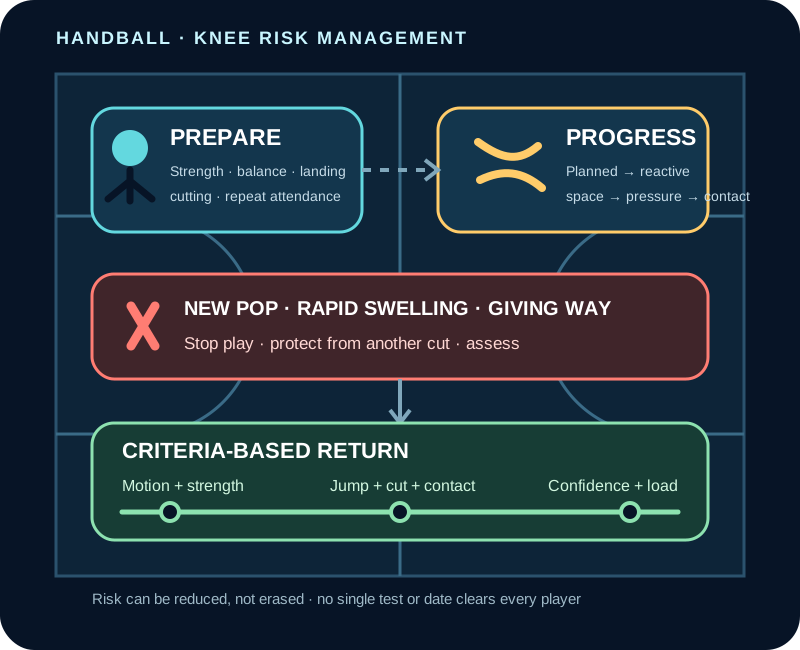
Key points
- Multicomponent programmes that combine strength, balance, landing, cutting and sport-specific movement can reduce lower-limb and ACL injury risk, but they do not make a player injury-proof.
- Programme quality and regular participation matter; the handball evidence includes heterogeneous designs and remains thinner for male, elite and Para players.
- A new knee pop, rapid swelling, giving way, inability to continue or loss of motion means stop play and obtain assessment; return is a shared, criteria-based decision rather than a fixed date.
Handball asks the knee to solve several problems at once
This guide is for handball players, coaches, families and health teams. A defender, a late pass or a crowded landing can change the movement that was planned in the air. The player may have to decelerate, rotate and produce the next action in a fraction of a second. ACL injury is not caused by one bad technique, and contact, fatigue, playing surface, previous injury and exposure all contribute to the risk picture.
A 2026 meta-analysis across sports found particularly high ACL incidence in female semiprofessional handball, but the available estimates varied by level, sex, surveillance and exposure definition. That ranking should guide prevention attention rather than label every female player as fragile. Individual risk cannot be calculated from a group rate, and large evidence gaps remain for male, youth, recreational and Para handball.
Use a multicomponent warm-up, not an isolated drill
The handball-specific systematic review found that exercise programmes can reduce lower-limb, knee, ACL, ankle and shoulder injuries. Effective programmes commonly combine movement control, strength, balance, landing, change of direction and sport-specific tasks. The EHF manual similarly brings strength, technique, balance, training-load monitoring and warm-up work together. A single balance drill, resistance band or landing cue is not the intervention tested in a complete programme.
Older prospective work in female handball reported fewer ACL injuries after a structured programme, while the broader 2026 ESSA statement supports neuromuscular warm-ups, especially for young female athletes. Neither source proves that one routine works for every team. Trials differ in quality, exposure and adherence, and evidence is less certain in males and elite populations. Prevention reduces probability; it cannot promise that an ACL tear will not occur.
Coach quality, progression and attendance
Place prevention work where it will be repeated: within the normal warm-up two or more times a week across pre-season and competition, with enough time for coaching feedback. Progress from controlled double- and single-leg landings to planned deceleration, reactive cutting, opponent pressure and handball-specific ball tasks. Strength and plyometric difficulty should match the player's age, training history and current capacity.
Coaches can watch for a stable trunk, controlled knee and hip motion, quiet balance recovery and a plant position that lets the player redirect without collapsing. These are coaching targets, not a visual ACL screening test. Record completion and the reason for missed sessions; a theoretically strong programme that players rarely perform will have little effect. Sudden spikes in match, jump or high-speed exposure also deserve attention alongside movement work.
A suspected ACL injury leaves the court
After a twist, collision or awkward landing, stop participation for a pop or tearing sensation, rapid swelling, giving way, marked loss of motion, inability to bear weight or inability to continue. Protect the athlete from another uncontrolled cut and use the event medical plan. Serious fracture, dislocation, loss of circulation or sensation, or other emergency signs require urgent care. Do not ask the player to prove the knee by sprinting or jumping again.
A pitch-side impression is not a final diagnosis. A qualified clinician integrates the mechanism, examination and, when indicated, imaging while considering meniscus, cartilage, collateral-ligament and bone injury. Swelling can evolve after the match, so clear follow-up instructions matter even when the player walks away. This article cannot diagnose an ACL tear or determine whether surgery or non-operative care is appropriate.
Return is a process, not one clearance test
Rehabilitation rebuilds knee motion, strength, power and confidence before increasingly demanding running, jumping, deceleration, cutting, contact and handball practice. A return decision should combine tissue and symptom status, objective strength and movement measures, sport-specific function, psychological readiness, the athlete's role and the next-day response to load. No single hop test, limb-symmetry number or elapsed month can answer all of those questions.
The athlete, clinician and coaching team should agree on staged exposure and what will trigger a pause or reassessment. Completing a non-contact drill is not the same as tolerating chaotic defence or repeated match landings. Continue prevention work after return because restored participation does not erase reinjury risk. The final decision is individual and shared; this guide is not a personal rehabilitation prescription or clearance.