
Handball goalkeeper’s elbow: repeated saves can become repeated hyperextension
Handball goalkeepers can develop medial elbow pain after repeated ball impacts and hyperextension. Learn what to report, assess and rebuild before returning.
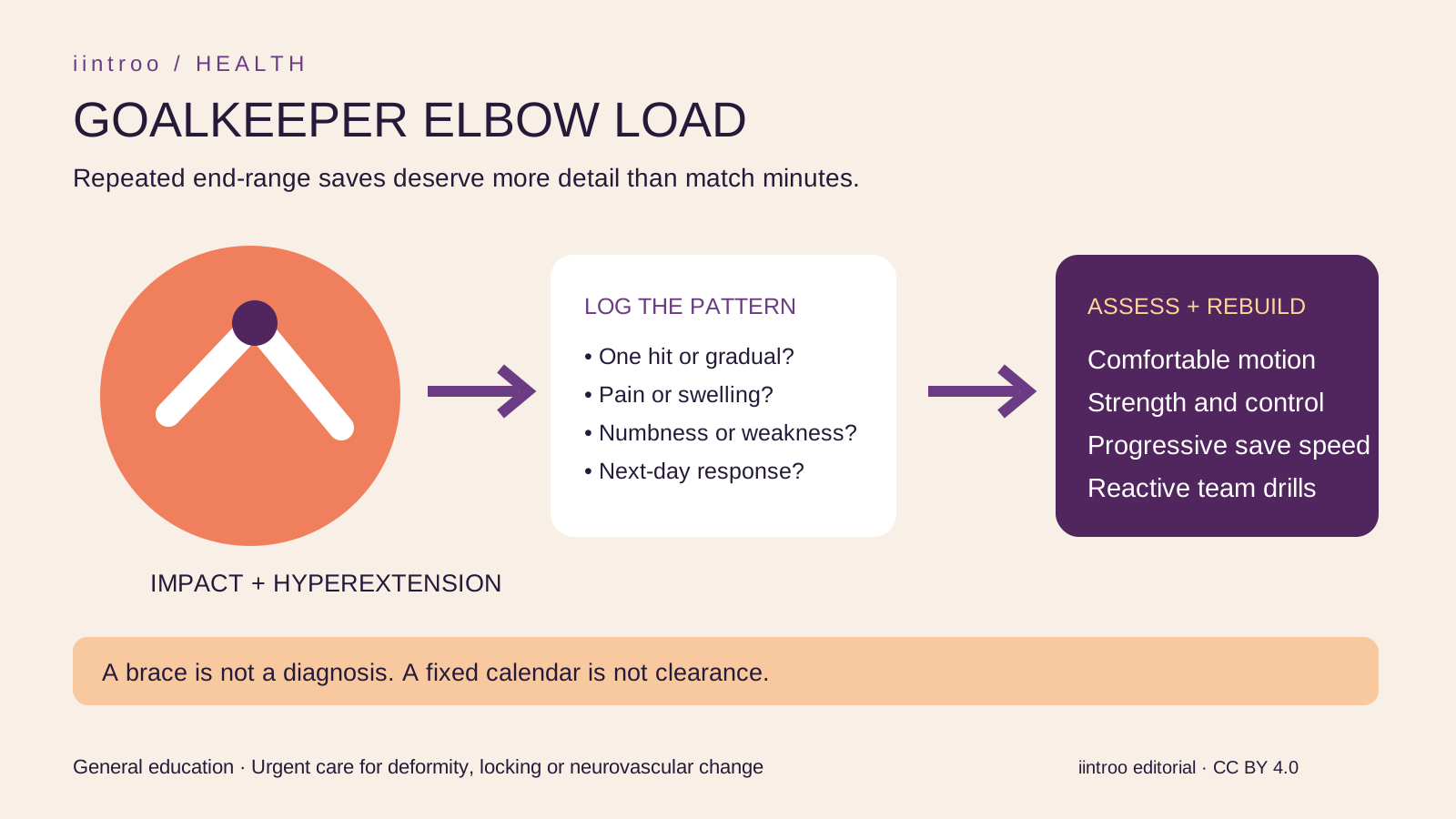
Key points
- Repeated hyperextension is a recognised mechanism, but elbow pain has other causes.
- Older imaging studies show associations, not a diagnosis from pain alone.
- Return should restore function and save exposure progressively, not follow a fixed date.
Why goalkeepers have a distinctive elbow problem
A goalkeeper often meets a fast ball with the arm extended. The ball can push the forearm backwards while the elbow is near its end range, producing repeated hyperextension rather than one obvious traumatic event. Classic studies called the resulting pattern ‘handball goalie's elbow’. They reported frequent pain among goalkeepers and linked symptoms and radiographic changes with repeated hyperextension, but those studies were small and are now more than two decades old.
Medial or posterior elbow pain in a goalkeeper should therefore prompt a proper history, not an automatic label. A single collision, dislocation, fracture, tendon injury, nerve irritation or another overuse problem can feel similar. Note whether pain followed one save or accumulated, where it is located, whether the elbow swelled or locked and whether there is tingling, weakness or reduced throwing and saving confidence.
Know which signs need prompt assessment
Stop the session and seek urgent assessment after a forceful event if the elbow looks deformed, cannot move normally, rapidly swells, feels unstable, or the hand becomes pale, cold, numb or weak. A locked joint, an audible crack with marked pain, or persistent neurological symptoms also deserve prompt care. Do not repeatedly force the elbow straight to ‘test’ it.
Gradually developing pain still deserves assessment when it persists, worsens, affects sleep, changes technique or requires regular pain medicine to keep playing. A clinician can examine the joint, ligaments, tendons and nerves and decide whether imaging is useful. X-rays may identify bone changes or an acute injury; they do not by themselves prove the source of pain or determine a return date.
Count goalkeeper exposure, not only match minutes
Goalkeeper load includes warm-up shots, high-velocity drills, repeated end-range saves, strength work, matches and tournaments with short recovery. A diary can record pain location, symptoms during and after training, next-day response, number and type of save exposures, throwing load and recent changes in schedule. This does not diagnose tissue damage, but it gives the clinical and coaching team a clearer pattern than total minutes alone.
A 2025 prospective cohort of elite male handball players found that injury patterns differed by playing position, while broader reviews show substantial heterogeneity in how handball injuries are defined and measured. Goalkeeper findings should not be generalised to every age, sex or level. Sudden spikes, fatigue, previous elbow injury and technique may matter, but current evidence cannot calculate a universal safe number of saves.
Rehabilitation should match the problem found
Management depends on the diagnosis and irritability. It may involve temporarily modifying painful end-range exposure, restoring comfortable motion and progressively rebuilding strength, control and sport-specific tolerance. A brace or tape can change sensation or end range for some athletes, but should not be presented as a proven cure or permission to ignore pain. Exercises copied from another goalkeeper may target the wrong structure.
Prevention evidence in handball is stronger for multicomponent programmes addressing common lower-limb and shoulder risks than for one specific goalie-elbow protocol. The EHF prevention manual supports organised warm-up, strength and load-management principles, but it does not establish one elbow routine that works for every goalkeeper. Technique review should be supportive, not a suggestion that an injured athlete caused the problem.
Return through progressive save demands
Return planning can move from daily tasks and comfortable range to strength and control, then controlled low-velocity ball contacts, varied save positions, higher speed and reactive team drills. Pain during the drill is only one measure; swelling, loss of motion, neurological symptoms and next-day response matter too. Competition adds unpredictability, fatigue and the inability to choose every impact angle.
The athlete, clinician and coach should agree what will be monitored and what triggers a step back or reassessment. Youth growth, previous instability and an acute traumatic injury may change the pathway. Persistent pain or recurrent hyperextension deserves renewed evaluation. This guide provides general education, not a diagnosis, rehabilitation prescription or individual clearance for goalkeeping.