
Hyperbaric oxygen for sports recovery: pressure is not proof of faster healing
Hyperbaric oxygen studies report selected recovery signals, but protocols and outcomes vary. Sports recovery is not a substitute for an accepted medical indication.
Key points
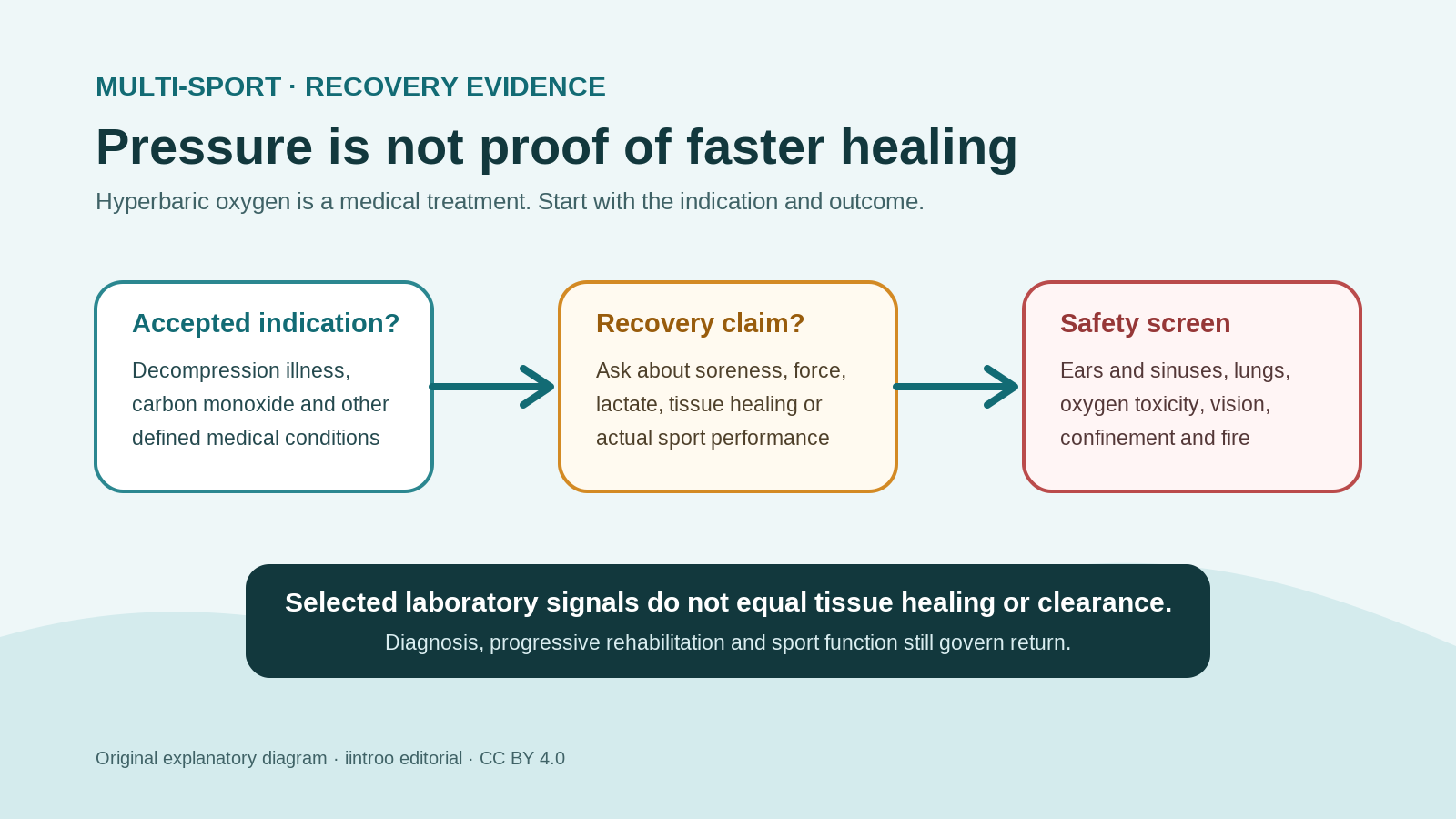
- Hyperbaric oxygen is a medical treatment delivered under pressure; a pressurised wellness session is not automatically the same protocol studied in a clinical chamber.
- Recent reviews report selected biochemical or muscle-function signals, but soreness, performance and injury-healing outcomes are inconsistent and protocols vary.
- Ear and sinus barotrauma, oxygen toxicity, temporary vision change, confinement anxiety and fire are relevant risks requiring trained medical oversight.
Define the treatment before discussing recovery
This guide is for adult athletes, coaches and medical teams considering hyperbaric oxygen for post-training recovery or a sports injury. Medical HBOT involves breathing high-concentration oxygen in a chamber at increased atmospheric pressure. Pressure, oxygen fraction, session duration, number of sessions and clinical supervision matter. Results from a medical chamber cannot be assigned to every low-pressure wellness pod, oxygen bar or product that uses the word hyperbaric.
The Undersea and Hyperbaric Medical Society lists accepted medical indications such as decompression sickness, carbon-monoxide poisoning and selected difficult wounds. Routine athletic recovery and ordinary sports injury are not interchangeable with those indications. An athlete who genuinely needs HBOT for an accepted condition should receive medical care for that condition; the existence of established uses does not validate a separate marketing promise about faster training recovery.
Read pooled signals outcome by outcome
A 2025 review included ten reports and 299 participants in exercise-induced muscle-damage models. It reported a pooled signal for recovery of selected muscle-injury measurements but no improvement in muscle soreness. A 2026 athletic-recovery review included eleven studies and meta-analysed six; it found lower post-recovery blood lactate on average, while applications to short-term power and force were limited. Lactate clearance is a physiological measurement, not proof that damaged tissue healed faster or that the next performance improved.
The studies used different exercise models, pressure and oxygen protocols, timing and outcomes. Samples were generally small and often involved healthy young adults rather than injured elite athletes, women across the life course, Para athletes or older competitors. A narrative review from the hyperbaric-medicine field likewise describes limited evidence and regulatory concerns. The most defensible conclusion is uncertainty by outcome—not a universal verdict that HBOT works or never works.
Do not turn a chamber session into return-to-play clearance
Soreness after unfamiliar exercise, a diagnosed muscle tear, concussion, bone stress injury and a surgical wound are different clinical questions. A biomarker change after induced soreness cannot be used to clear an injured athlete. Return decisions still require diagnosis, progressive loading, sport-specific function, symptom response and the treating team's judgement. HBOT should not delay imaging, wound care, rehabilitation or urgent assessment when those are indicated.
Persistent focal pain, major swelling, weakness, loss of function, neurological symptoms, chest symptoms or an injury that is worsening deserves qualified evaluation. Clinics should state the exact indication, protocol, expected outcome, alternatives, cost and uncertainty. Teams should also ask whether sleep, nutrition, ordinary load planning and evidence-based rehabilitation are being neglected for an expensive technology. This page does not prescribe chamber pressure, oxygen dose, session number or return timing.
Treat chamber safety as medical safety
Pressurisation can cause ear or sinus pain and barotrauma; oxygen exposure can rarely provoke seizures or lung effects; temporary vision change and confinement anxiety can occur. Untreated pneumothorax and several medical or medication contexts require particular assessment. High oxygen concentration also creates a serious fire hazard. The FDA has reminded facilities to follow device instructions, maintenance schedules and fire-prevention controls after reports of serious incidents.
Use a properly regulated facility with appropriately trained staff who can screen contraindications, manage pressure equalisation and respond to complications. An athlete should disclose respiratory disease, recent ear or sinus problems, pregnancy, medicines and prior chamber difficulty to the treating professional. Stop and alert staff for ear pain, breathing difficulty, vision change, twitching, unusual neurological symptoms or distress. A waiver, wellness label or professional-athlete testimonial does not replace these safeguards.