
Hypertrophic cardiomyopathy in athletes: replace blanket bans with expert shared decisions
HCM needs diagnosis, symptom and sudden-risk assessment, then an annually revisited sport plan—not automatic exclusion or automatic clearance.
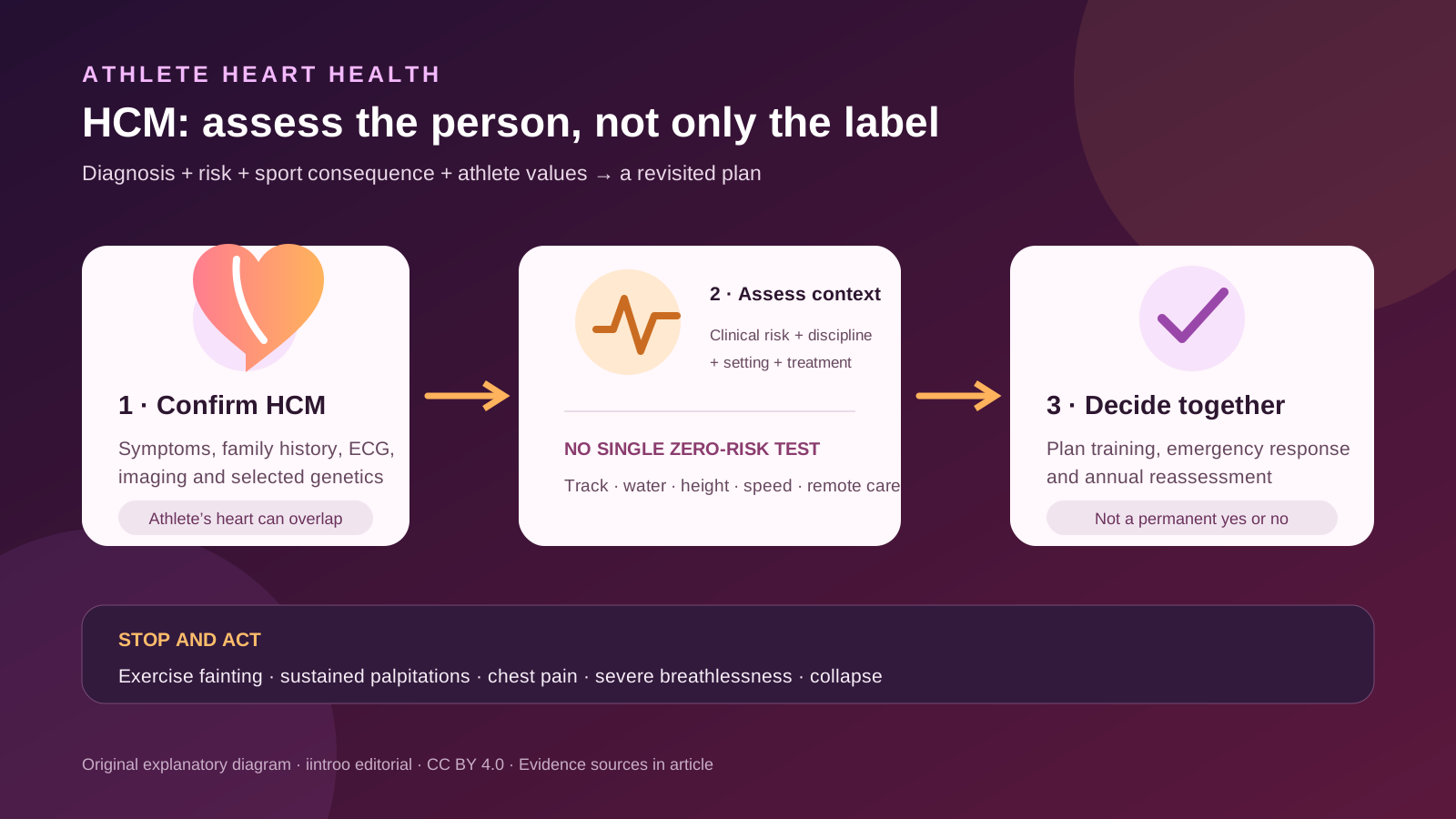
Key points
- Athletic heart adaptation and hypertrophic cardiomyopathy can overlap, so wall thickness alone should not be used to diagnose or clear an athlete.
- The 2024 multisociety guideline supports beneficial mild-to-moderate exercise and expert shared decisions for higher-intensity or competitive sport rather than universal restriction.
- A sport decision must be revisited as symptoms, heart findings, treatment, age and exposure change; an emergency action plan and AED access reduce consequences but do not make risk zero.
Confirm the diagnosis instead of treating wall thickness as an answer
This guide is for athletes, families, coaches and health teams after suspected or confirmed hypertrophic cardiomyopathy, or HCM. Training can enlarge the heart and increase ventricular wall thickness, while HCM can arise from inherited disease and show different patterns across age, sex and genetic background. A screening ECG, echocardiogram or family history can raise the question, but no single measurement separates every athletic adaptation from disease. Diagnosis belongs with clinicians experienced in cardiomyopathy and sports cardiology.
Assessment can combine symptoms, three-generation family history, examination, ECG, echocardiography and ambulatory rhythm monitoring. Cardiovascular magnetic resonance, exercise testing and genetic counselling or testing may answer selected questions. Genetic results require careful interpretation: a pathogenic variant with no expressed phenotype is not the same as established disease, while a negative panel does not erase a convincing phenotype. Exercise fainting, sustained palpitations, chest pain, severe breathlessness or collapse requires prompt medical evaluation; unresponsive abnormal breathing should activate the venue cardiac-arrest plan, CPR and AED rather than a diagnostic debate.
Build risk assessment around the person and the sport
HCM risk is not defined by the name alone. Clinicians review prior cardiac arrest or sustained ventricular arrhythmia, unexplained syncope, family history, ventricular thickness and function, apical aneurysm, outflow obstruction, rhythm monitoring and imaging findings. The significance of each feature depends on the complete clinical context. A risk calculator can inform discussion but cannot predict an individual event with certainty, and a reassuring training session does not replace longitudinal assessment.
Sport consequence also matters. A brief loss of control has different implications in running on a track, solo open-water swimming, climbing, motorsport, collision sport or a remote expedition. Heat, dehydration, altitude, stimulants, illness and medication can change symptoms or arrhythmia exposure. The plan should describe the actual discipline, intensity, environment, access to rescue and athlete priorities instead of applying a generic list of permitted and forbidden sports.
Use shared decisions, not automatic exclusion or clearance
The 2024 AHA/ACC multisociety guideline states that mild-to-moderate recreational exercise is beneficial for people with HCM. It no longer supports universal restriction from vigorous activity or competitive sport. Competitive participation may be considered after a comprehensive evaluation and shared decision with an expert who explains possible benefits, uncertainties and the potential for serious events or appropriate implantable-cardioverter defibrillator shocks. The process should be repeated at least annually and sooner when symptoms or clinical findings change.
The prospective LIVE-HCM study did not find a higher rate of its composite serious cardiac outcome among participants reporting vigorous exercise than among those exercising moderately or less. It was observational, participants selected their activity and people with advanced limitations were excluded, so it cannot prove that every athlete or every sport is safe. An ICD should be implanted for a clinical indication, not solely to make competitive participation possible. Symptomatic obstruction and other guideline-directed treatment issues should be addressed before return.
Make emergency readiness and follow-up part of participation
For an athlete who participates, the plan should include symptom reporting, current medication, the response to palpitations or fainting, trained responders, a rehearsed emergency action plan and rapid AED access. Teammates and coaches need only the practical information the athlete has agreed to share. They should not interpret device data, pressure an athlete to conceal symptoms or assume that an AED prevents the event itself. A remote or aquatic venue may require additional rescue planning.
Young athletes need close reassessment because phenotype can evolve with growth; adults also require longitudinal review. Revisit decisions after syncope, new arrhythmia, reduced exercise tolerance, imaging change, treatment or device change, pregnancy, or a change in discipline or competition level. This page cannot diagnose HCM, calculate sudden-death risk, recommend an ICD or clear sport. It supports accurate diagnosis, individualized risk discussion, athlete autonomy, emergency preparation and continuing expert review rather than a one-time yes-or-no label.