
Lightweight rowing weigh-ins: choose the category before race week
A rowing weigh-in is an eligibility check, not a measure of health. Learn why late weight cuts and a short turnaround should not determine your race plan.
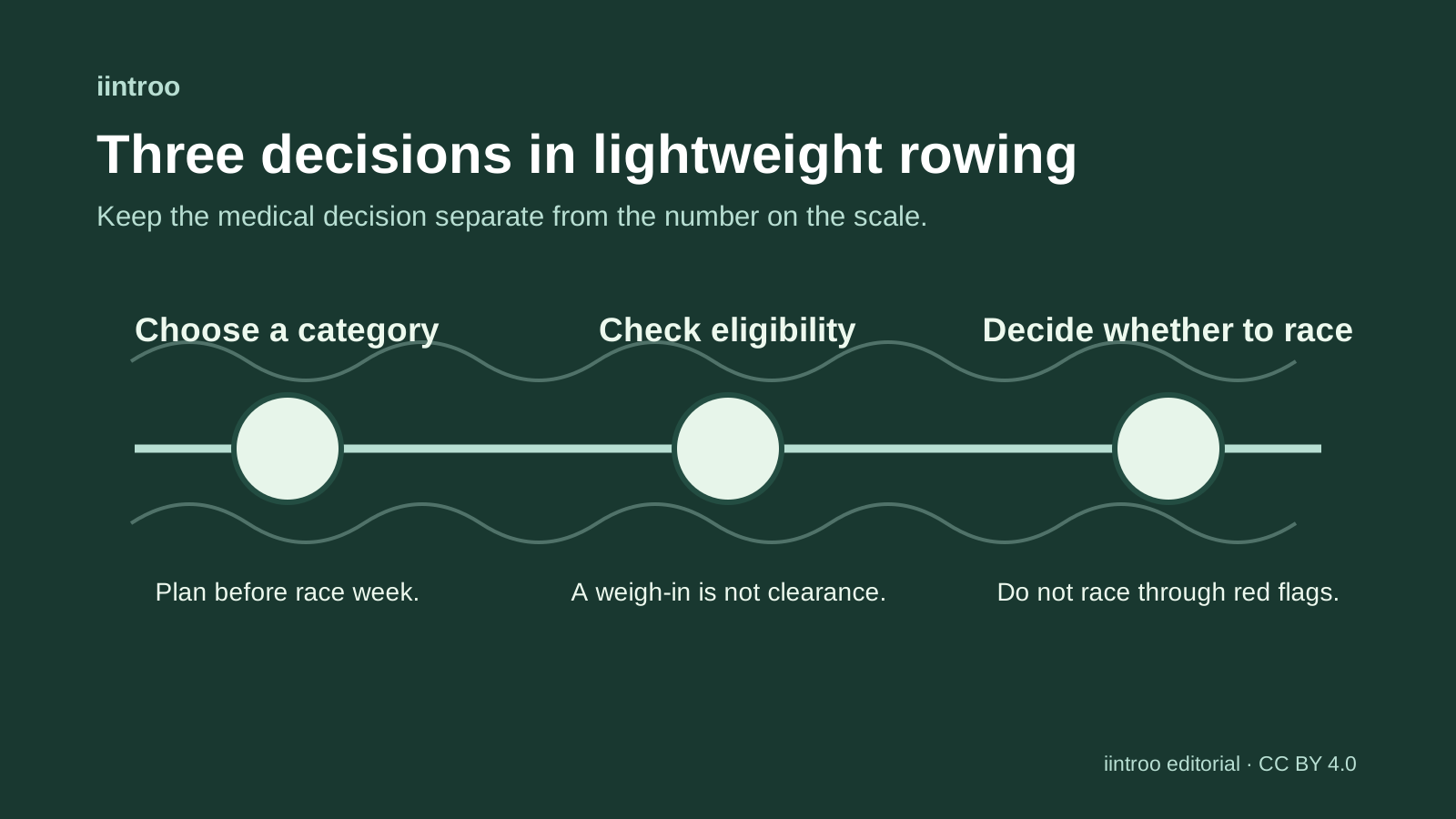
Key points
- Passing a weigh-in does not establish that an athlete is well fuelled, hydrated or fit to race.
- Small rowing studies measured performance under specific conditions, not whether repeated weight cuts are safe.
- If a category cannot be maintained without restriction or dehydration, discuss a different event or category with the athlete and support team.
Make the category decision while there are still choices
Lightweight rowing imposes a limit at a particular event; the scale cannot decide whether the athlete has enough energy to train, recover and race. This guide is for rowers, coaches and regatta support staff. Before committing to a boat, check the current rules for the specific organiser and event; do not apply a historical rule or another federation’s allowance. Discuss category suitability early with the athlete and a sports dietitian or sports-medicine clinician, particularly when training demands, weight history or access to food have changed.
The useful question is whether the athlete can stay well fuelled through ordinary rowing training and race in the chosen category without a last-minute cut. Give an athlete a genuine way to choose a different event without losing standing on the team. Keep body and health discussions private, avoid routine public weights or comments about appearance, and avoid treating eligibility as a performance target for younger rowers whose nutrition and growth need particular protection.
A small performance effect is not a safety finding
A 2006 on-water crossover study included 17 competitive rowers and examined rowing performance in a specific short recovery window after making weight. Its modest difference in finishing time is sometimes read as reassurance about the practice. But the study evaluated timed efforts under study conditions; it was not designed to detect acute medical complications, repeated-season effects, or risks in adolescents. A separate ergometer study found that acute weight loss and heat each impaired performance under its tested conditions. The different settings and endpoints are reasons to avoid generalising either result to a regatta.
The American College of Sports Medicine’s consensus on weight-category sports and the IOC’s consensus on relative energy deficiency in sport address broader health concerns than those time trials. Repeated restriction can compromise energy available for normal physiology after exercise. Tiredness, recurrent illness, bone stress injuries, menstrual changes or declining performance merit assessment; each is nonspecific, and a scale alone cannot diagnose the cause. This evidence supports early assessment and a change of category when needed, not a universal target mass, fluid replacement rule or weigh-in workaround.
Protect the plan when the schedule changes
Before travelling, confirm race and weigh-in times and locate ordinary food and drink options near the venue. Build in familiar meals, recovery between rounds, shade in hot conditions and access to the team’s clinician. If the timetable slips, protect these basics rather than delaying food and fluids to hit a number. Do not use heated rooms, deliberate dehydration, purging or unprescribed medicines to qualify. If qualification would require unsafe restriction, the safer choice is a different event or not racing.
Dizziness that persists, fainting, confusion, collapse, chest pain or severe weakness should be taken seriously. Stop the session or race preparation and obtain medical assessment or emergency help as appropriate; do not send the athlete onto the water to see how they cope. Persistent restriction, fear around food or recurrent injuries warrant confidential professional support. This guide does not authorise a weight cut, prescribe a nutritional plan or clear any athlete to race.