
Plantar plate injury in running and dance: protect toe stability before speed
Pain beneath the second toe can reflect plantar-plate injury. Early stability assessment, load modification and staged forefoot work may limit progression.
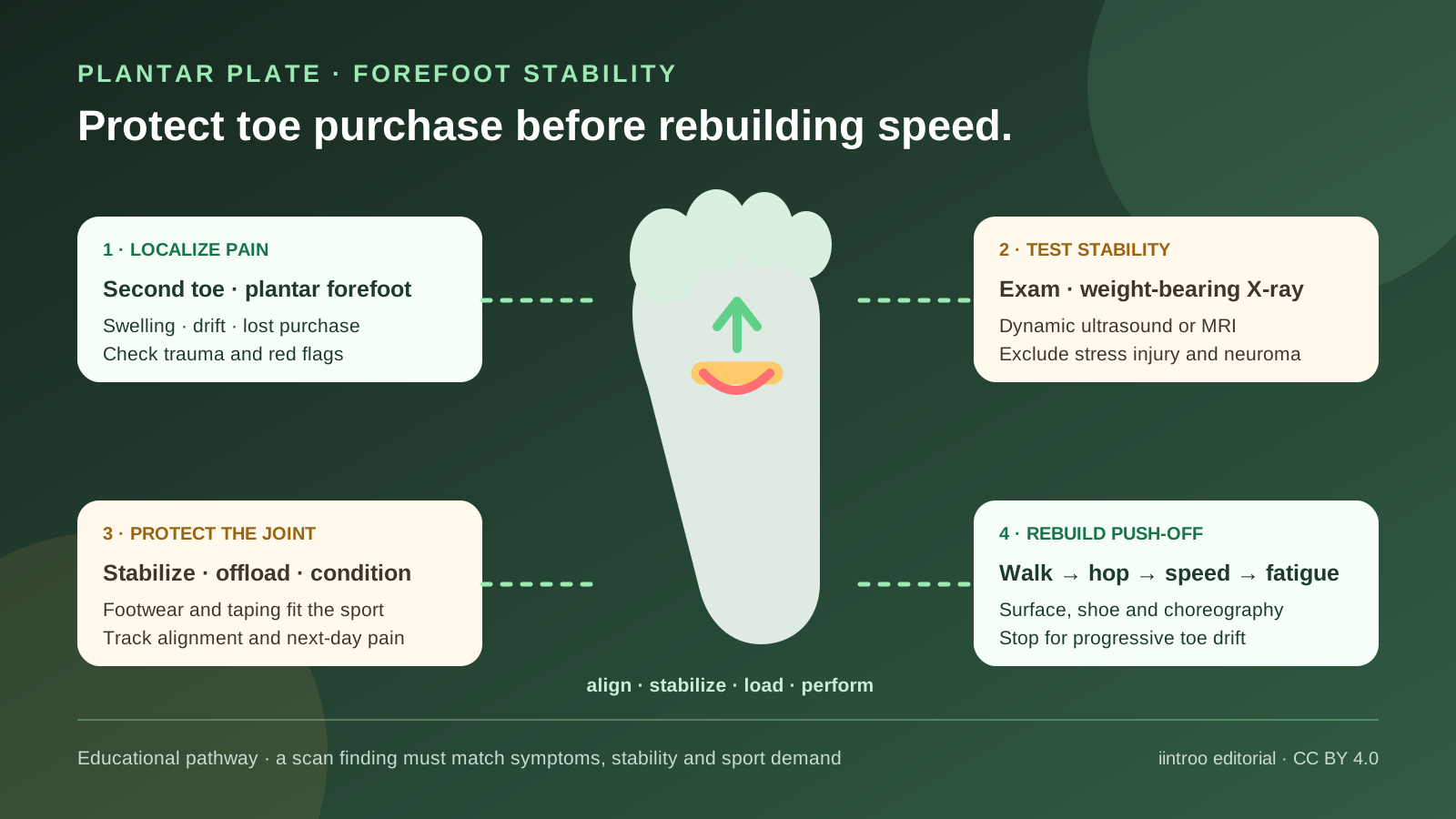
Key points
- The lesser-toe plantar plate stabilizes the metatarsophalangeal joint; repetitive forefoot loading or acute hyperextension can produce pain and progressive instability.
- Clinical examination, weight-bearing radiographs and targeted ultrasound or MRI answer different questions and should be interpreted together.
- Return should restore toe purchase and tolerate walking, hopping, acceleration and sport-specific forefoot load without increasing pain or deformity.
Look beyond generic metatarsalgia
The plantar plate is a strong fibrocartilaginous structure beneath each lesser metatarsophalangeal joint, most commonly symptomatic under the second toe. It helps resist upward drift of the toe and distributes forefoot load during push-off. Runners, dancers, gymnasts and court-sport athletes may develop gradual pain from repeated forefoot loading or an acute episode after toe hyperextension. Early symptoms can feel like a pebble, bruise or burning under the joint and may be confused with a stress injury, neuroma, synovitis or shoe pressure.
Assessment should note focal plantar tenderness, swelling, bruising, toe alignment, loss of toe purchase and instability on a drawer-type test. A widening gap or crossover deformity suggests progression, but a normal-looking toe does not exclude an early tear. Inability to bear weight, marked deformity, extensive bruising, numbness, a wound or pain after significant trauma warrants prompt evaluation. Athletes should not repeatedly provoke the joint to decide whether it is serious; that adds load without resolving the differential diagnosis.
Combine examination with the right imaging question
Weight-bearing radiographs assess alignment and help exclude fracture, Freiberg disease, arthritis or other bony causes, although they do not directly show the plantar plate. Dynamic high-resolution ultrasound can examine the plate in motion and is accessible, but accuracy depends on technique and operator experience. MRI offers detailed anatomy and greater specificity for some tears, yet subtle lesions can still be missed. The 2025 diagnostic review therefore supports a multimodal approach rather than treating one scan as the diagnosis.
The clinician must also separate lesser-toe plantar-plate injury from turf toe, which affects the first metatarsophalangeal complex. The mechanism, painful location, sesamoids, joint stability and sport demands differ. Imaging findings should be matched to the athlete's symptoms and examination; asymptomatic irregularity does not automatically require treatment. Evidence is mostly from diagnostic studies, narrative reviews and case series, with limited athlete-specific prospective research and no universally accepted return test battery.
Stabilize and offload without deconditioning the athlete
Early conservative care aims to reduce painful forefoot loading and limit upward drift while the tissue settles. Depending on severity, clinicians may use a stiff-soled or rocker shoe, taping or strapping, a boot for a short protected phase and a correctly positioned metatarsal pad. Offloading can relieve plantar pressure, but it does not by itself stabilize the joint; crossover taping is intended to resist hyperdorsiflexion. Shoe changes must suit the sport and should not create new pressure, balance or skin problems.
Training can shift temporarily toward low-impact conditioning that does not reproduce forefoot pain, while rehabilitation maintains ankle, calf, hip and trunk capacity. Progress to calf raises, short-foot control, toe purchase and single-leg loading is guided by symptoms and alignment. Steroid injections may reduce inflammation but can further attenuate stabilizing structures, so they are not a routine shortcut to competition. Progressive deformity, persistent instability or failure of a well-delivered conservative plan warrants foot-and-ankle specialist review; surgery is selected by tissue, alignment and functional demand rather than calendar pressure.
Return from walking to push-off, speed and choreography
A staged return begins with comfortable walking in appropriate footwear, stable toe alignment and no next-day symptom increase. It can then add controlled calf raises, balance, low-amplitude hopping and straight-line running before acceleration, cutting, repeated jumps, relevé, pointe work or barefoot choreography. Track pain beneath the joint, swelling, toe purchase, push-off quality and whether the toe begins to drift as fatigue builds. Taping or footwear may support the transition but should not conceal worsening instability.
Return criteria are functional rather than a promise based on injury grade alone. The athlete should tolerate the relevant surface, shoe, volume and recovery interval and understand when to stop. New deformity, recurrent swelling or loss of propulsion requires reassessment. This article cannot identify the injured structure, prescribe taping, interpret imaging or recommend surgery. It provides a practical framework for early recognition, precise diagnosis, joint protection and a progressive return that respects the limited quality of plantar-plate outcome evidence.