
WPW pattern in athletes: evaluate the pathway before making sport decisions
Ventricular pre-excitation on an ECG needs structured risk assessment and shared decisions—not an automatic sport ban or automatic ablation.
Key points
- A WPW pattern means ventricular pre-excitation on ECG without attributed symptoms; WPW syndrome adds a symptomatic accessory-pathway arrhythmia.
- Risk assessment can combine history, examination, echocardiography, exercise or ambulatory ECG and sometimes an electrophysiology study, but no single non-invasive sign makes risk zero.
- Current sports guidance supports shared decisions with an electrophysiology specialist rather than an automatic lifetime ban or automatic ablation for every athlete.
Separate an ECG pattern from a symptomatic syndrome
This guide is for athletes, families, coaches and health teams after an ECG shows ventricular pre-excitation. An accessory electrical pathway can activate part of the ventricle earlier than the usual atrioventricular-node route. The 2024 Heart Rhythm Society consensus distinguishes a WPW pattern—pre-excitation without symptoms attributed to the pathway—from WPW syndrome, in which the pattern is associated with symptomatic accessory-pathway arrhythmia. That distinction matters: a screening ECG is not itself proof that fainting was cardiac, and absence of symptoms does not answer every pathway-risk question.
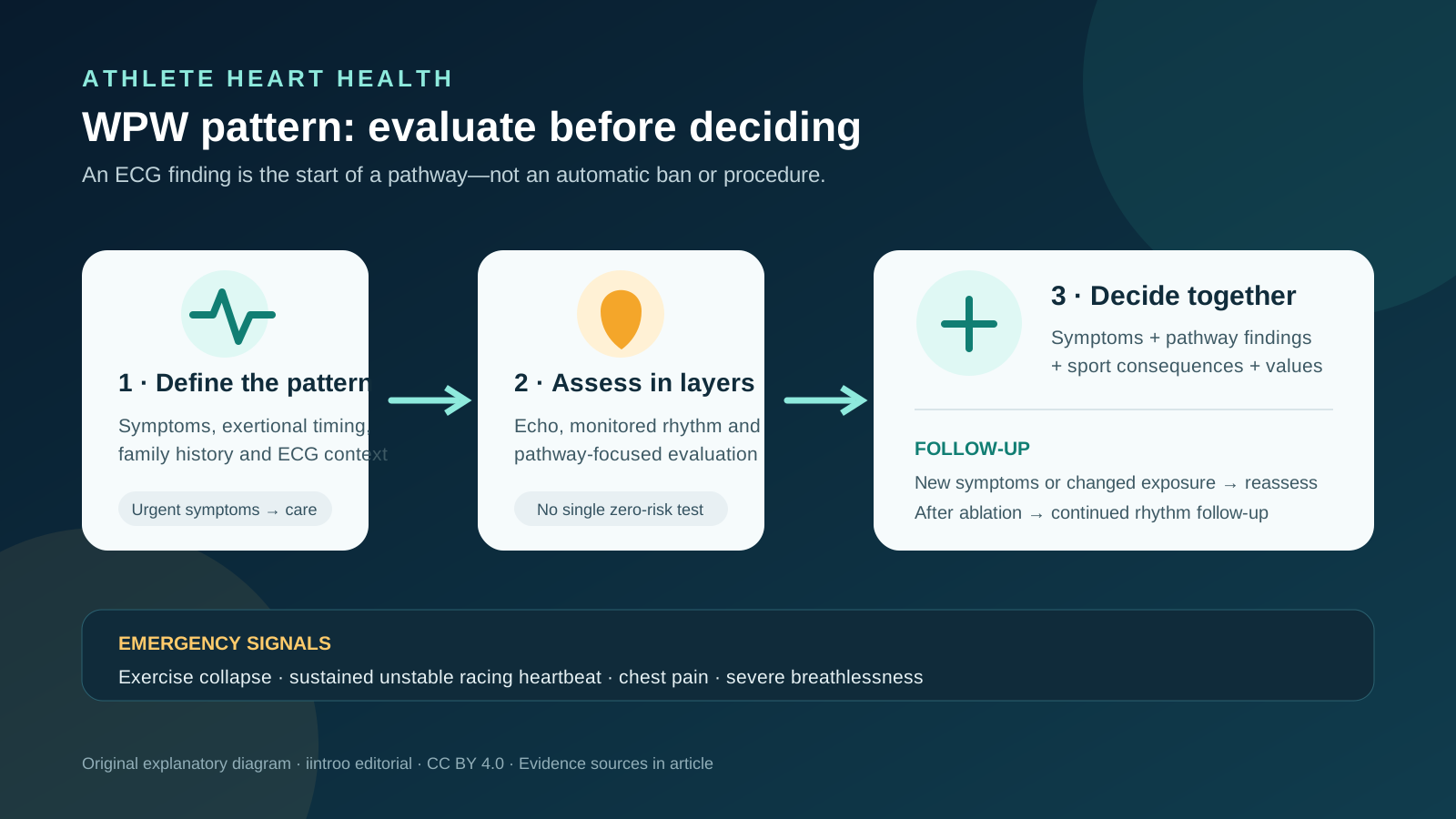
Record palpitations, abrupt racing heartbeat, dizziness, chest discomfort, breathlessness, fainting or near-fainting, their relationship to exertion, and any family history of sudden unexplained death or inherited heart disease. Collapse during exercise, sustained rapid palpitations with instability, chest pain, severe breathlessness or new neurological symptoms needs urgent assessment. Do not tell an athlete to reproduce a dangerous episode, use a consumer watch to clear competition or assume that a familiar-looking ECG belongs to the same risk category as a teammate's.
Assess the heart and the accessory pathway in layers
HRS recommends a physical examination, family history and echocardiography at diagnosis whether or not symptoms are present. Non-invasive assessment may include a carefully supervised maximal exercise ECG and ambulatory monitoring to look at how pre-excitation behaves as heart rate changes. Abrupt loss of pre-excitation can be reassuring, but reviews warn that intermittent or exercise-related loss does not completely exclude a pathway capable of rapid conduction. Test quality, medication, age and the athlete's actual exertional demand affect interpretation.
An electrophysiology study can measure pathway conduction and provoke relevant arrhythmias when the result would change management. The HRS statement recommends invasive evaluation for young athletes under 18 with a persistent WPW pattern, while adult pathways are approached through individualized risk assessment and shared decisions. These are specialist decisions, not a reason for coaches to order tests. Echocardiography also checks for structural disease; a normal scan does not define accessory-pathway physiology, and an abnormality needs its own evaluation.
Make ablation and sport choices through shared decisions
Catheter ablation is recommended for WPW syndrome with documented accessory-pathway arrhythmias and is considered when pathway characteristics or other clinical factors indicate higher risk. It can be highly effective, but it is an invasive procedure with vascular, conduction-system and other procedural risks that vary by pathway location and patient context. An asymptomatic pattern is not an automatic command to ablate, just as a competition calendar is not a reason to ignore a concerning pathway.
For an asymptomatic athlete undergoing evaluation, the HRS consensus allows continued participation in many circumstances while a clinician and electrophysiologist complete risk assessment. The decision should account for symptoms, age, pathway findings, structural disease, the sport and setting, emergency response, the athlete's preferences and uncertainty in the evidence. High-speed, aquatic, climbing or remote environments can magnify the consequence of sudden incapacity even when estimated arrhythmic probability is low. Eligibility is therefore not a single ECG threshold copied across every discipline.
Plan follow-up instead of treating one decision as permanent
Athletes managed without ablation need periodic specialist follow-up and clear instructions for new symptoms. After ablation, HRS advises follow-up for at least a year because recurrence and other rhythm questions can emerge; return depends on procedural recovery, rhythm status and the treating team's assessment rather than a universal number of days. New palpitations, fainting, exercise intolerance or an ECG change deserves reassessment even after a previously reassuring evaluation.
Keep an emergency action plan appropriate to the venue, ensure staff can activate emergency care and avoid hiding symptoms to protect selection. Medication and anti-doping status must be checked for the exact product and route rather than guessed from a drug class. This article cannot interpret an ECG, estimate sudden-death risk, recommend ablation or clear sport. It supports precise language, layered pathway evaluation, shared decision-making with electrophysiology expertise and continuing review when symptoms, sport exposure or clinical findings change.