
Football · Single-club research
Football GPS study tests injury predictions in a single-club sample
An evaluation raises questions about how clubs should assess forecasting tools.
Study publication:
What the new paper reports
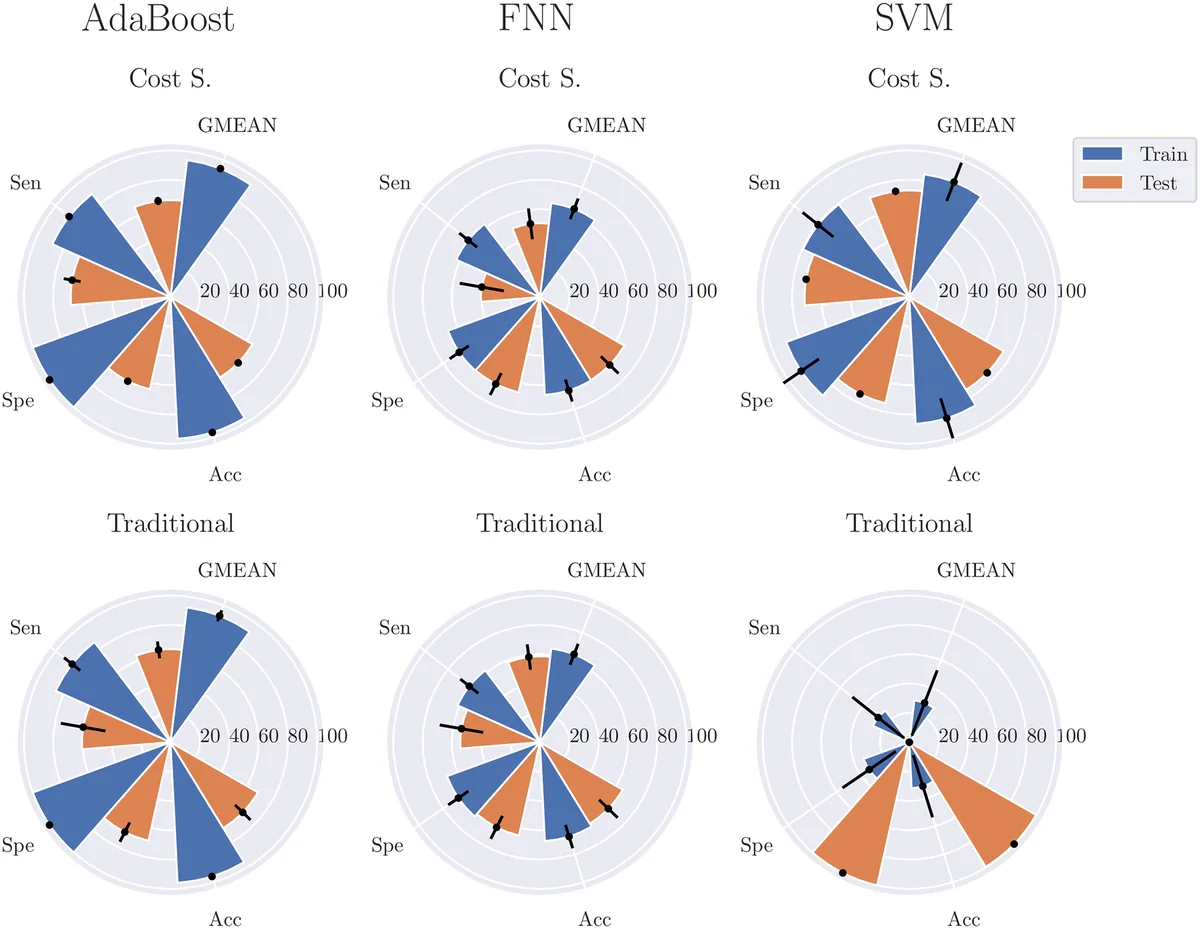
Freitas and colleagues’ January 2025 paper evaluates injury classification using historical football GPS data. Its single-club sample and reported model metrics are set out in the accompanying facts.
No independent validation dataset or injury-prevention intervention established that acting on the predictions improved outcomes.
The reporting standard behind scrutiny
The official TRIPOD+AI checklist provides a useful framework for examining a prediction-model claim. Its recommendations cover the sources and representativeness of development and evaluation data, the population being studied, how outcomes and their time horizons are defined, and the handling of missing information. It also asks researchers to explain sample-size decisions and the steps used to build and internally validate a model.
For results, the checklist calls for performance estimates with uncertainty intervals and information about relevant subgroups. It distinguishes development from evaluation, and asks authors to discuss limitations such as overfitting and generalisability. The standard includes discrimination, calibration and clinical utility among possible performance measures. Its purpose is transparent reporting that permits appraisal; being able to report an accuracy percentage is only one part of that wider assessment.
The distinctions between these measures deserve attention. Discrimination concerns separation between outcomes, while calibration concerns agreement between predicted probabilities and observed frequencies. Reporting clinical utility brings the consequences of decisions into view. Treating them as separate questions helps readers understand why a single accuracy measure cannot provide a complete appraisal.
Analysis: an alert is a decision problem
As an editorial interpretation, the practical challenge is what a club would do with an alert. Missing an impending injury and unnecessarily restricting a player have different consequences. A useful evaluation must describe those trade-offs in the setting where the system will operate. Two systems can have similar overall accuracy while producing different patterns of missed cases and false alarms, so a headline percentage cannot by itself settle usefulness.
Testing on a later season or another team would answer a different question from repeatedly dividing one existing dataset: whether the approach travels to conditions it has not already encountered. That distinction matters because playing schedules, monitoring routines and staff decisions can vary. A prospective comparison would then be needed to assess whether acting on predictions improves outcomes, rather than simply describing how a model classifies past observations.
How to read the research figure
Analysis of a model-performance chart should begin with the question each labelled measure answers. A training result describes performance in the data used to develop a system; an evaluation is an attempt to examine its behaviour elsewhere. Neither can settle whether a particular club should change a player’s programme without evidence about the consequences of that decision.
The responsible news value is the attempt to connect routine football monitoring with a testable forecasting approach. The unresolved implementation question remains substantial: would a transparent, externally evaluated system help staff make better decisions? That question is analysis of the evidence and the reporting framework, not a finding that the model is ready for selection decisions, medical diagnosis or automated restrictions on individual footballers.
This research report is for education and professional discussion. Personal diagnosis, treatment and return-to-sport decisions require a qualified clinician.
Original sources
Read the underlying records.
Explore the official results, organiser reports or original research behind this story.