
Running · International research
Running cohort links equipment use with injury rates without establishing cause
Two 2025 studies illustrate different questions about equipment, biomechanics and injury outcomes.
Study publication:
What the August cohort found
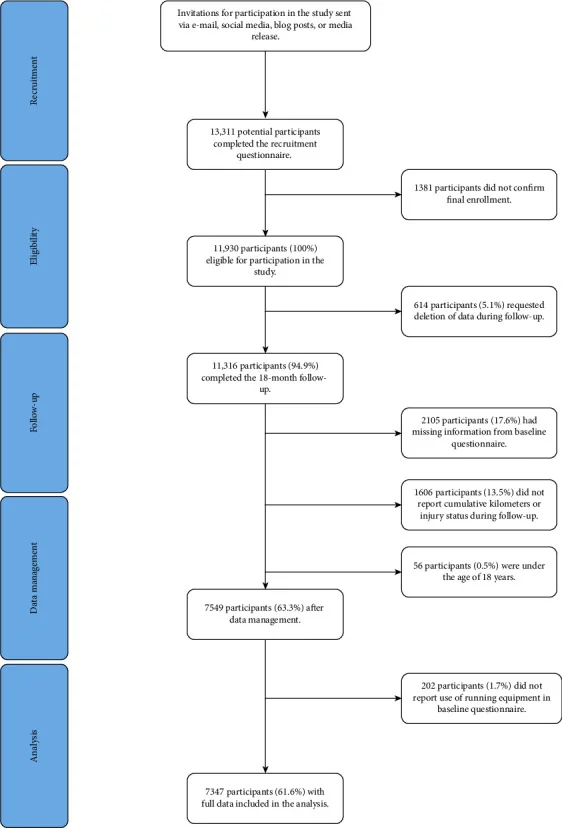
Pedersen and colleagues’ August paper examines reported equipment use and injuries in the Garmin-RUNSAFE cohort, using cumulative kilometres as the analysis time scale.
The authors reject causal claims and identify selection, dropout and exposure-measurement limitations.
A separate laboratory study asks another question
In Scientific Reports on 22 May 2025, Hyunji Kim and Jooeun Ahn published a comparison of advanced, conventional cushioned and minimalist running shoes. Fifteen male recreational runners completed short treadmill runs under the different conditions. The researchers measured movement and ground reaction forces, then used inverse dynamic modelling to estimate internal joint and muscle forces. Advanced shoes reduced some measured or estimated mechanical loads relative to conventional shoes.
That experiment did not count future injuries. Its authors caution that mechanical changes cannot directly establish injury outcomes, while its modelling, male-only sample and treadmill setting constrain interpretation. It provides a controlled look at biomechanics, whereas the August cohort examines reported injury events among equipment users. The two studies do not test identical exposures or support a combined ranking of products.
Analysis: an association needs a defined purpose
The editorial interpretation is that an equipment category can identify a group with different outcomes without explaining the reason. People who already have symptoms may choose support equipment, so a comparison can partly reflect who uses it. A trial assigning a defined intervention would address a different causal question. Even a large observational sample cannot make those designs interchangeable or convert an association into instructions for an individual runner.
The official STROBE reporting checklist asks cohort researchers to explain eligibility and follow-up, describe exposures and outcomes, address potential confounding, report missing information and give estimates with precision. It also calls for a cautious interpretation that considers limitations and generalisability. These reporting requirements help readers assess the evidence; they are not a certificate that a study has eliminated bias or demonstrated prevention.
The checklist also asks researchers to report participant numbers at each study stage, reasons for non-participation and characteristics relevant to interpretation. It distinguishes unadjusted estimates from estimates adjusted for specified confounders. That transparency matters when readers consider how recruitment, exclusions and follow-up relate to the population to which a conclusion might apply.
The figure documents the study population
Analysis of a participant-flow diagram should focus on the transitions between stages. A large initial response does not mean that every respondent supplies usable exposure and outcome information. Showing exclusions makes the final denominator visible, but the diagram alone cannot explain whether those who remain differ from people who were not analysed.
For readers assessing sports research, a transparent account of who entered an analysis is as useful as a striking percentage. The next evidence needed depends on the question: prediction requires independent evaluation in the intended population, while prevention requires evidence that a specified change reduces injury outcomes. This report treats the cohort and laboratory findings as distinct contributions. Neither paper supplies an individual diagnosis, a shopping recommendation or proof that all equipment in a category has the same effect.
This research report is for education and professional discussion. Personal diagnosis, treatment and return-to-sport decisions require a qualified clinician.
Original sources
Read the underlying records.
Explore the official results, organiser reports or original research behind this story.