
Strength Training · National
Small caffeine-gum trial reports acute differences in resistance-exercise tests
Sixteen trained men completed laboratory comparisons; the results do not establish long-term gains or universal suitability.
Study publication:
The laboratory result
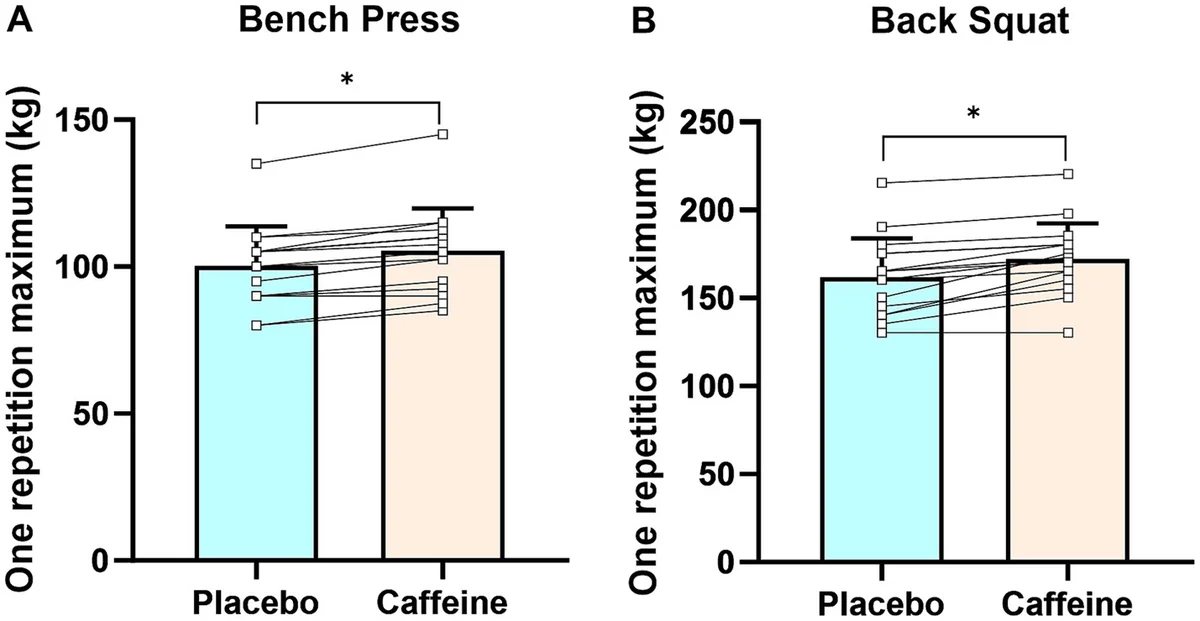
Published on 29 January, a randomised, double-blind crossover experiment compared caffeinated and placebo gum in 16 resistance-trained men. Participants completed bench-press and back-squat tests in both caffeine and placebo sessions. Caffeine produced higher average one-repetition maximum values and more repetitions at a fixed relative load; pain and perceived exertion did not differ significantly. These immediate laboratory outcomes do not establish long-term muscle growth, recovery or competition performance. The young male sample cannot establish effects in children, women or people with medical conditions, nor broad product safety. The tested exposure is not an intake recommendation or brand endorsement.
Performance evidence depends on the task
The NIH Office of Dietary Supplements' evidence review distinguishes among ingredients, sporting tasks, study populations and the quality of available research. Its discussion of caffeine describes evidence that differs across endurance and strength-related outcomes, as well as variation in individual responses. This makes the choice of endpoint important. A supplement can be studied for a single exercise test without having been shown to improve every dimension of athletic performance. An increase in repetitions is also a different claim from an increase in a competition result or a lasting training adaptation. Reading a trial through this framework means identifying what was tested, how the comparison was made and which outcomes were actually recorded. The evidence review also separates efficacy from the regulatory status of products. A result for an ingredient or protocol does not certify every commercial preparation containing it. A complete evaluation must distinguish an acute comparison from the wider questions of product quality, repeated use and who would benefit under real-world conditions.
Individual sensitivity remains a separate question
The FDA's caffeine information explains that sensitivity and the rate of elimination vary between individuals, and that medications and health conditions can affect responses. It describes unwanted effects of excessive exposure, including sleep disturbance and anxiety, and treats children and teenagers separately from adults. Those distinctions are relevant to reporting a performance experiment even when its participants complete a test successfully. An acute strength result is not a substitute for evidence about sleep, cumulative exposure or an individual's health circumstances. Equally, the absence of a statistically significant difference in one reported symptom does not establish the absence of every possible adverse effect. This is a question of what the study measured, rather than an assumption that the intervention is either harmless or unsuitable for everyone. Further research can examine different populations, repeated exposures and outcomes that matter outside the laboratory. The January result is therefore best presented with its population and time horizon attached. It describes the tested comparison while leaving personal decisions and assessment to the appropriate professional context.
This research report is for education and professional discussion. Personal diagnosis, treatment and return-to-sport decisions require a qualified clinician.
Original sources
Read the underlying records.
Explore the official results, organiser reports or original research behind this story.