
Para Powerlifting · National
Small Para powerlifting study compares short-term recovery measures
Eleven male athletes completed a crossover comparison, with force tests and blood markers assessed over a short follow-up.
Study publication:
What the January paper measured
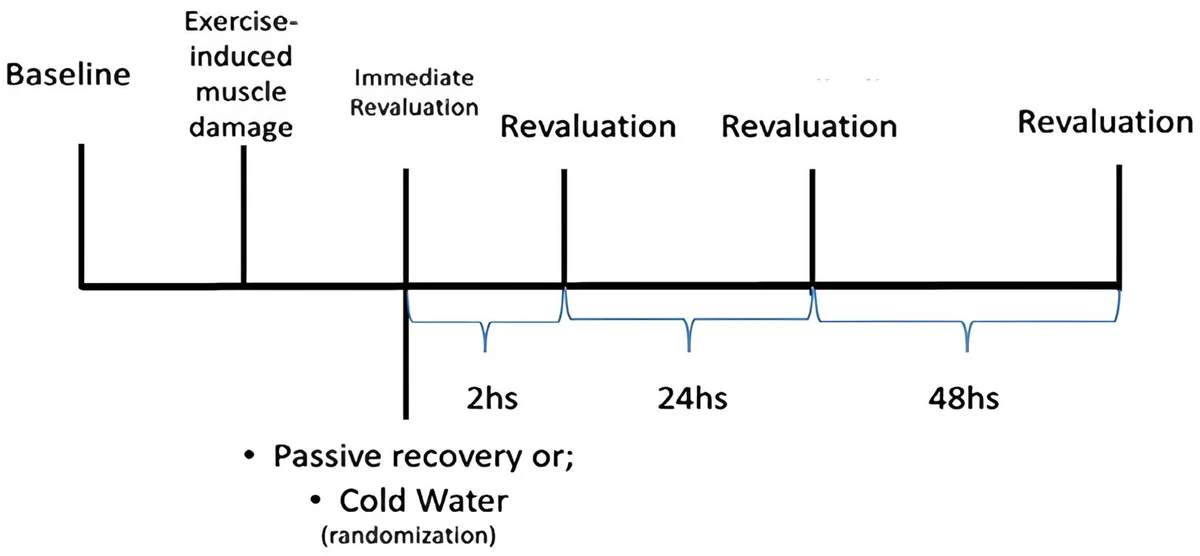
Published on 18 January, the study's methods describe a crossover comparison of passive recovery and cold-water immersion in 11 male Para powerlifters after resistance training. Researchers measured isometric force indicators and inflammatory markers during short-term follow-up. Some force outcomes favoured the cold-water condition, while blood-marker analysis did not show significant differences between recovery methods at the assessed time points. This distinction matters: a favourable result in one measure does not establish improvement in every aspect of recovery. The study did not test long-term training adaptation, competition outcomes or an individual rehabilitation plan. Its small, selected male sample limits generalisation across athletes and impairment groups. The findings are preliminary research evidence, not a prescription for unsupervised cold-water exposure.
A force test differs from a competition lift
World Para Powerlifting describes competition as a bench-press discipline: athletes receive the bar at arm's length, lower it to the chest, hold it motionless and press it upward under referee commands. Successful execution is assessed as part of a complete lift, and the competition result depends on the weight lifted under the sport's rules. This makes it important to identify the laboratory outcome in a recovery study. A static-force measure captures a specified task; it is not automatically a completed competition attempt. A paper can therefore contribute to understanding a physical response without showing that an athlete would lift more successfully at a meet. The federation's description also shows why sport-specific movement and equipment matter when researchers choose tests. For a research reader, the bridge between a measured force outcome and a competitive outcome is a further question to investigate. A report should keep its claim attached to the task actually measured, rather than converting every favourable laboratory result into an expected medal or personal best.
What a crossover comparison needs
The CONSORT extension for crossover trials explains that participants receive interventions in a sequence, making the timing and analysis of within-person comparisons important. Reports need to describe the order of interventions, periods between them, losses to follow-up and how possible carryover was addressed. A previous period can influence a later measurement, and recovery or changing conditions can complicate the interpretation. These principles are useful in sports research, where an athlete's earlier training and testing may matter to the next session. A crossover design can reduce some differences between participants because the same person contributes to both conditions. It does not remove every influence of order, time or expectation, and it does not solve the problem of a very small or narrowly selected sample. Reading the report therefore involves checking the comparison schedule as well as the endpoint. Further studies can test reproducibility, different populations and longer-term outcomes. The January paper offers a short-term comparison; determining a durable benefit or a suitable personal recovery approach requires evidence addressing those separate questions.
This research report is for education and professional discussion. Personal diagnosis, treatment and return-to-sport decisions require a qualified clinician.
Original sources
Read the underlying records.
Explore the official results, organiser reports or original research behind this story.