
Athletics · International
Running experiment separates oxygen uptake from heart-rate time at high intensity
Twelve trained runners completed two treadmill sessions in randomised order.
Study publication:
What the January paper found
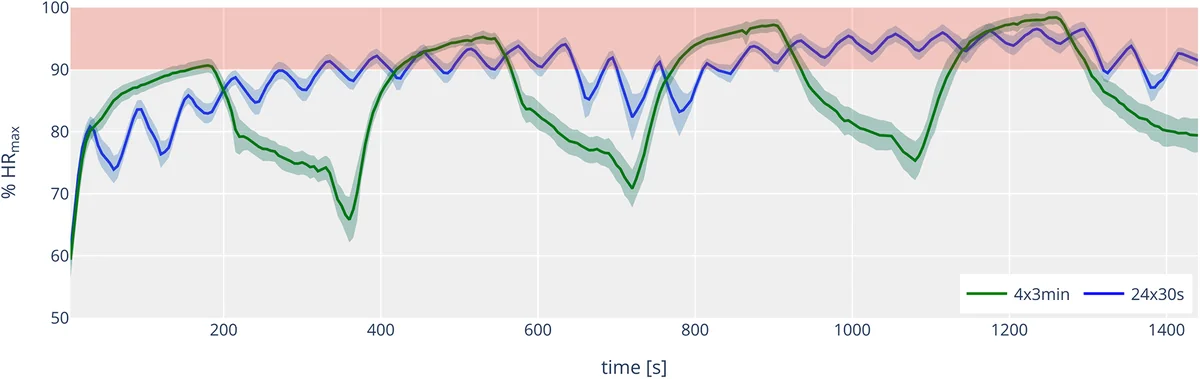
Published 6 January, the experiment compared three-minute intervals with intensified thirty-second intervals in 12 highly trained middle-distance runners, seven men and five women. The shorter format produced less time above 90% of maximal oxygen uptake but more time above 90% of maximal heart rate. Perceived exertion did not differ significantly. The indicators pointed in different directions. The small sample, particular protocols and single-session outcomes limit the conclusion. This study did not test long-term fitness gains or race results, and it cannot identify one best interval format for all runners. January marks publication.
Earlier work also measured several physiological responses
Cipryan and colleagues' 2017 experiment compared short intervals, long intervals and continuous exercise in sixteen highly trained men drawn from endurance and sprint sports. The exercise conditions were matched for average load and total time, with interval conditions also matched for work-to-recovery ratio. The researchers recorded oxygen uptake, heart rate, lactate and several post-exercise responses. Endurance and sprint athletes differed in aspects of aerobic metabolism even when exercise intensity was expressed in relative terms. Other responses showed greater similarity. This is useful background because a session has several measurable characteristics, and an athlete's training history can affect their pattern. It also shows why comparisons need to describe what was matched: equal work, equal speed and equal duration are different controls. The earlier paper does not prove that the January result applies to every sporting population. It contributes a related laboratory example in which multiple measures and explicit protocol details provide a fuller account than the interval duration alone. None of those acute measurements by itself establishes a season-long performance benefit.
Interval programming involves several kinds of load
Buchheit and Laursen's second paper on interval programming examines anaerobic energy demand, neuromuscular load and practical applications. It places interval formats within a broader set of physiological responses, rather than making oxygen uptake the only description of a session. Work and recovery, exercise mode and the movement demands of a sport all matter to how an interval programme is characterised. This gives a useful context for interpreting a comparison based on time near maximal oxygen uptake. A difference in that measure is informative about the tested aerobic response, but it does not describe every demand of the session. Likewise, similar perceived difficulty need not mean identical physiological or movement loads. The review offers an organising framework rather than proof that a specific format produces a particular result for every athlete. Applied to research, it encourages an explicit account of the targeted response and the other demands left outside the primary outcome. That distinction helps readers understand why an acute laboratory comparison should not be turned automatically into a universal ranking of training programmes or a prediction of future race performance.
This research report is for education and professional discussion. Personal diagnosis, treatment and return-to-sport decisions require a qualified clinician.
Original sources
Read the underlying records.
Explore the official results, organiser reports or original research behind this story.