
Table Tennis · National
Table-tennis trial examines balance training through movement tests
An eight-week comparison measures agility and changes of direction, with match outcomes still outside the study.
Study publication:
The trial and its endpoints
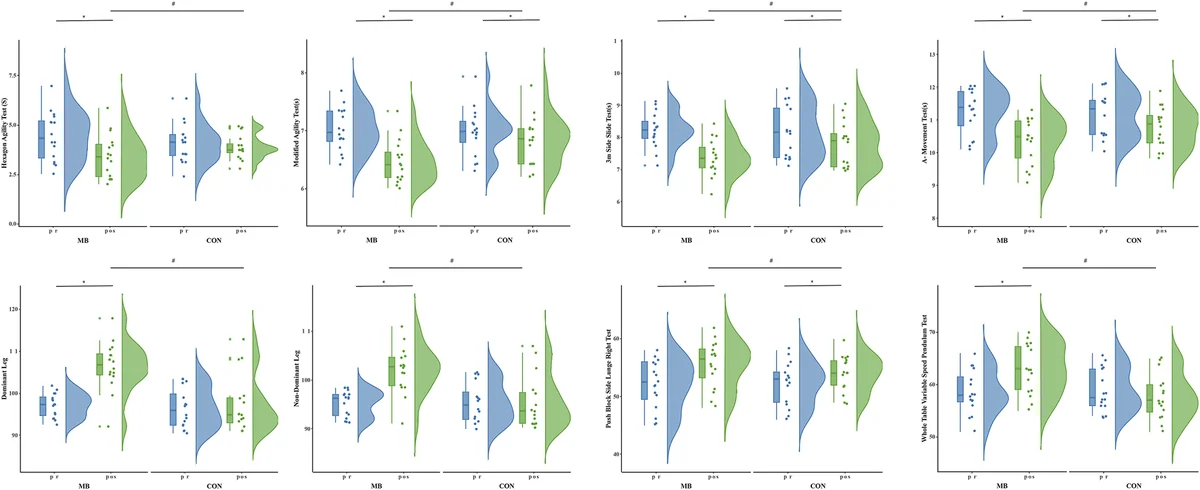
Published on 28 January, this trial allocated young table-tennis players from one team to two groups. Both completed the same multidirectional movement programme; balance exercises used unstable surfaces in one group and stable ground in the other. Testing before and after eight weeks found different patterns of improvement across movement tasks. The study reports time-by-group interactions across its measured variables, while not every test had a significant overall group effect. These are training-test outcomes, rather than evidence of more tournament wins or fewer injuries. The comparison concerns the additional balance condition within a shared programme. Its small, single-team sample and limited follow-up mean that wider application and durability require further work.
Physical preparation has several dimensions
ITTF Education's physical-preparation resource for young players discusses fundamental movement skills alongside sport-specific skills. Its outline includes whole-body and multi-joint movement, flexibility, mobility, adapting work to individuals and monitoring training intensity. This provides a broader frame for reading a trial focused on one training component. Change-of-direction performance is relevant to movement preparation, but it does not encompass every task a table-tennis player must learn. A physical test, technical skill and competitive decision answer different questions. For a research reader, that means asking whether the claimed outcome is a movement measure, an on-table skill or a result in actual matches. Improvements in one category should not silently become improvements in all three. The federation's resource also helps show why a common exercise programme can be adapted to different players rather than treated as a universal template. This is existing coaching context for the January study; it is not evidence that the precise experimental programme is appropriate for every age, training background or health circumstance.
Why the comparison matters
CONSORT reporting guidance asks trial reports to describe allocation, participants, interventions, outcomes and analysis clearly enough for readers to assess the comparison. Its flow diagram and checklist help distinguish those assigned to a group from those who completed follow-up or were analysed. Applying this framework to training research also means checking what the comparison group actually did. A control group that receives substantial training is different from a group receiving none; a result then estimates a difference between programmes rather than the effect of exercise versus inactivity. Readers should look for between-group estimates and their uncertainty, not infer a superior programme simply because one group's before-and-after change reached statistical significance. A trial also needs to identify its intended outcomes so that a set of tests does not become an open-ended search for positive findings. These reporting principles do not decide whether an intervention works. They make the evidence inspectable and clarify the further question: whether a measured difference is reproducible and meaningful for the sporting outcome of interest.
The paper gives conflicting sample counts between its main text and a results table, so those sections do not establish one consistent participant total.
This research report is for education and professional discussion. Personal diagnosis, treatment and return-to-sport decisions require a qualified clinician.
Original sources
Read the underlying records.
Explore the official results, organiser reports or original research behind this story.