
Gambling harm in athletes: separate health support from rule compliance
Sports betting can affect money, mood, relationships and performance. Athletes need confidential clinical support alongside a separate check of the betting and inside-information rules that apply to them.
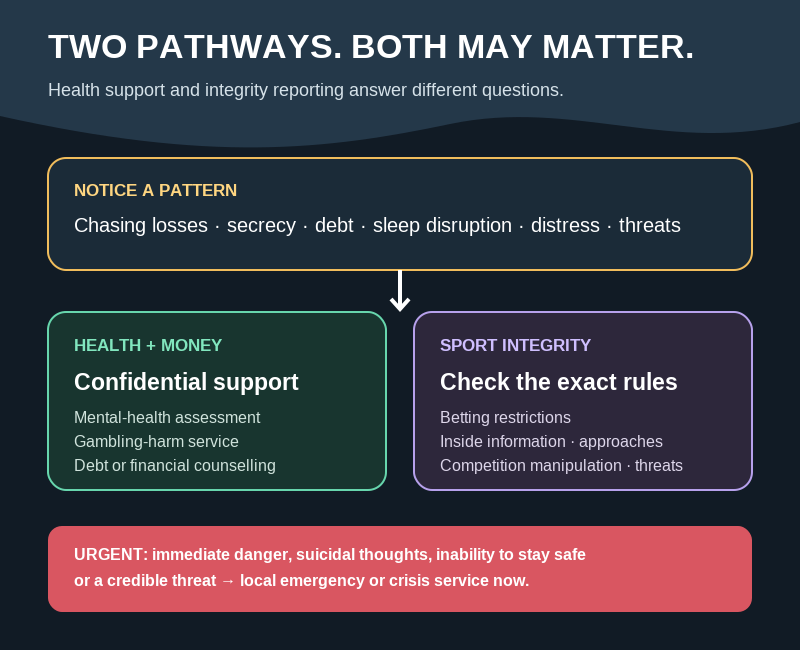
Key points
- Gambling harm can affect finances, relationships, mental health and sporting performance; it is not limited to the amount of money lost.
- The 2026 IOC mental-health consensus notes mixed prevalence evidence and does not establish that every athlete is at greater risk than non-athletes.
- Clinical support and sports-integrity reporting are different pathways, and an athlete may need both.
Look beyond a simple win-or-lose story
This guide is for adult athletes, older adolescents, families, coaches and support teams across sports. Gambling harm can include debt, secrecy, conflict, lost study or training time, anxiety, depressed mood and repeated attempts to recover losses. A person does not need to reach a particular financial loss before asking for help.
The WHO describes gambling as a public-health issue shaped by product access, marketing and social conditions. The 2026 IOC consensus discusses gambling disorder within athlete mental health, while also noting that studies comparing athletes with non-athletes have produced mixed findings. Do not label an athlete from one behaviour or assume that sporting competitiveness is a diagnosis.
Sport can intensify exposure without proving causation
Betting products, live wagering, team discussion and sports sponsorship can make gambling highly visible. A systematic review of 22 studies found that sports-related advertising exposure was associated with several measures of gambling behaviour, but most studies were observational and many were conducted in Australia. Association does not prove that one advertisement caused an individual's gambling problem.
Team and league data are not interchangeable. NCAA surveys, for example, concern specific student-athlete and young-adult populations under US rules. Use the relevant federation, league, school and national evidence rather than exporting one prevalence estimate globally.
Open a confidential health conversation
Possible warning patterns include chasing losses, hiding transactions, borrowing to gamble, being unable to cut back, gambling during training or travel, sleep disruption and distress after betting. These signs can have other explanations. A qualified mental-health professional or local gambling-harm service can assess the whole situation and discuss evidence-based care.
Teams should identify a confidential route that is not controlled solely by selection staff. Support may need to include mental-health care, debt or financial counselling and protection from harassment. This article does not diagnose gambling disorder or prescribe treatment.
Treat urgent risk as an emergency
If an athlete is in immediate danger, has thoughts of suicide or self-harm, cannot stay safe, or is being threatened, contact the local emergency or crisis service now and involve a trusted person where safe. Do not leave an acute crisis to a future team meeting or an online self-test.
Coaches and teammates should listen without promising secrecy they cannot keep in an emergency. After immediate safety is addressed, connect the athlete with qualified follow-up care and practical support appropriate to the country and age group.
Rules and clinical care are separate pathways
The Olympic Movement code prohibits defined participants from betting on their own sport or on a multisport competition in which they are accredited, and it restricts misuse of inside information. Other competitions may have broader or different rules. Check the exact current rule before acting; never assume that a legal bet is permitted under sport regulations.
A suspected rules breach, an approach to manipulate competition or a threat from a bettor may need reporting through the event or governing body's integrity channel. That process does not replace confidential health care. Seeking clinical support should not be presented as an admission of an integrity violation.