
Dengue and outdoor sport: plan mosquito protection before the trip
Dengue prevention belongs in the travel and venue plan. Protect against bites during daylight activity and seek care for fever or warning signs after exposure.
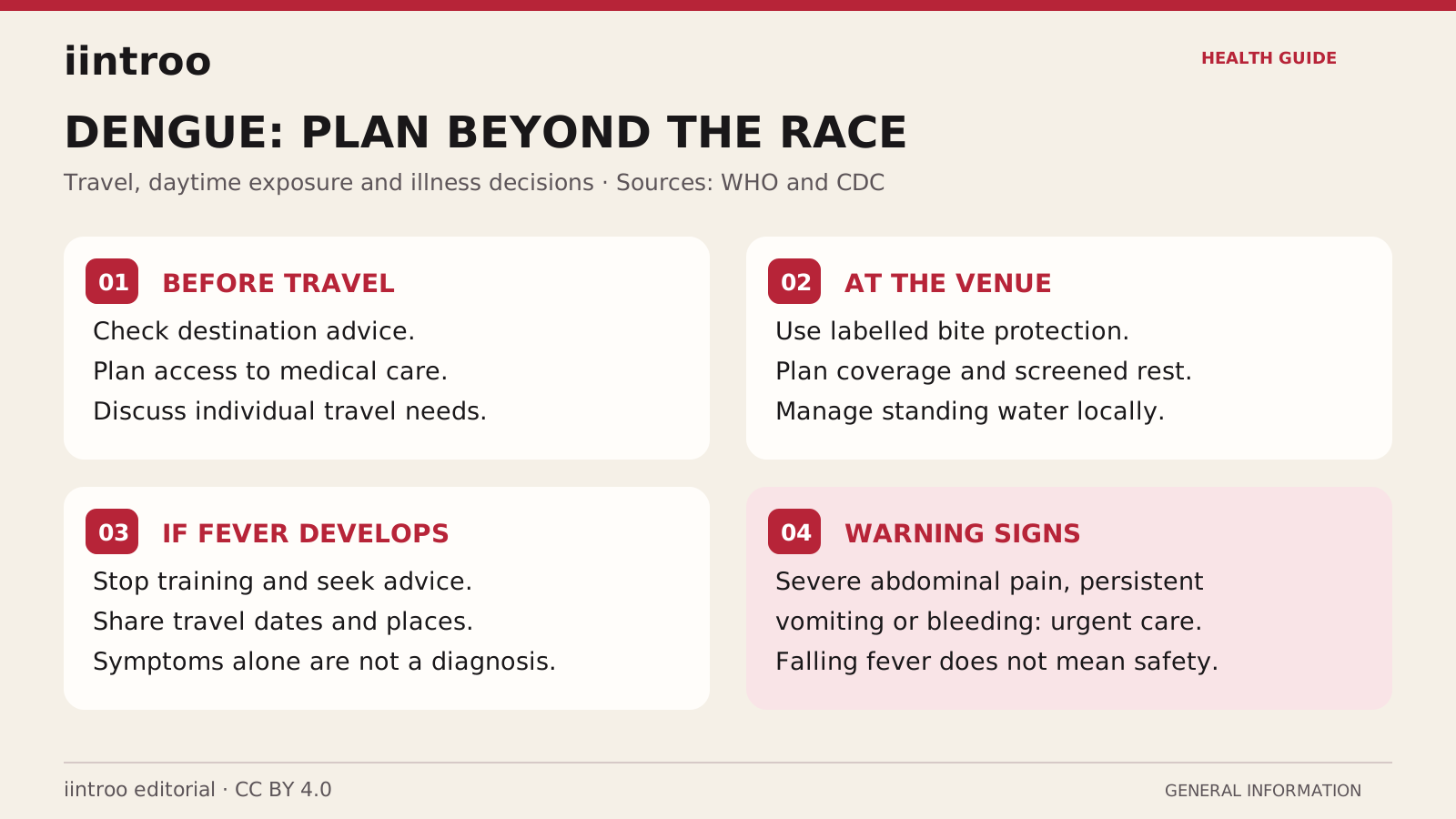
Key points
- Check current destination advice and build bite protection into training, rest and accommodation—not only the evening.
- Fever after travel needs medical assessment; a falling temperature does not rule out severe dengue.
- Aspirin and ibuprofen can increase bleeding risk in dengue. Do not self-treat a suspected infection to keep competing.
Check the destination, not the athlete's home address
Dengue is a mosquito-borne viral infection. A short competition trip can include outdoor warm-ups, waiting at a start area, transfers and recovery outside the hotel. Before departure, review the destination's current public-health advice and arrange travel-health consultation when indicated. Identify how to obtain medical help during the event and after returning home. These are practical planning tasks, not a reason to label every mosquito bite as dengue.
Risk depends on the place, season and current transmission. This guide does not identify a current outbreak or provide a country-by-country risk map. A vaccine recommendation from one country must not be copied into another team's policy: products, eligibility and access differ. Ask a travel-health professional about the individual itinerary and medical history.
Make daytime bite prevention workable for sport
Aedes mosquitoes commonly bite during daylight, including early morning and late afternoon, so an evening-only routine misses relevant exposure. Use an approved repellent according to its label and choose breathable coverage where compatible with the activity. Accommodation screens and air conditioning, or suitable nets where needed, add another layer.
Sweat, water exposure and rubbing can shorten a repellent's useful protection. Coaches can plan access to the product during long outdoor sessions; reapplication must still follow the label. Use separate sunscreen and repellent products, with sunscreen applied first. For young participants, adults should follow age restrictions and application instructions rather than share an unlabelled bottle.
Include the venue and recovery area
Bite prevention is not only an athlete's responsibility. Organisers can ask venue staff to identify and manage containers or other sites holding standing water, maintain screens and provide a practical reporting route for mosquito problems. Check sheltered waiting and rest areas as well as the competition course. Local vector-control teams should direct pesticide use.
Repellent reduces bites; it does not prove that an athlete is protected from every infection. The recommendations combine public-health guidance and evidence about bite prevention, rather than trials measuring dengue infections per canoeing race or orienteering event. Do not convert national case totals into a participant's probability of infection.
Treat fever and warning signs as a health decision
Fever with headache, pain behind the eyes, muscle or joint pain, nausea or rash during or after travel needs assessment. Tell the clinician where and when the athlete travelled. These symptoms overlap with other illnesses; symptoms alone cannot diagnose dengue. Stop training while seeking advice rather than using a painkiller to mask the problem.
Severe abdominal pain, persistent vomiting, bleeding from the nose or gums, blood in vomit or stool, marked restlessness or profound fatigue require immediate medical care. Warning signs can develop as fever subsides. Do not wait for another high temperature or a scheduled team review.
Keep recovery and medicines individual
WHO advises avoiding aspirin and ibuprofen in dengue because of bleeding risk. Medication, fluid management, testing and the need for hospital care belong with the treating clinician; a sports drink or normal-looking athlete cannot establish that care is unnecessary.
Fatigue can persist after the acute illness. Return to exercise should reflect clinical recovery, complications and current function; no fixed online rest period clears every athlete. Continue bite prevention after travel under current public-health advice, and make sure anyone providing follow-up knows the travel and illness timeline.